

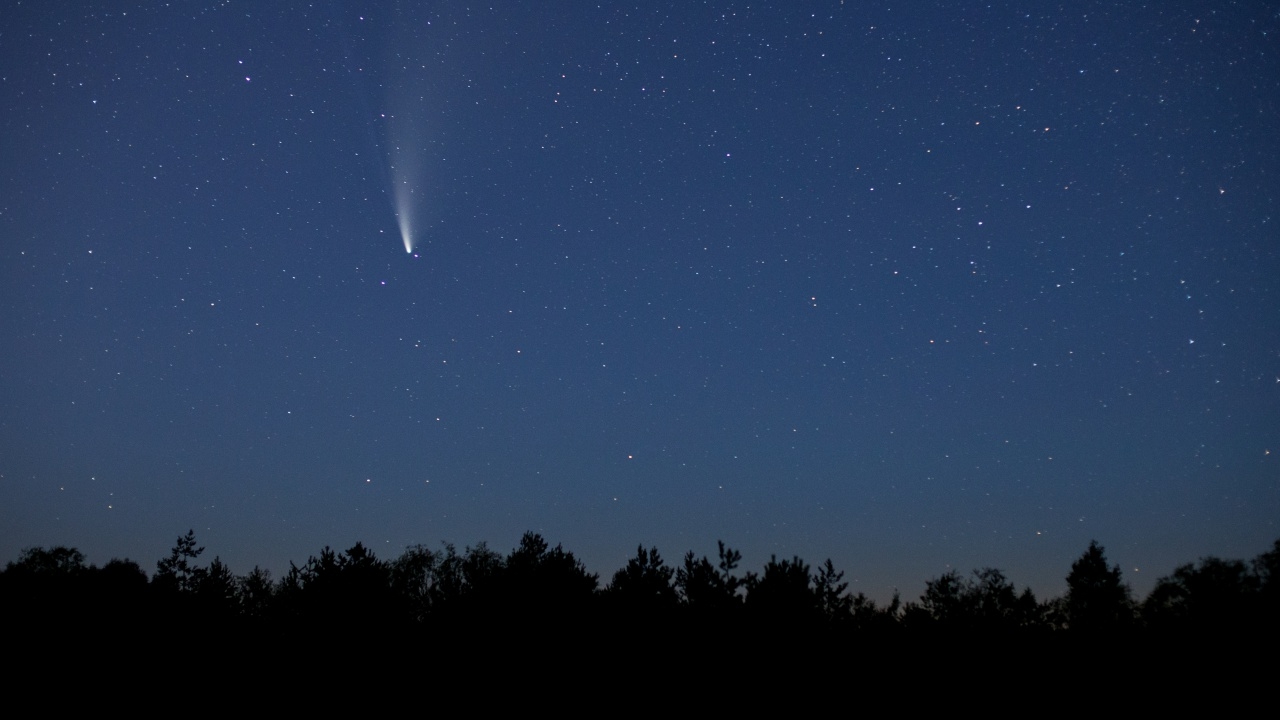
In April 2026, get ready as NARIT announces two comets to watch: Comet MAPS and Comet PanSTARRS, both with chances to brighten enough to be seen with the naked eye.
On 1 April 2026, the Facebook page of NARIT, the National Astronomical Research Institute of Thailand, posted an update on the situation regarding "comets". In April 2026, it stated that
currently there are two comets to watch: C/2026 A1 (MAPS) and C/2025 R3 (PanSTARRS). The comets are expected to reach peak brightness in early April and after Songkran respectively, with chances to brighten enough to be visible to the naked eye.
C/2026 A1 (MAPS), known as Comet MAPS,
Comet MAPS belongs to the Kreutz sungrazer group, which approaches very close to the Sun and often becomes bright enough to see with the naked eye. It will be closest to the Sun on 4 April 2026 and will approach Earth closest on 6 April 2026 at a distance of 143.7 million kilometers. It is expected to reach a peak brightness of magnitude -4, comparable to Comet Tsuchinshan-Atlas in 2024.
However, it remains uncertain whether the comet will survive the intense solar radiation when passing close to the Sun. If it does, it may become a spectacularly bright comet visible in the early evening sky after 4 April. If not, it will disintegrate and fade away in space.
Therefore, the best time to observe Comet MAPS is from 4 April onward in the early evening toward the west, especially on 6 April when it is closest to Earth and has just passed its closest approach to the Sun, increasing its angular distance from the Sun and improving visibility. Real-time information on Comet C/2026 A1 (MAPS) can be found athttps://theskylive.com/c2026a1-info
C/2025 R3 (PanSTARRS), known as Comet PanSTARRS,
*Apparent magnitude indicates how bright an object appears from Earth; lower values mean brighter objects. The human naked eye can typically see objects around magnitude +6 or brighter (e.g., Venus at about -4.5, a full Moon at about -12.5).
Comet PanSTARRS is believed to originate from the Oort cloud, the outermost icy shell of the solar system. It will pass closest to the Sun on 19 April 2026 and will be closest to Earth on 26 April 2026 at a distance of 73.2 million kilometers. Its peak brightness is expected near magnitude 4, visible to the naked eye in dark, light-pollution-free areas, similar in brightness to Comet Lemmon in 2025.
The best time to observe Comet PanSTARRS is from 18 to 23 April in the early morning eastern sky, especially on 19 April, despite being closest to the Sun, it has a relatively large angular separation. However, it cannot be observed at its closest approach to Earth because it rises and sets with the Sun. Observation opportunities resume from 28 April onward in the early evening western sky. Real-time data on Comet C/2025 R3 (PanSTARRS) is available at https://theskylive.com/c2025r3-info
Thus, in April, two comets will grace the sky. If predictions hold true, both will be visible to the naked eye throughout much of the month. Let's look forward to how bright they become and follow updates closely.
Compiled by Thanakorn Angwattana – Astronomical Information Officer, NARIT.
Information courtesy of the Facebook page of NARIT, the National Astronomical Research Institute of Thailand.