

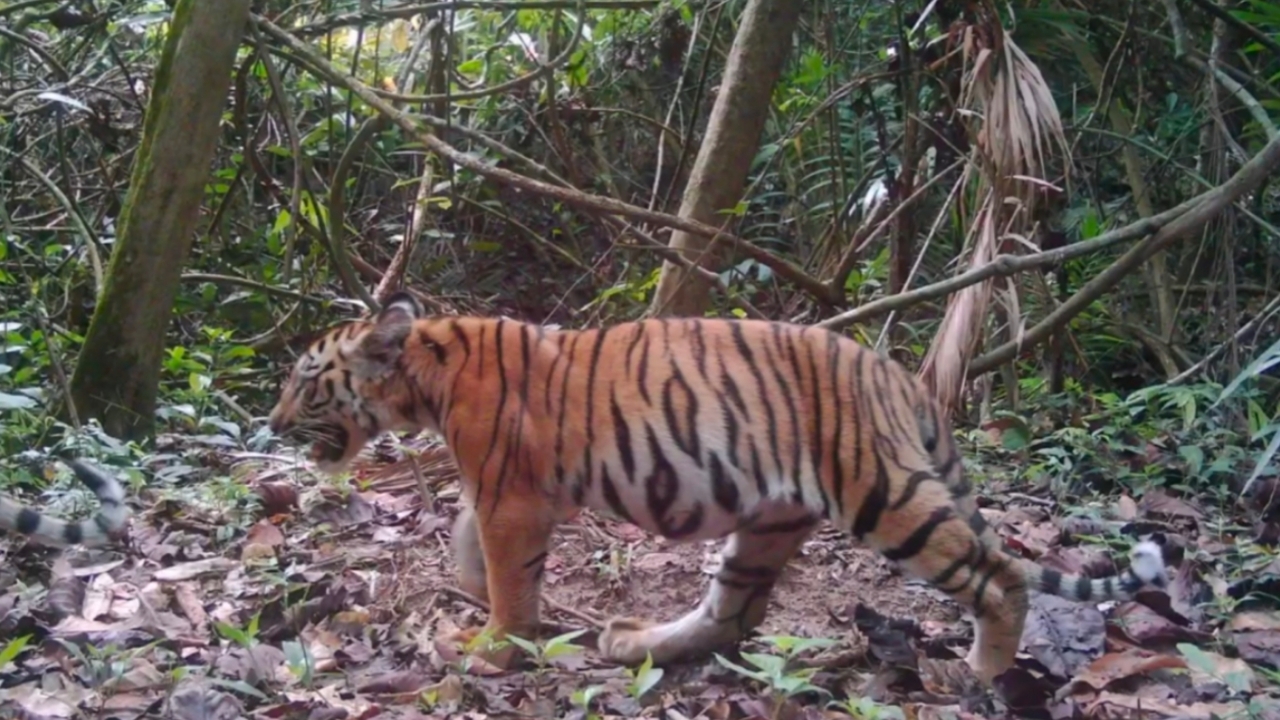
Photos reveal the family of the Thap Lan mother tiger and her cubs, now grown but all with full, rounded bellies, confirming the forest's abundance.
On 4 Apr 2026 GMT+7, reporters reported that the Facebook pageDong Phayayen–Khao Yai Wildlife Research Stationposted a video clip showing a mother tiger carrying a small animal passing by a wildlife camera trap operated by the Wildlife Conservation Society (WCS) Thailand on 8 Jan 2026 GMT+7 at 00:50. Later, at 04:51 the same day, the camera captured the same mother tiger returning with three cubs, all with distended bellies—a rare and adorable family scene.

The page stated that this is the Thap Lan mother tiger family, code TLT-106F, and the clip confirms that the mother tiger delivers prey to her cubs so they can taste and eat until full. This is the first recorded clip showing this behavior.

Most recently, on 4 Apr 2026 GMT+7, the Facebook pageDong Phayayen–Khao Yai Wildlife Research Stationreleased another clip of the Thap Lan mother tiger family, code TLT-106F, showing the cubs having grown significantly and still walking with distended bellies as before.
The post stated: "Reaffirming the abundance of Thap Lan National Park. The photos and clips of a mother tiger and her cubs walking with full bellies come from the ongoing tiger population survey by Dong Phayayen–Khao Yai Wildlife Research Station this year."

They are the Thap Lan mother tiger family (TLT-106F) with cubs all well-fed, which strongly confirms there is a sufficient population of ungulate prey for the mother tiger to raise her cubs to the age when they can establish territories and reproduce.
The previous litter of three cubs has grown and survived until dispersal to find their own hunting areas. “Pianporn” is one of the three who successfully established a territory in Pang Sida National Park.
The survival success of the previous litter, along with the current small cubs, indicates a healthy population of ungulate prey, which correlates with the plant life providing the energy base sustaining the ungulate populations.