

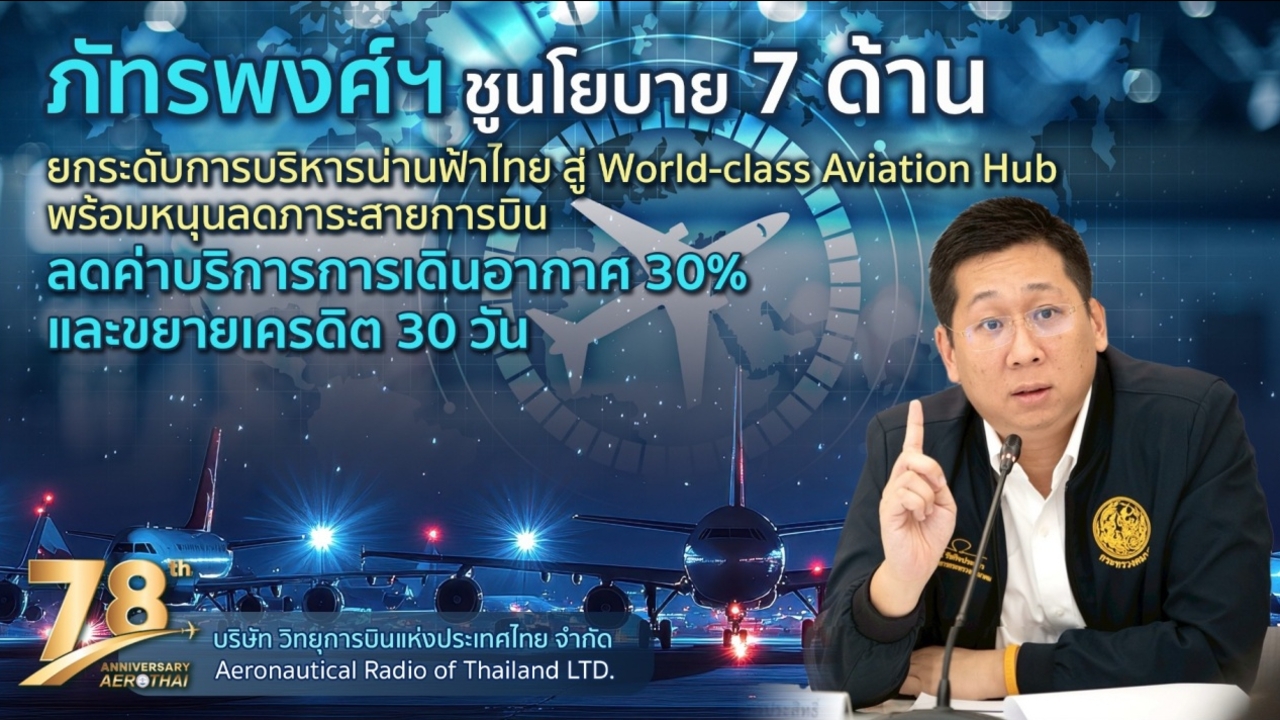
Phattharaphong Phattharaprasit highlights a seven-point policy. Elevating the management of Thailand's airspace to become a world-class aviation hub. Supporting airlines by reducing air navigation service fees by 30% and extending credit terms by 30 days.
Mr. Phattharaphong Phattharaprasit Deputy Minister of Transport revealed after inspecting and issuing operational policies to the Aeronautical Radio of Thailand Limited (AEROTHAI), the regulatory agency, that he had presented seven key operational policies to AEROTHAI to jointly “Enhance airspace management and drive Thailand toward becoming a world-class aviation hub” as follows.
1. Instruct AEROTHAI to propose measures to reduce airline operating costs alongside implementing air traffic management measures. This includes applying Air Traffic Flow Management (ATFM) to manage flight congestion and reduce delays, which will cut airlines' fuel consumption. This addresses urgent issues and helps improve liquidity for operators amid ongoing volatility in energy prices affecting the aviation industry.
2. Support government policies on stimulating cash flow within the industrial sector to drive the national economy. Expedite the disbursement of the 2026 fiscal budget and prepare and revise the 2027 budget allocation plan, considering necessity, investment value, and maximum benefit to the public and the country.
3. Adhere to the principle that safety is the highest priority in air navigation services. Maintain and continuously elevate service standards and quality to meet international benchmarks.
4. Establish concrete strategic connections and integration with relevant agencies.
5. Coordinate closely with related agencies to support aviation safety missions, such as sharing meteorological information.
6. Accelerate the development of air navigation infrastructure and service systems using modern technology to accommodate future changes through key projects, aiming to transform into a future digital organization.
7. Operate with consideration for the long-term sustainability of Thailand's aviation industry, integrating environmental, social, and governance (ESG) aspects into the organization's core operations. This enhances the country's competitiveness, supports industry growth, and bolsters the overall economy.

Mr. Phattharaphong emphasized the important goal of “Enhancing airspace management to drive Thailand toward becoming a world-class aviation hub.” This mission requires strategic partnerships and cannot be achieved by any single agency alone. It demands close integration among four key agencies overseeing infrastructure development by the Department of Airports, efficient air traffic management by AEROTHAI, quality personnel training by the Civil Aviation Training Center, and service enhancement at Suvarnabhumi Airport's hotel. All are essential components working cohesively. He pledged policy-level support to advance key agendas, including regulatory improvements to enhance organizational capacity to meet growing air traffic demands, and backing necessary resources such as budget and technology. The ultimate goal is the national public interest, convenience, and maximum safety for the people.
He also instructed AEROTHAI to implement measures to reduce airline operating costs by cutting domestic air navigation service fees by 30% and extending payment terms. Airlines will pay 50% of fees as scheduled, with the remainder payable 30 days later than originally due, during May–June 2026. This aims to improve cash flow for airlines affected by geopolitical conflicts and fluctuating energy prices, while maintaining service continuity and Thailand's competitive edge.

Mr. Surachai Nooprom Acting Senior Executive Vice President and Acting President of AEROTHAI added that AEROTHAI, as the national air traffic service provider, is ready to support government and Ministry of Transport policies by accelerating the air navigation service readiness project at U-Tapao Airport. This Quick-win 2 project focuses on infrastructure and service system upgrades using modern technology. Additionally, it enhances air traffic management efficiency and safety through Digital Tower systems, including Hybrid models for high-traffic airports such as Suvarnabhumi and Don Mueang, and Remote Towers for low-traffic airports like Betong and Narathiwat. They are also studying future air transport services by developing integrated aviation data exchange systems aligned with modern aviation system development frameworks, progressing toward System Wide Information Management (SWIM). This includes integrated airspace management and services for unmanned aerial vehicles and flight information support to facilitate new air mobility modes such as Advanced Air Mobility (AAM), including pilotless and electric vertical takeoff and landing aircraft. AEROTHAI prioritizes workforce development to keep pace with advanced technology alongside environmentally friendly Green Air Traffic Management, working closely with aviation and related agencies. Currently, AEROTHAI is implementing airline cost reduction measures to support the aviation industry short-term while improving efficiency and safety for long-term growth of Thailand's aviation sector.

