

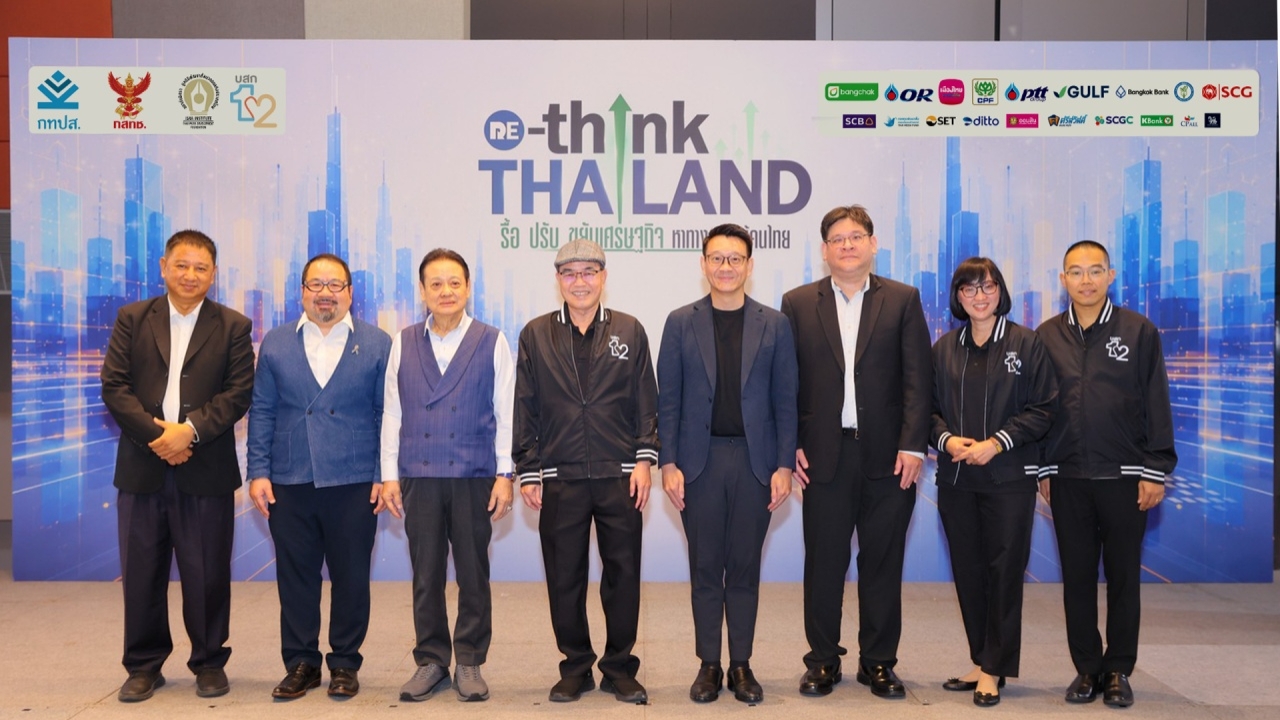
On 20 June 2026, Isra Institute under the Media Development Foundation of Thailand, through the 12th Executive Program in Mass Communication Management for Radio and Television, held a public seminar. "RE-THINK THAILAND: Restructure, Adjust, Move the Economy—Finding Survival Paths for Thai People." The event featured Mr. Sangchai Theerakulwanich, Honorary Chairman and Strategic Chairman of the Thai SME Confederation; Dr. Thanit Sorat, Vice Chairman of the Employers’ Confederation of Thai Trade and Industry; Dr. Nanarit Pisalyabut, Senior Researcher at the Thailand Development Research Institute (TDRI); and Associate Professor Dr. Weerayuth Kanchoochat, Deputy Leader of the People’s Party, who exchanged views and proposed strategies to drive Thailand’s economy amid new global challenges at Hall 1–2, 10th Floor, SCG Multipurpose Building, Bang Sue headquarters.


Dr. Nanarit Pisalyabut Dr. Nanarit Pisalyabut, Senior Researcher at TDRI, revealed that Thailand’s economy faces slow growth and low per capita income. Although GDP figures show expansion, without swift structural economic reform, the country risks remaining trapped in the middle-income bracket and failing to reach its goal of becoming a developed, high-income nation.
TDRI sees that despite ongoing challenges, Thailand can seize opportunities by focusing on developing exceptional talent—"heroes"—to propel leapfrog growth. For example, producing even a single individual like Elon Musk could generate value up to three times Thailand's GDP, likely yielding faster results than solely developing the agricultural sector. Meanwhile, Thailand’s service sector should address the outflow of foreign service platforms that fail to generate real income for the country.

Mr. Sangchai Theerakulwanich Mr. Sangchai Theerakulwanich, Honorary Chairman and Strategic Chairman of the Thai SME Confederation, said SMEs are facing mounting pressure. The proportion of SMEs continuously operating at a loss and at risk of becoming non-performing loans (NPLs) rose from 18% in the last quarter of 2025 to 22% in the first quarter of 2026. Meanwhile, Thailand’s economic structure still suffers from structural inequality. Although small businesses make up 84% of the system, they have low bargaining power compared to large capital, making competition difficult.
He emphasized that SMEs must shift their mindset from competing on price to enhancing productivity, innovating, and developing traceability standards to access international markets. SMEs should also move from being end-product manufacturers to becoming integral parts of the business value chain from upstream, building strength and sustainability. Moreover, they must rapidly adopt digital technology and AI to boost competitiveness and prevent technology from widening economic disparities.

Dr. Thanit Sorat Dr. Thanit Sorat, Vice Chairman of the Employers’ Confederation of Thai Trade and Industry, said technological changes put workers in many industries at high risk of unemployment. One such group is financial institution workers, with estimates suggesting tens of thousands could lose jobs in the next 3-4 months due to shifts toward branchless virtual banks. Similarly, the automotive industry faces risks as it struggles to adapt to the transition to electric vehicles (EVs), threatening future employment.
“A key concern for workers, especially Gen X and Gen Y, is how to avoid being left behind amid major transitions. Future businesses will rely on fewer but highly skilled workers, while machines and robots become cheaper. I advise workers over 40 to enhance their competitiveness with skills that are self-developed, not just textbook knowledge. Also, avoid burnout at work,” Dr. Thanit said.

Associate Professor Dr. Weerayuth Kanchoochat Associate Professor Dr. Weerayuth Kanchoochat, Deputy Leader of the People’s Party, identified four major structural economic problems—"4 Bugs"—that require urgent fixes for sustainable growth. The first is injected money not circulating effectively; despite government stimulus measures, economic activation remains weak. The second is Thailand’s export volume is high but largely low-tech products, reflecting declining competitiveness compared to rivals.
The third bug is that foreign direct investment (FDI) fails to create new industries, especially during the transition to EVs. Although Thailand attracts substantial foreign investment, it has not sufficiently leveraged this to develop new industries or upgrade workforce skills. The last bug is that Thai agriculture is not keeping pace globally, raising concerns that Thailand is merely "keeping the patient alive" rather than curing it. Despite being recognized as the world’s kitchen, many farmers still face low incomes, high debt, and an aging population.
All panelists suggested economic structural reforms. TDRI recommended leveraging technology, especially AI, to drive the economy by adapting models from Europe and China, which have enhanced self-reliance amid geopolitical conflicts. The People’s Party urged the government to revise agricultural strategies, stop temporary fixes, and focus on increasing agricultural productivity to enrich farmers. Simultaneously, efforts must accelerate to build a high-tech industrial ecosystem.

The business sector proposed survival requires changing mindsets and vision, embracing modern business management, environmental risk preparedness, and workforce skill development to meet new global challenges. The Thai SME Confederation’s chairman urged the government to expedite support mechanisms, especially by reducing legal constraints that create hidden costs and expanding SME access to formal financing. Their key goal is to increase direct exporters and elevate Thai SMEs into higher-level value chains to sustainably escape the middle-income trap.
