

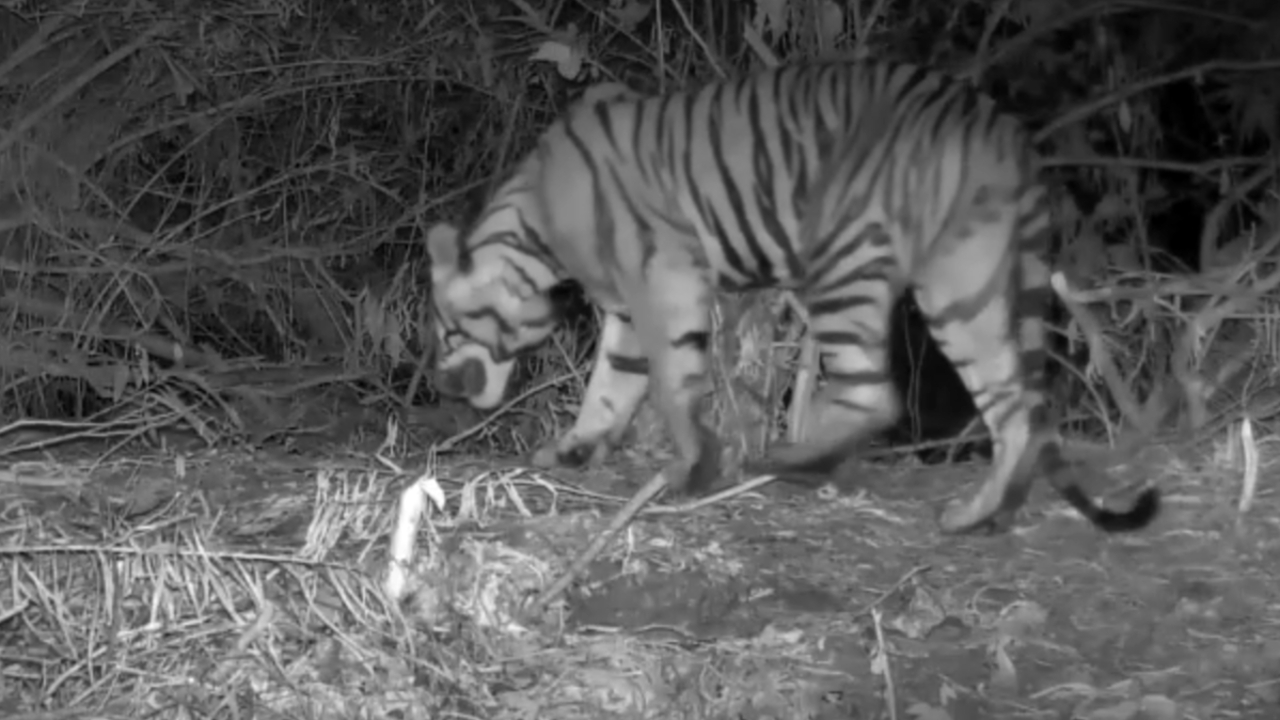
The Department of National Parks provided an update on the case of a tiger injuring an official at Huai Kha Khaeng, clarifying that it was a playful cub tiger and the incident was accidental, not qualifying as a "man-eating tiger" case. "Man-eating tiger" They also announced a temporary closure of tourism in the area.
On 6 Aug 2026 GMT+7, Mr. Atthapon Charoenchansa, Director-General of the Department of National Parks, Wildlife and Plant Conservation, assigned the Office of Conservation Area 12 (Nakhon Sawan) along with the Wildlife Conservation Division to clarify facts regarding a tiger attacking an official in Huai Kha Khaeng Wildlife Sanctuary, resulting in death on 5 Aug.
Present were Mrs. Chayaporn Amradit, Director of Conservation Area 12 (Nakhon Sawan), Mr. Sukhee Boonsang, Director of the Wildlife Conservation Division, and Mr. Permsak Kanitchat, Chief of Huai Kha Khaeng Wildlife Sanctuary, who jointly presented facts and operational measures at the Thung Faek Forest Protection Unit, Huai Kha Khaeng Wildlife Sanctuary, Uthai Thani Province.
Mrs. Chayaporn Amradit stated that examination of the tiger stripe photo database (Camera Trap), maintained and studied continuously for over 30 years with precise identification of individual tiger patterns, confirmed the tiger involved was one of three male cubs of mother tiger Apinya. This tiger family naturally inhabits and uses a hunting range covering about 40 square kilometers in that area.

Based on behavioral analysis and wildlife instinct, it is believed this event was a natural accident. The cub tiger, about 1 year and 6 months old, is in adolescence, learning to hunt, exhibiting playful and curious behavior, and beginning to forage independently. At the time, the official was lying flat on the ground, leading the cub to mistakenly perceive this posture as natural prey and attack. Normally, if a tiger sees a standing, moving, or noisy human, it would be startled and flee immediately.
This behavior does not qualify as "man-eating tiger" because there is no pattern of repeated attacks on humans or humans as primary prey. Furthermore, the tiger family continues to hunt within their usual territory, has not fled in panic or caused trouble for local residents in surrounding areas.
For future management, the Department has installed camera traps to closely monitor the cub’s behavior. If it hunts and preys naturally, it will be allowed to remain in its ecosystem. Long-term behavioral studies will be conducted using tracking devices. However, if there is a tendency or repeated attacks on officials, immediate capture and behavioral adjustment according to scientific standards will be initiated.
Officials have been instructed to exercise the highest caution to prevent wildlife access, avoid close travel or working alone, always have a partner, improve housing security, and increase lighting in dark areas. Sleeping must occur in secure buildings. Additionally, Huai Kha Khaeng Wildlife Sanctuary has temporarily closed tourism and nature study activities until tiger behavior monitoring and safety assessments are complete.
According to the tiger population database, the survival rate for tigers over 1 year old in Huai Kha Khaeng Wildlife Sanctuary is high, with about 100 adult tigers in the system, approximately 30 cubs at risk, and about 40 tigers dispersed into adjacent forests such as Thung Yai Naresuan Wildlife Sanctuary. The habitat capacity and prey availability in Huai Kha Khaeng remain sufficient and safe to support the tiger population.