

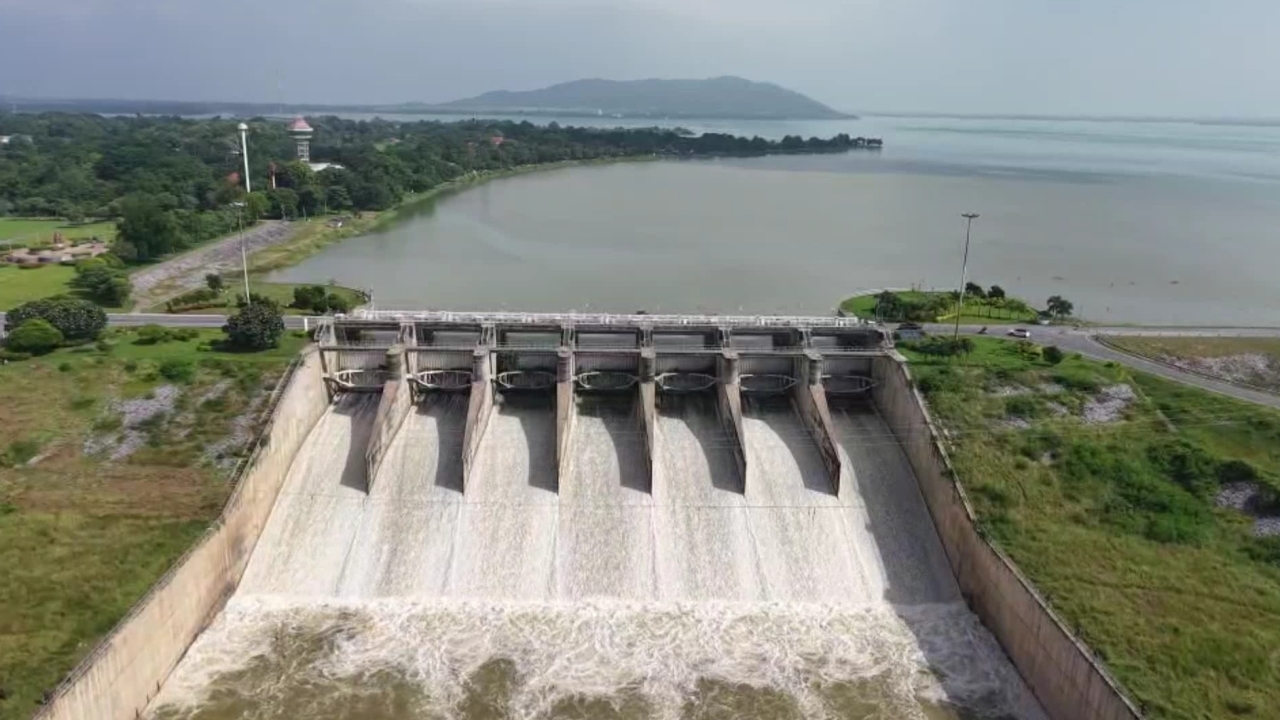
The Royal Irrigation Department explained that water from the Pasak Jolasid Dam is being gradually released according to the situation with continuous control, emphasizing that this does not affect the Bangkok Metropolitan area.
Due to heavy rainfall in the upper Pasak river basin, water inflow into the Pasak Jolasid Dam has been continuous. As of 2 Oct 2026 GMT+7, the reservoir holds 962 million cubic meters, its full capacity. Therefore, water must be released at a rate of 400 cubic meters per second to maintain appropriate water levels and ensure dam safety. The release rate will be adjusted according to inflow and rainfall conditions, which are currently declining, allowing the Pasak river basin situation to gradually return to normal. The fully stored water also provides sufficient reserve for use during the next dry season.
Water released from the Pasak Dam flows downstream to the Phra Ram 6 Dam, which is currently discharging at 546 cubic meters per second. This causes the water level in the Pasak River downstream of Phra Ram 6 Dam to rise by approximately 1.00–1.20 meters. The water then merges with the Chao Phraya River and flows to station C.29B in Pathum Thani Province at about 2,444 cubic meters per second. At this point, water flow is controlled to not exceed 3,600 cubic meters per second to prevent effects on Bangkok. The release is managed in consideration of local rainfall and tidal conditions, which influence the capacity to discharge water into the sea.
The Royal Irrigation Department will closely monitor the water situation and adjust releases appropriately to control water volumes at each stage, minimizing impacts on the public as much as possible.