

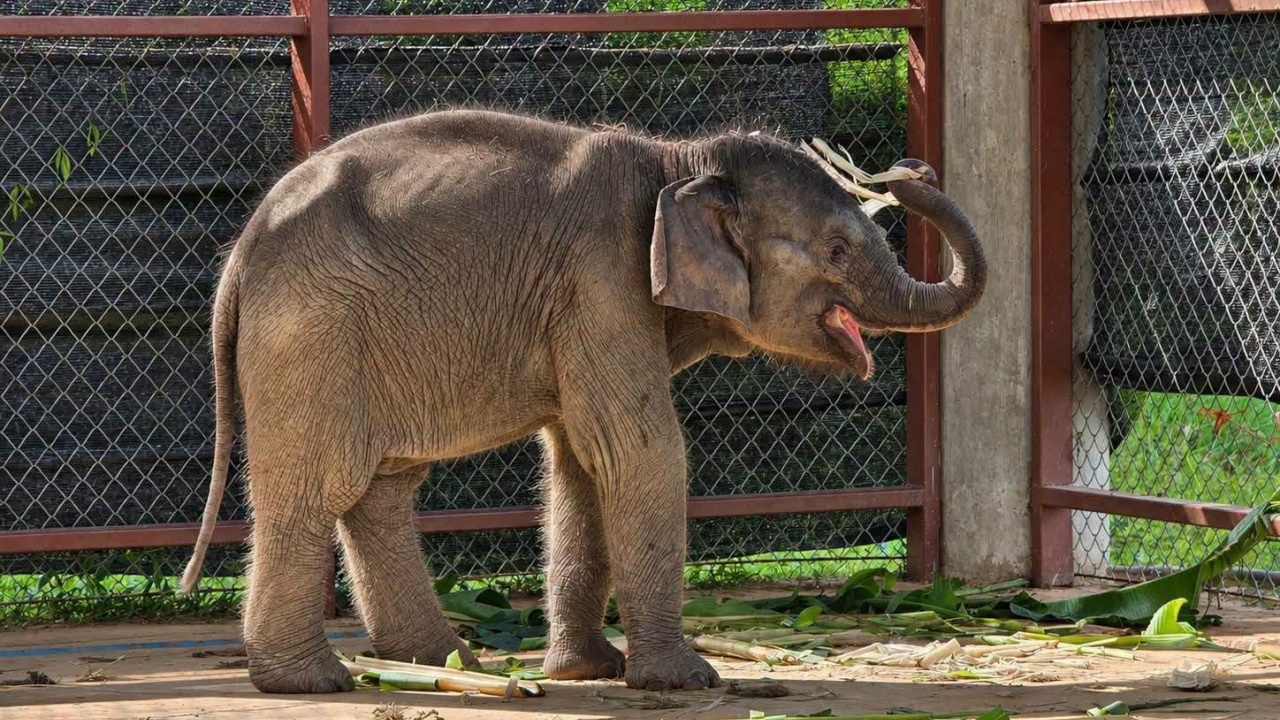
Health update "Orphaned wild elephant" at Khao Soi Dao shows continuous improvement. The Department of National Parks has organized a team of veterinarians and staff to provide 24-hour close care, and requests cooperation to temporarily suspend visits and food donations to scientifically restore health, emphasizing that "appropriate food and care are most important for the wild elephant."
On 5 Nov 2026, regarding the case of an orphaned wild elephant wandering around its deceased mother in Moo 6, Ban Bo Bok Poon, Pawa Subdistrict, Kaeng Hang Maeo District, Chanthaburi Province, within the responsibility area of Khao Ang Rue Nai Wildlife Sanctuary under the Department of National Parks, the Office of Conservation Area Administration 2 (Sriracha) arranged to transfer the orphaned wild elephant to Khao Soi Dao Wildlife Breeding Station, Soi Dao District, Chanthaburi Province, late on 1 Nov 2026 for close health rehabilitation and welfare protection.
"Khao Soi Dao Wildlife Breeding Station"provided a daily health update stating the elephant continues to improve steadily and its appetite has increased. Food intake includes 10 kg of wild banana stems and leaves, 4 kg of ripe bananas, 1.5 kg of bamboo leaves, and 0.5 kg of Khome grass, totaling 16 kg (an increase of 5.5 kg from the previous day). Its bowel and urine output are normal. The elephant is alert, shows cautious behavior, and charges when someone approaches the pen. Veterinarians administer vitamin C, calcium, and probiotics as part of the care plan.
The quantity and variety of natural food plants have been increased, along with fresh wild elephant dung to encourage natural microbial intake behavior (coprophagy) under veterinary supervision. The elephant shows interest in the dung but has not touched or eaten it yet. The veterinary team continues to monitor health and assess nutrient adequacy closely.

Most recently, the official pageDepartment of National Parks, Wildlife and Plant Conservationposted a message thanking everyone for their concern and close monitoring of the orphaned wild elephant at Khao Soi Dao Wildlife Breeding Station in Chanthaburi. All love and support are crucial encouragement. However, for the elephant's safety, the department requests cooperation in two matters during this period: no visits and no external food donations. These measures are part of a scientifically based care and animal welfare plan, as the key goal is the elephant’s safety and health recovery.
As is well known, caring for a young orphaned wild elephant is a challenging task requiring strict management. The department has assigned veterinarians and staff to rotate 24-hour care, managing food type and quantity, water, vitamin and mineral supplements as needed, and observing behavior, elimination, and rest while recording data to continuously assess health recovery. Initial positive signs bring some relief, as the elephant responds well to care and is alert to abnormalities, reflecting it still retains its wild elephant instincts.

Why control the diet?
An elephant’s digestive system relies on microorganisms to break down plant fibers. Naturally, a wild elephant calf acquires these microbes by consuming its mother’s or herd’s dung. An orphaned calf separated from its herd may have an incomplete gut microbiome. Therefore, its main diet focuses on appropriate amounts of natural food plants, especially during the first 2–4 weeks of care.
Overeating, sudden diet changes, or consuming large amounts of high-sugar fruit can cause bloating, diarrhea, or digestive disturbances, which are dangerous for a still-weak calf. For these reasons, external food donations are not accepted, to tightly control food type, quantity, nutritional balance, and source for safety.
Why suspend visits?
Outsiders may carry disease agents into the care area even if asymptomatic. Limiting access is a key disease prevention and hygiene measure. It also reduces unnecessary habituation to humans, helping the calf maintain its wild instincts and prepare to return to the wild. Interested parties can support the calf by following official department channels and sharing accurate information to promote public understanding.
The department confirms it will do its utmost to care for the wild elephant, prioritizing the animal’s health and welfare, and will keep the public informed of progress regularly.
Love and concern from a respectful distance help keep the young elephant safe and allow staff to perform their duties fully, as everyone shares the goal of seeing the wild elephant grow strong. The Department of National Parks, Wildlife and Plant Conservation thanks everyone for their care and for being part of wildlife resource stewardship with understanding.
Facebook page of the Department of National Parks, Wildlife and Plant Conservation