

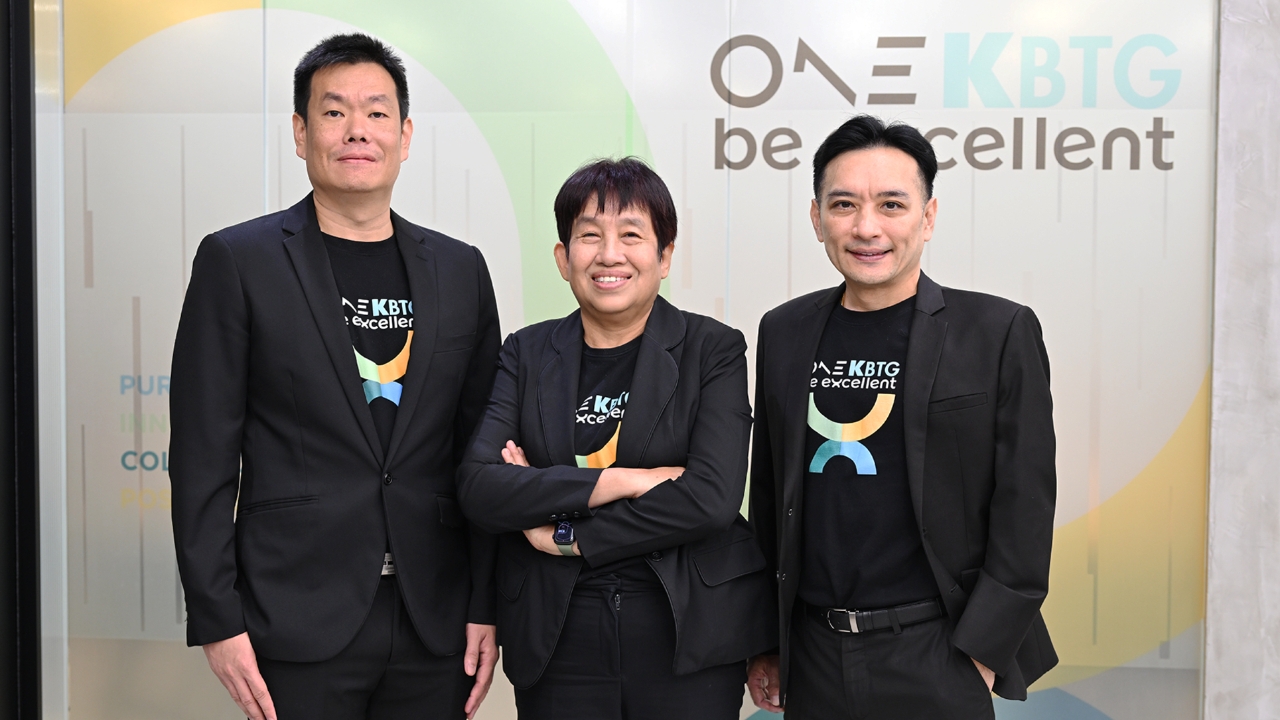
In an era where technology and artificial intelligence (AI) are pivotal in transforming industries worldwide, the financial and banking sectors cannot avoid rapid adaptation. Kasikorn Business-Technology Group (KBTG), a regional technology leader and the innovation engine behind Kasikornbank, has announced its key 2026 vision, advancing from proof of concept (POC) to genuinely leveraging AI to create business value and robustly confronting new forms of cyber threats.
Woranuch Dechakaisay, Executive Chairman of KBTG, revealed that KBTG continues to grow its IT investments to handle increasing transaction volumes and emerging technologies.
A clear success indicator is the rapid growth in users: the K PLUS application now has about 24.5 million accounts, while MAKE by KBank, targeting younger users, has over 4 million accounts.

Regarding technology strategy, Woranuch emphasized that KBTG focuses on three main pillars:
On AI transformation, Woranuch stressed, "AI is an investment, not just an expense," though measuring AI's return on investment (ROI) is challenging. KBTG applies concrete evaluation methods and incorporates AI throughout system development processes, from requirement gathering to coding and testing.
However, she advised that before adopting AI, businesses must identify their pain points and have a ready data foundation; simply buying AI won't solve everything.
"Most importantly is the principle of ‘Human in the loop,’ since AI cannot fully replace human work. Work processes must clearly define which parts AI handles, which humans handle, and which require collaboration."
KBTG fosters an "AI Culture" by requiring all employees to undergo training for proper AI understanding. It organizes activities like Warm-up projects and Hackathons, encouraging staff to competitively apply AI in technology roles. Besides work, KBTG also prioritizes employees' mental health care.
Dr. Tadpong Pongthavornkamol, Managing Director of KBTG, outlined AI development direction for this year with the theme "AI and Value Creation," shifting from experimentation to generating tangible business value under the principle of "Human First x AI First," emphasizing humans as central and AI as an empowerment tool.
He noted that globally, many AI projects fail to deliver real results, so KBTG redefined its framework to focus on "value creation" through the success formula V = (P + P + P)Ecomprising

Currently, KBTG has developed core capabilities in Q&A chatbots, advisory services, document processing, and voice technology to support both front-end and back-end business needs.
Technological advancement must be paired with security. Chatchawat Aswarakawong, Vice Chairman & Group CISO of KBTG, stated that the top goal is building trust—Digital Trust. Financial institutions now face three main challenges:

To address these, KBTG has announced AI Governance policies and risk management alongside Responsible AI principles emphasizing transparency, security, privacy, and bias-free systems. It has established controls preventing employees from using sensitive data with public generative AI to protect customer information.
The most critical emerging threat is quantum computing, expected possibly by 2030, raising concerns about breaking global internet security encryption in minutes.
"KBTG is preparing for quantum threats using Post-Quantum Cryptography (PQC), encryption resistant to quantum computers. Transition planning began in 2024, aiming to upgrade critical system encryption by 2029—one year ahead of global projections. This process is a global challenge comparable to the Y2K crisis," he explained.
Toward the end of the press conference, Woranuch Dechakaisay and Dr. Tadpong Pongthavornkamol jointly clarified KBTG's practical AI adoption path.
"In the future, KBTG will increasingly bring system development in-house and reduce outsourcing. The key reason is that current AI technology accelerates development significantly, cutting the need to hire costly specialists and reducing geopolitical risks that could impact business," Woranuch said.

On managing AI-related costs—a challenge for many organizations—she emphasized KBTG's caution. Though viewing AI as an investment, they carefully assess resource use and token consumption during POC phases to decide if projects are worthwhile. They prepare for risks of vendors raising prices and are ready to abandon costly or unprofitable projects in favor of more suitable systems.
Regarding ROI evaluation, Dr. Tadpong added that AI success isn't always quantifiable financially, such as increased customer satisfaction or improved conversion rates. Therefore, cost-effectiveness assessments are done collaboratively with business units on a project-by-project basis to reveal true investment value.
Addressing widespread concerns about AI replacing jobs and causing layoffs, Dr. Tadpong firmly affirmed KBTG's commitment to the "Human in the loop" principle.

"We will not adopt AI models that lead to layoffs as seen in some foreign firms. Instead, we manage workforce by slowing new hires and focus on upskilling current employees to effectively work with AI," he stated.
This aligns with Woranuch's vision that if AI reduces routine work time, employees can use the saved time to create additional value for the organization.
This comprehensive vision shows that KBTG is not merely following tech trends but strategically integrating AI and human capabilities to propel Kasikornbank into a robust, secure financial institution ready to sustainably face future changes.