

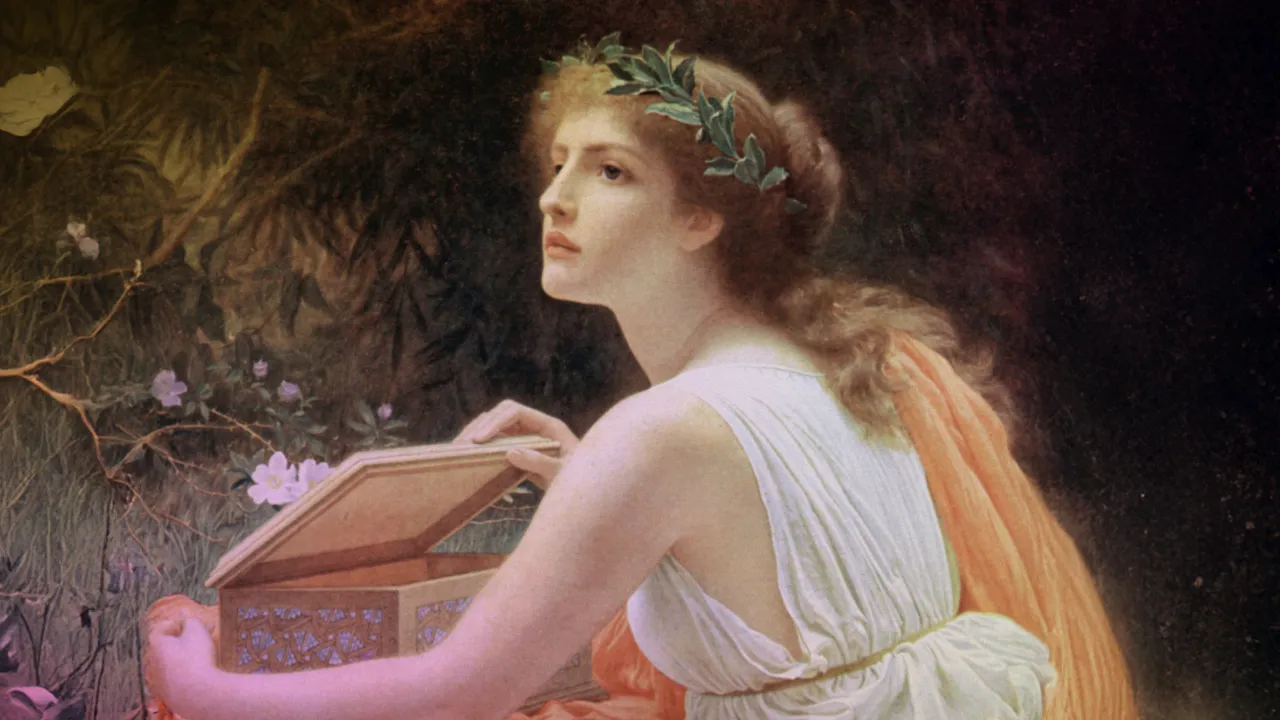
In Hesiod's Theogony and Works and Days, ancient Greek poems about the origins of the gods, it is told that after Prometheus stole the precious fire from Zeus to give to humans, Zeus became enraged and ordered Hephaestus, the god of craftsmanship, to create a woman. This woman was extraordinarily beautiful, captivating all who saw her. She was born holding a large jar containing many evils. Then various gods bestowed blessings upon her. Crucially, Hermes, the god known for cunning and trickery, not only named her Pandora but also gave her a deceitful nature as a woman.
After Pandora's creation, Zeus gave her as a gift to Epimetheus, Prometheus's brother, knowing well that he would not refuse despite his elder brother's repeated warnings. Epimetheus accepted Pandora (whose name means "all-gifted"; Prometheus means "forethinker" and Epimetheus means "afterthinker," acting before thinking). Thanks to Hermes's blessing, she opened the jar, releasing suffering, old age, and disease into the human world. Only one thing remained trapped at the jar's edge: Elpis, an ancient Greek word meaning expectation or anticipation, though today it is often interpreted as hope.
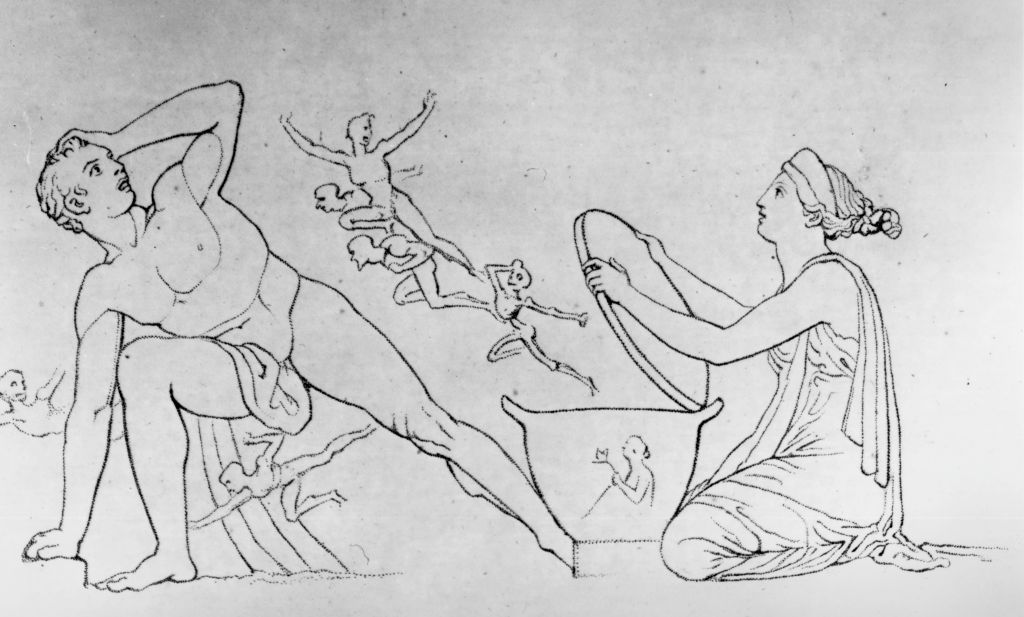
Greek mythology may sound like bedtime stories, but in its era, it functioned like science, explaining phenomena to ancient people. Hesiod was among the few poets who tried to explain how the cosmos, stars, and earth came into being. Even emotional states had explanations. Yet he never explained why 'hope' remained stuck at the jar's edge in his poems, as if leaving a clue for listeners or readers to ponder.
By common sense, Elpis is what causes us to yield or accept what is about to happen. But since Elpis stayed in the jar, it became that we develop expectations toward those things. It is possible that Zeus was tormenting humans through expectation, making humans believe they would get what they want, encouraging them to endure life day by day without knowing if it would come true. This can be seen as a cunning revenge by the god of sky and thunder.
Elpis is the neurotransmitter responsible for happiness.
From a scientific perspective, Elpis in the jar can be seen as dopamine, the 'feel-good' neurotransmitter. It is a biological mechanism that motivates humans to act. Dopamine is released when we imagine or anticipate something, turning into desire.
Expectation, in earlier times, was a mechanism pushing humans out of safety zones to find food or migrate. Without this hope, humans might have ceased development, stayed stagnant, or even become extinct.
Research explains that hope acts as a placebo, sometimes called the Pandora’s Jar Effect. When we hope to recover, the prefrontal cortex signals the body that healing is underway, releasing endorphins and enkephalins, which act as natural painkillers. This boosts immunity and reduces physical pain to aid survival. Conversely, without hope, immunity drops, and one may surrender to death. This explains the common saying that hope can conquer nearly all diseases.
Zeus’s Elpis serves as a warning to know moderation and acceptance.
Friedrich Nietzsche referred to Pandora in his book Human, All Too Human, saying:
“Zeus did not want man to throw his life away (no matter how much suffering might torment him), but rather to continue being tormented repeatedly. To that end, he gave man hope, which is actually the most evil thing because it prolongs man's suffering.”
“Zeus did not want man to throw his life away, no matter how much the other evils might torment him, but rather to go on letting himself be tormented anew. To that end, he gives man hope. In truth, it is the most evil of evils because it prolongs man’s torment.”
Nietzsche clearly was not a fan of hope, viewing it as denial of reality and the present. Hope represents “what ifs,” creating a reality that does not match the actual one. He regarded hope as cowardice.
Though harsh and extreme, Nietzsche urged humans to rely on themselves fully. He used the concept of Amor Fati, or Love of Fate—the acceptance of whatever destiny brings—to explain that instead of dwelling on hopes for a better tomorrow or dreams coming true, we should accept all truths and pain as part of life. Pain does not diminish our worth but strengthens us, and we choose to overcome it.
Thus, Nietzsche did not imply giving up hope but suggested placing our hopeful energy in the present, since no one else but ourselves can make our desires and goals happen.
Pandora and Nietzsche represent two extremes: the evil side of so-called 'hope' versus extreme self-reliance and distancing hope. Likewise, we see hope as a double-edged sword—either as mere wishful thinking or as a sustaining fire. Both have downsides: false hope leads to lack of will and halts survival mechanisms and creativity; believing hope will always fuel us prevents us from living in the present and appreciating surrounding joys.
However, if we find the Golden Mean or balance between these extremes, Aristotle suggested that the best course is to use reason to assess situations. That means we should hold some hope for achievable goals. Exactly that.
References: