

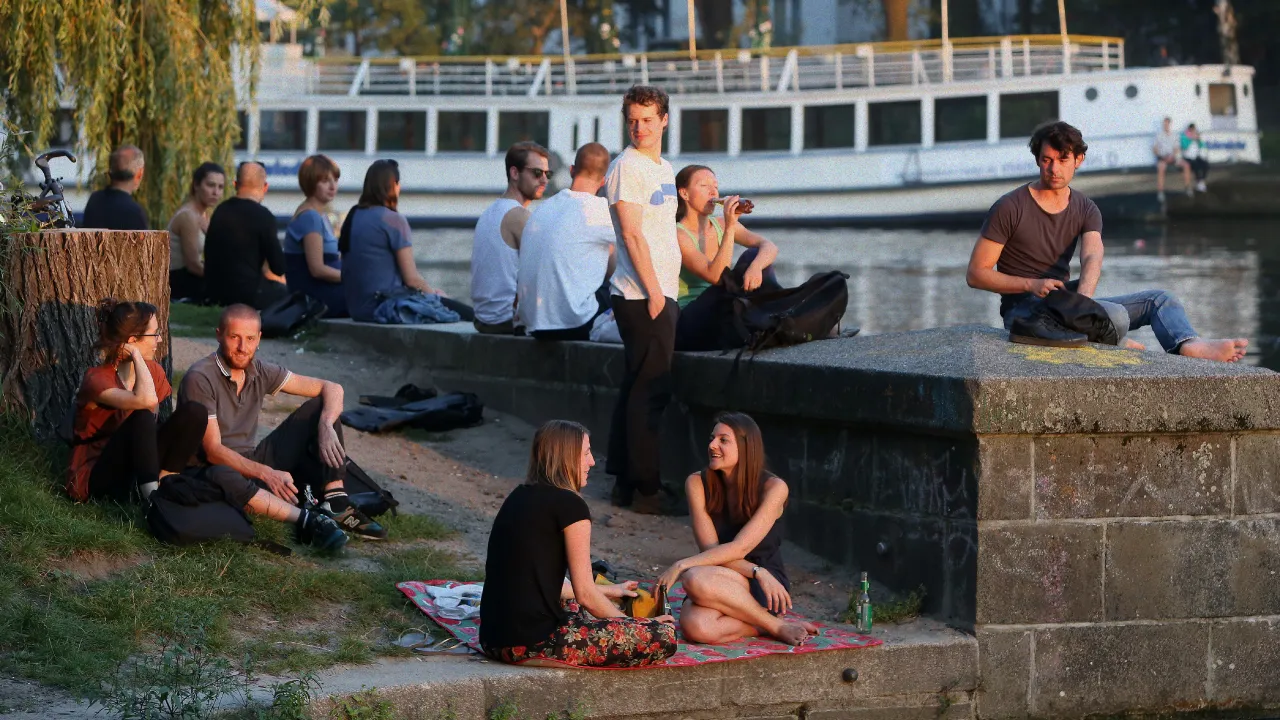
In an age when the line between "work time" and "rest time" is blurred—whether due to phone alerts sounding late at night or Work From Anywhere policies—many of us forget to allow ourselves moments of daily happiness.
A lesson from Germany, a country renowned for work efficiency, is its culture of after-work happiness known as "Feierabend."
Literally, Feierabend combines “Feier” (celebration) and “Abend” (evening), meaning "evening celebration." Germans often add “Bier” to say "Feierabendbier," referring to an evening celebratory beer.
Although it sounds like a happy hour for after-work drinks, the concept is much deeper and broader.
Dr. Caroline Rothauge, a modern history expert at the Catholic University of Eichstätt-Ingolstadt, explains that originally the term did not imply partying. In agricultural times, the church bell ringing in the evening signaled that "work time was over," and it was time to rest or pray.
Therefore, Feierabend is not just a time period but a state of mind indicating the day's tasks are fully completed, marking a clear boundary between the Professional Self and the Private Self.
We often think of Germans as hardworking, but the other side is that when it's time to rest, they do so seriously, enabling them to return to work fully refreshed.
This idea became clearer in the 20th century after the industrial revolution when workers demanded clear rest periods, based on the principle that rest is not laziness but necessary to restore body and mind for effective work the next day.
Of course, this is an efficient capitalist mindset: to get maximum value from labor, workers must disconnect completely during rest, rather than partially resting while still worrying about work.
Many might think they are the same, but Work-Life Balance is a broad concept seeking equilibrium between work and life. In the digital age, this often means flexibility to work anytime, anywhere, which can trap us into working constantly.
Feierabend, however, is a protective shield or strong wall safeguarding that "working late is not allowed; this is Feierabend time." It is a disconnection preserving true personal space.
Experts recommend that even when working from home, changing from work clothes into workout pants or pajamas immediately after work signals to the brain that the workday is over.
Or simulating the commute home by taking a walk or cycling after shutting down the computer creates a transition between work and home.
Importantly, respecting the right to no communication—such as managers scheduling emails to be sent during work hours the next day instead of late at night—gives the team their Feierabend.
Feierabend is not just a German farewell at the end of the workday but a reminder for those pressured to be on standby constantly. Its essence is working hard but clearly separating life from work—not selfishness but caring for your most valuable asset: yourself.
Today, when the clock signals quitting time, allow yourself to shut down your computer, turn off notifications, and softly say, “Schönen Feierabend!” (Have a pleasant evening). Use the remaining time to truly celebrate life because work is done today; tomorrow is another day.
ReferencesBBC Laetitia at Work
#ThairathPlus #Thairath #Feierabend #Germany #WorkLifeBalance