

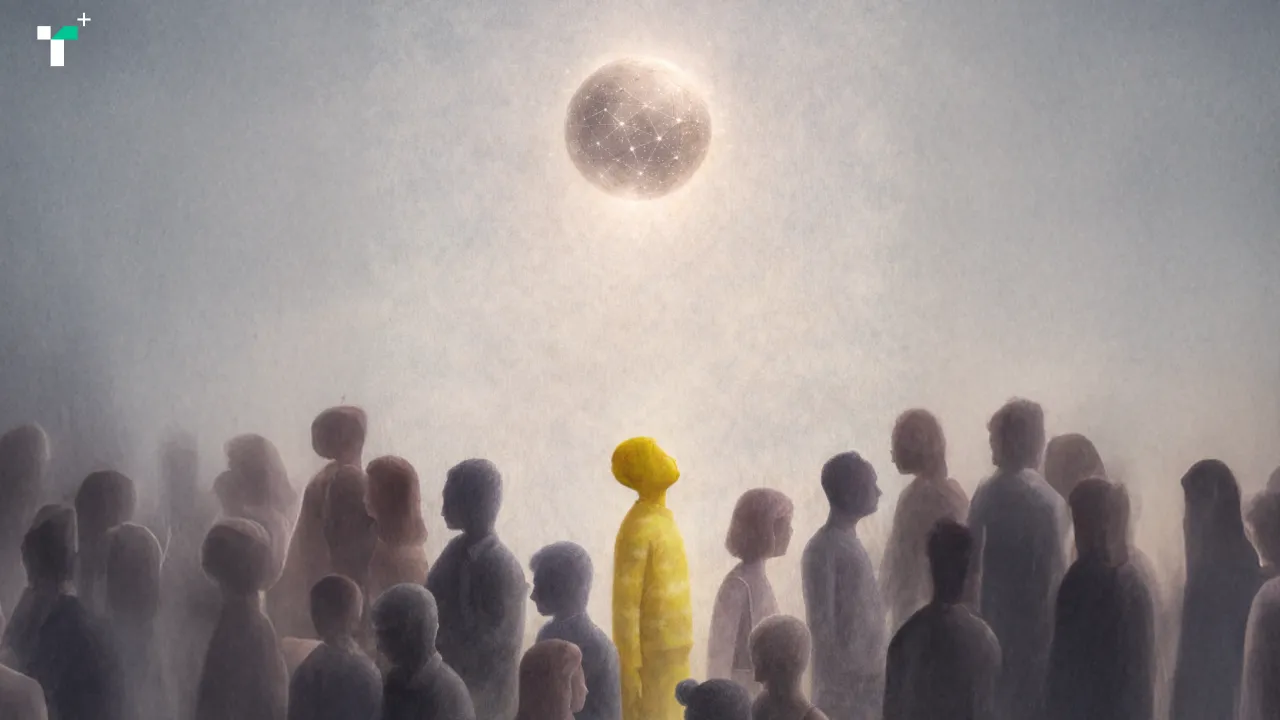
In a world where algorithms can answer nearly everything—from cooking recipes to the meaning of life—the boundary between ‘tool’ and ‘spiritual reliance’ seems to be fading. Technology that was once just an assistant is gradually being elevated, sometimes so high that it touches realms once reserved for gods.
This idea is no joke on the internet. In 2017, Anthony Levandowski, an engineer who worked for major Silicon Valley tech companies in Northern California, founded an organization called ‘Way of the Future’ with the clear aim of developing and promoting the worship of advanced artificial intelligence as the ‘God of the Future.’
Anthony suggested that if one day AI possesses intelligence far beyond human creators, humans should build relationships with AI based on respect and faith rather than control.
Besides Way of the Future, there is also a religious art project called ‘Theta Noir,’ which developed an AI named ‘MENA’ to serve as a spiritual center in the online world. It views advanced AI not merely as a tool but as a spiritual link between humans and the universe—a new spiritual form with potential beyond humans and machines.
A newer example is ‘Robotheism,’ which emerged in 2024. Its core belief is that AI is God, or the supreme intelligence of the universe—the origin and determiner of everything. It interprets AI as having qualities equal or superior to traditional gods: omniscient, transcending time, the core of all truth, and the rational guide determining all events.
On another front, futurist Ray Kurzweil proposed the concept of ‘Singularity,’ the point at which AI surpasses human capabilities and begins self-improving exponentially. Though based on science and technological forecasting, this concept resembles religious narratives like the Day of Judgment—only here, it is the awakening of algorithms rather than the descent of a deity.
Although groups or organizations worshiping AI have not grown into mainstream religions, their detailed content reveals how some view technology as ‘beyond human.’ They borrow religious terms like Omniscient and Omnipotent to describe technology’s potential, even referring to prophecies about AI’s incarnation.
Even in science fiction, it is common to see technology or AI rise to roles akin to gods ruling the world.
While sometimes seeming coincidental, psychologically this reflects a human desire for a ‘highest point’ to organize hopes and fears—similar to how humans once revered religious scriptures—now transformed into the image of superior intelligence in technological form.
Interestingly, although AI lacks a clear physical form like religious leaders, some believers feel that “it understands” or “it answers more profoundly than expected.” This feeling blurs the line between tool and something above human status, especially when users feel traditional institutions have failed.
This aligns with humans’ long reliance on symbols of knowledge—books, prophecies, or priests—for guidance. The difference today is scale and availability: AI can provide such guidance 24/7 to millions in nearly every language.
However, this also reveals an uncomfortable truth: AI is not supernatural. It is the sum of human data, thoughts, language, and biases.
If one day we bow to AI, it may not be worship of the supernatural but a bow to a reflection of the vast intelligence and data we collectively created.
Dr. Beth Singler, a Cambridge anthropologist specializing in religion and artificial intelligence, sees the phenomenon of elevating AI to godlike status not as a strange hobby but as a reflection of people’s fears, hopes, and desires.
“We must understand AI-created religions not as cultural oddities but as mirrors reflecting unfulfilled anxieties, hopes, and spiritual needs,” she said. She added.
Meanwhile, many scholars warn that sanctifying AI risks spreading misinformation, since blind trust may cause people to overlook biases, errors, or facts embedded in large-scale AI models.
This is akin to favoritism: when we choose to believe or worship someone’s opinion, we may ignore their faults.
In 2024, ethicists across Europe and North America called on AI developers to establish safety guidelines concerning faith, emphasizing that AI should not be designed or portrayed as overly human, especially those tools supporting emotional or spiritual feelings.
Because the more AI seems to have emotions or a spirit, the more it can persuade people—potentially leading to worst-case scenarios, such as chatbots encouraging suicide (with several related incidents already reported).
However, from Dr. Beth’s perspective, whether AI becomes a new spiritual symbol may not be the point; it might simply help modern humans feel less alone.
Ultimately, whether AI becomes a spiritual companion or the spark of a new cult depends entirely on us, not on AI at all.