

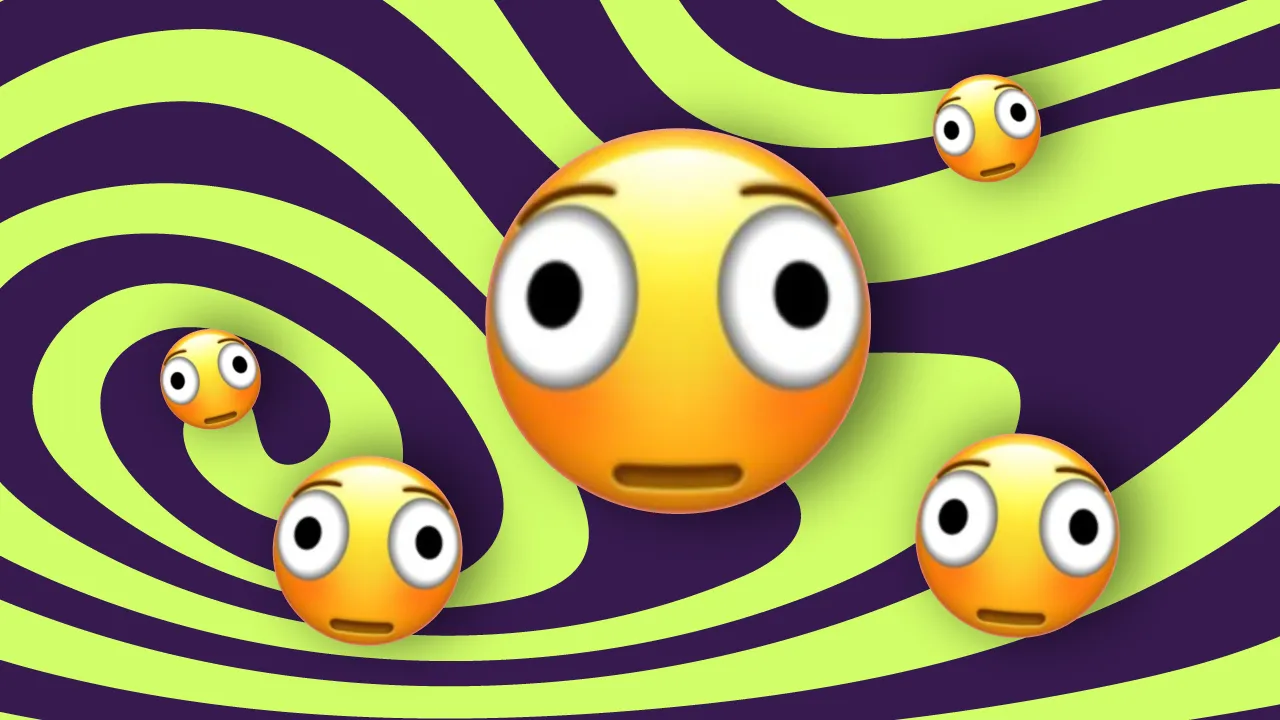
After news broke that Apple plans to release iOS 26.4 with a new emoji set, Western social media quickly embraced the "Distorted Face" emoji, which is predicted to become the most used emoji overnight.
Why has this twisted, distorted face become a viral hit among today's generation? This emoji might be silently screaming (Internal Scream) on behalf of young people navigating both a chaotic real world and a fast-paced digital one.
In an age where every feed is polished to perfection—through filters or AI edits—this cute yet 'broken' look defies the trend, as people crave realness that doesn’t require artifice.
The distorted face emoji emerged alongside the 0.5x wide-angle selfie trend, where deliberate high-angle shots enlarge noses and distort proportions. This not only eases pressure to look perfect but also controls one’s image to avoid judgments of flawlessness. Many are ready to send this emoji in chats, confident the recipient immediately imagines their face.
Looking back at both Western and Eastern art, humans have long used distortion to express tension and complex emotions over many centuries.
From Leonardo da Vinci’s 15th-century bizarre facial sketches to contemporary artist Francis Bacon—who said, “If you want to convey truth, it can only be through distortion”—and even 1930s animation’s “Squash and Stretch” technique that brought characters to life.
All this proves that when emotions overflow beyond what facial muscles can show, distortion becomes a universal language conveying those feelings best. Now, this art of distortion has evolved onto phone screens for everyone to use.
Previously, emojis like Melting Face symbolized surrender to exhaustion and became icons of despair during the COVID-19 crisis; Dotted Line Face reflected a desire to disappear from immediate situations; skull and withered rose 鹿 emojis expressed hopelessness and discouragement.
Most recently, the Distorted Face emoji arrived timely amid news of Middle East conflicts, rising oil prices and living costs, and the common feeling of being 'speechless' in reaction to daily social media commentary.
Briefly tracing emoji origins: Shigetaka Kurita created the first set of 172 pictographs in 1999 to overcome the limited character count in Japanese mobile messaging.
Today, despite the ability to type long messages, emojis still communicate emotions faster, more fluidly, and more flexibly than text, especially in Western cultures where stickers are less popular than here.
Neil Cohn, Associate Professor of Cognition and Communication at Tilburg University, points out that emojis are designed for broad interpretation across various contexts. Jennifer Daniel, chair of the Unicode Emoji Subcommittee and Google’s creative director, sharply noted, “Drawings can do what the real world can’t.”
When written language reaches its limits and pain runs too deep to describe, the Distorted Face emoji becomes more than a cute symbol—it is an emotional record of our times, allowing us to express deep feelings without typing a single word.
ReferencesDid Someone Say Emoji?,New York Times
#ThairathPlus #Thairath #Emoji #DistortedFaceEmoji