

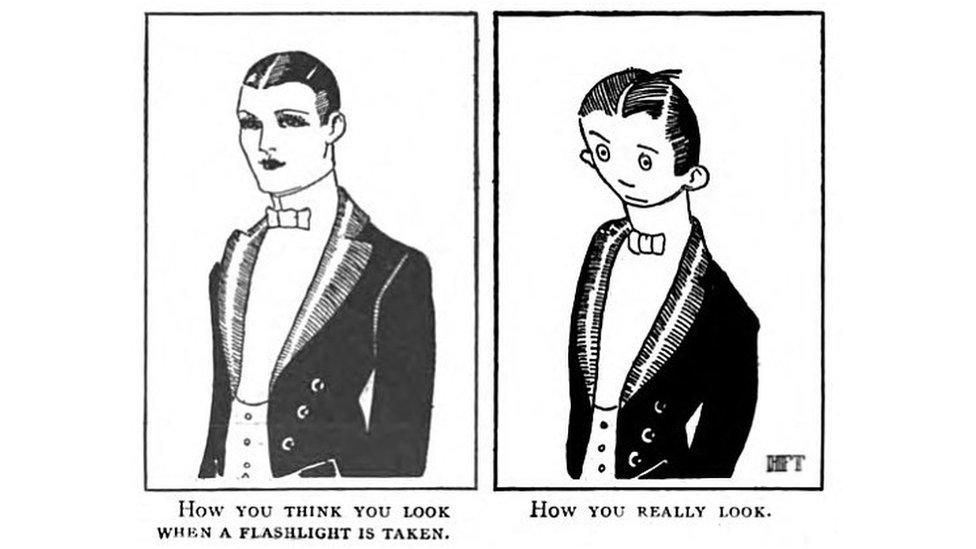
Although there is no definitive information, it is said that the first meme to appear publicly was a two-panel meme featuring a man in a tuxedo. The first panel had the caption "How you think you look when a flashlight is taken" alongside an image of the man looking dignified, while the second panel was captioned "How you actually look," showing the same man with a comically stunned expression.
This meme first appeared in 1921 in The Judge magazine published by the University of Iowa. Although this cartoon resembles today's concept of a meme, strictly speaking, the tuxedo man cartoon may not be a meme but rather a satirical cartoon reflecting reality.
The term meme came later and became more widely used as the internet became part of daily life. The purpose of memes and satirical cartoons is similar: to create humor and reflect undeniable truths. What satirical cartoons lack, however, is repetitive reuse and adaptation into fixed formats. For something to become a meme, it requires shared understanding among a group of people. If someone uses the tuxedo man's image with a different caption one day, it immediately becomes a meme. The more people adopt the format, the more it becomes a meme.
Nowadays, memes have expanded to include jokes shared online. Memes do not have to be a fixed format but rely on context. Just by seeing them, we can understand if we know the context beforehand—this is called a Meme Reference. Memes with references (drawn from previously existing media) may be incomprehensible without prior knowledge.
Memes continuously evolve and also serve well as media by making news more accessible. They cover various fields and types of information, including history, politics, and everyday life, while retaining their core of satire and truth reflection.
However, memes share a problem similar to news: they require critical consumption. Although designed as entertainment, memes often embed information, which sometimes arises from bias or untrue personal opinions. More concerning is repeated exposure that can distort the truth and lead us to misunderstand the world.
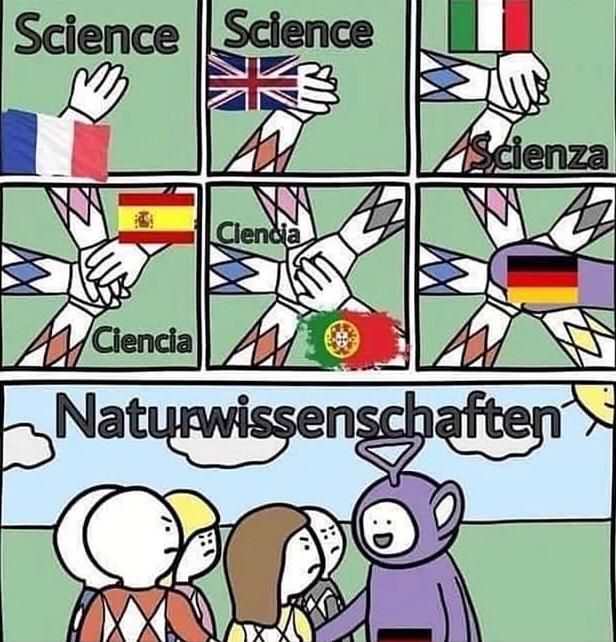
For example, in language learning, there are many language-related memes. Some topics get repeated attention, such as memes comparing words across languages. Starting with the word 'science,' which looks similar in English, Italian, and Spanish, but then German unexpectedly uses 'naturwissenschaften.' Anyone seeing this meme would laugh or smile, immediately understanding the context that German not only differs but is also difficult to read. This leads to the idea that German might be too hard to learn. In fact, the German word is not as difficult as it seems: 'natur' means nature, 'wissen' means knowledge, and 'schaft' means a branch or part extending out—similar to 'branch' in English. Together, it means the branch of natural knowledge or natural science.
Another example is work-related memes. While not like language memes, they can evoke agreement or empathy, even if we might actually feel better. One meme shows John Coffey from The Green Mile with the caption, "My state every Monday after just finishing one task."

"Nobody likes Mondays" is a phrase repeated globally because Monday is the first workday after the weekend. But constantly repeating how bad Mondays are can make us agree more than inspire us to see Monday as just another workday and normal responsibility before the next holiday. Memes make us laugh because they are so true, but deep down we yield to the truth. It's like laughing through tears—we let the truth (through memes) influence us more than we realize.
A final example is memes about generational differences between those born in 19xx and 20xx years. Many tend to think people born between 1995 and 1999 seem older than those born in 2000, even though anyone born before 2010 is generally considered Gen Z, with no significant difference in worldviews. Differences depend more on upbringing and environment than birth year.

If we see memes as repeated content in form or theme, their function is like repeated discourse, reinforcing beliefs and ideas among like-minded groups, with the internet as an echo chamber where algorithms feed us content based on our consumption behaviors.
This phenomenon can be explained by the Availability Cascades theory by Cass R. Sunstein and Timur Kuran, comparing information to a snowball rolling downhill, growing larger and unstoppable.
They propose that this phenomenon starts with a set of information vivid enough—whether images or content that evoke strong feelings like anger, amusement, happiness, or fulfillment—causing public emotional engagement and sharing. In the past, this spread was slower, but the internet now accelerates it many times over. When information circulates enough, a Heuristic Kick occurs—a cognitive shortcut where repeated exposure makes us think the issue is important, big, and possibly true.
Not all memes have the same impact or cause misunderstanding; some can make us laugh without limiting our potential. We must view memes as media, news, or online information mixed with truth and falsehoods. Regardless of how much or little information we consume compared to memes, we need to verify facts regularly and avoid letting any information limit us when we can do more or find greater happiness in doing so.
References: