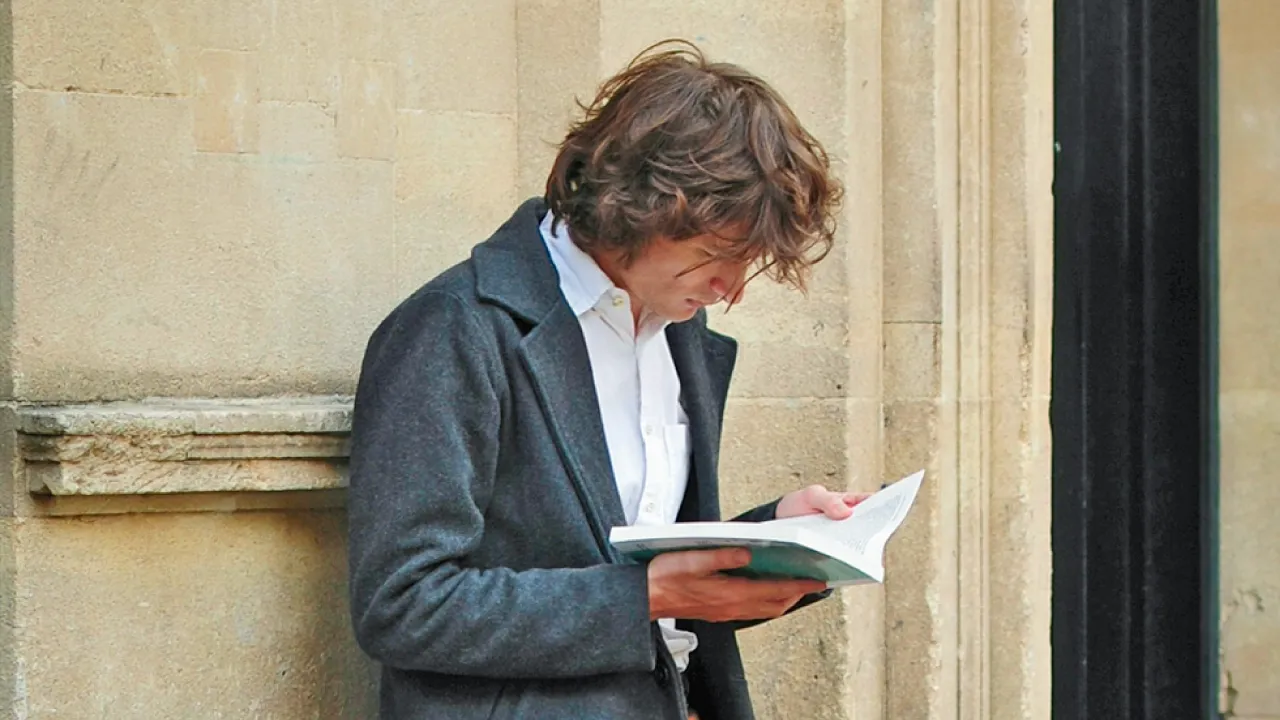
Is it wrong if we rarely read those types of books but still find happinessin reading?Comics, detective manga, or novels, amid the surrounding pressure and a deep worry that we might not gain any knowledge at all from reading these types of books.
Thairath Plus will help unlock the (non) guilty feelings and demonstrate that 'reading' is the starting point for improving ourselves in any area, regardless of the book type. And if a book isn’t enjoyable, simply closing it and putting it down... is enough.
Reading serves as a powerful 'mental simulator.' Research from Emory University found that reading 'fiction' stimulates connections in the brain’s left temporal cortex, responsible for language, and the primary sensorimotor region, which processes physical responses.
When we read scenes where a character is running or touching objects, the brain acts as if we are doing those actions ourselves. Thus, imagination from reading is not just daydreaming but the brain 'practicing' experiences through words, leading readers to have higher problem-solving skills and empathy.
Many people view reading comics, manga, or novels merely as entertainment, but psychological and learning research by Cunningham and Stanovich (1998) in 'What Reading Does for the Mind' found that reading comics helps develop vocabulary and thinking skills. This study shows that comics contain a higher proportion of specialized or complex vocabulary—20% more than everyday adult conversation.
This means that reading Doraemon or Conan might expose us to more specialized or academic terms than just listening to conversations or watching television.
Moreover, because the brain processes both images and dialogue simultaneously, it also trains analytical and logical thinking skills. Reading comics is thus not trivial but a tool that expands knowledge and language skills beyond everyday life.

The difference between the brains of regular readers and those who rarely read is very clear. Neuroscience research shows that reading increases white matter density, which connects different brain regions. Regular readers have more flexible brain function, slowing cognitive decline with age, while non-readers often have poorer long-term focus and slower development of logical analytical thinking due to lack of complex stimulation.
Reading also directly affects skills in attention control and resistance to distractions. In the digital era, where social media encourages superficial scanning, reading trains deep, vertical attention, enhancing the brain’s ability to focus continuously.
Research from Rush University Medical Center emphasizes that lifelong readers experience memory decline 32% slower than non-readers because their brains build a 'cognitive reserve' that protects against age-related dementia. In contrast, brains lacking reading stimulation develop slower logical thinking and lose focus more easily in distracting environments.
Focusing on just one genre might give us specialized knowledge, but 'reading widely' builds well-rounded intelligence. Research published in Psychological Science notes that diverse information intake develops cognitive flexibility, enabling better adaptation to new situations.
This works because each content type stimulates different brain areas: comics enhance novel vocabulary and image-based processing; news and documentaries develop logic and real-world analysis; novels stimulate brain regions related to emotions and empathy.
Mixing genres balances brain functions, reduces fatigue from repetitive information, and turns us into explorers with broad perspectives through letters, ready to face change in today’s world.

Many readers have felt the guilt of not finishing a purchased book, which is a major barrier causing some to stop reading altogether. This guilt can lead to cognitive fatigue, turning reading from a brain-enhancing activity into stress if we force ourselves to finish books that don’t suit us.
Daniel Pennac, a renowned writer and reading advocate, states in 'The Right of the Reader' that‘We have the right not to finish a book because the goal of reading is to spark curiosity, not to complete a task dutifully.’
If you regret buying a book you don’t finish, instead of letting it gather dust, passing it on through online platforms (such as X, Shopee, Lazada, Reshelf, or Facebook book exchange groups) not only transforms an unused book into funds to buy a more fitting one but also creates a circular economy in the book world, passing knowledge and imagination to those who truly want it and returning those books to the shelves.
Ultimately, reading is the starting point for improving in every area, whether the book is a world-renowned literary work or a favorite childhood comic. Every letter we read contributes to building intelligence and imagination in the brain.