

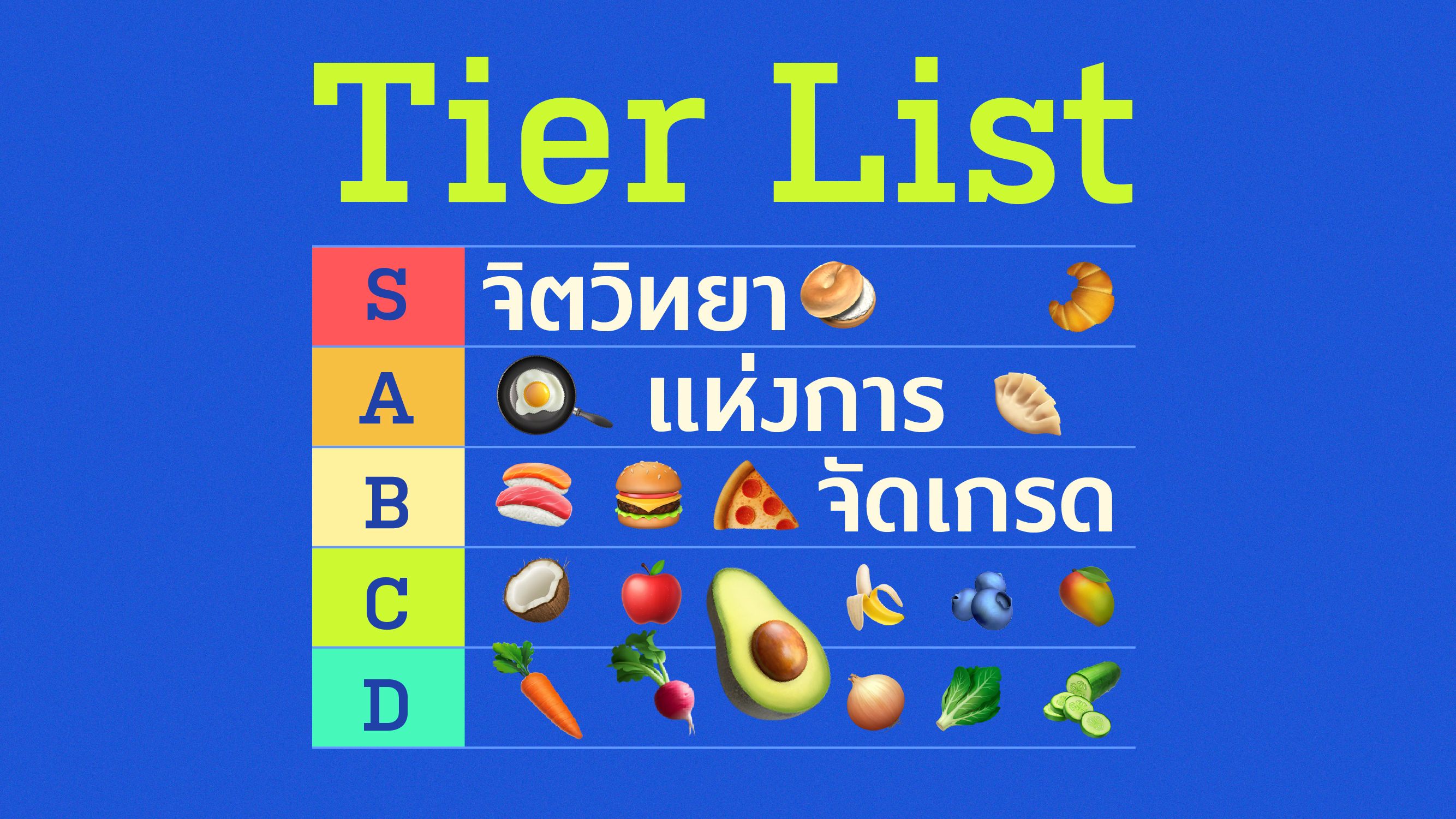
Recently on social media, we often see square tables divided into boxes ranked from top to bottom, listing everything in the world—from dream careers and franchise restaurants to the most livable cities.
Why has the Tier List culture expanded from ranking the strength of video game characters to become a universal language used by netizens in Thailand and abroad to evaluate the value of things around them? What psychology lies behind these grid boxes that makes us stop to watch and inevitably debate every time?
In an age where we receive an overwhelming amount of information, having to read a ten-page review of livable cities or listen to a streamer analyze pros and cons of a restaurant for half an hour becomes exhausting.
Tier Lists address this by serving as a cognitive shortcut, condensing complex information into a single visual story.
The human brain favors categorization because it helps us immediately process and decide what is “the best” and what to “avoid at all costs.”
The original Tier List format often uses the American school grading system from A to F or Japanese scoring systems. YouTube and Twitch streamers have adopted this to rank everything, making it go viral.
When it arrived in Thailand, it was adapted to fit local fun contexts, ranging from “Must try” and “Don’t miss” to “Terrible.”
The Tier List system is deeply rooted in video game culture, especially fighting games like Tekken and Super Smash Bros., as well as MOBAs like League of Legends and Dota, and adventure team games like Genshin Impact. Players use these tables to rank which characters are strong or OP (Overpowered).
In almost every modern game, ranking tiers for items, characters, events, or equipment has become standard—especially in online games where updates affect the tier lists over time.
The highlight is the letter “S” at the top of the table, sometimes extending to “SS.” Although its exact origin is unclear, it is generally interpreted as meaning Superb, Super, Superior, or from Japanese words like Sugoi (すごい), meaning excellent/amazing, or Shuu (秀), meaning excellence.
Applying a system that measures power scales in fantasy worlds to everyday life is a form of gamification, transforming serious and boring topics into something accessible and fun instantly.
The main purpose of creating a Tier List is to generate a space for discussion. Its strategy is to place subjective opinions into a table that looks like credible statistical data.
When personal opinions are framed as official data, it easily triggers passionate debates.
As soon as someone dares to rank a beloved capital city in the C or D tier, tours descend and fierce comments arise defending their beliefs. Social media algorithms love this because it draws people into endless clashes.
Conversely, when someone likes or comments in agreement with a Tier List, it attracts like-minded people, creating small online communities.
Ultimately, Tier Lists may not represent the absolute truth of what is best in the world because human preferences are too diverse to fit into a simple box.
However, they are tools that give us a chance to debate shared interests, and deep down, we all just want to organize this chaotic world into tables we can control and understand more easily.
ReferencesTier Maker,Computer Hope
#ThairathPlus #Thairath #TierList