

The world is currently in turmoil. We see global political tensions heating up, such as the conflicts between the United States and Iran, and between Palestine and Israel, which are intertwined with religious issues. Even in the East, countries like China and Japan face economic pressures. Whenever these topics arise, it becomes difficult to discern or position ourselves on what is truly right. Additionally, there are other issues including environmental crises like global warming and direct impacts on natural habitats and water sources. Animal rights raise doubts about whether one should adopt vegetarianism, and ethical frameworks serve as lenses through which we judge each case or event to determine the most correct stance or behavior.
All of this is the greatest challenge in a century brimming with freedom of thought. It is an era where ideas and historical frameworks are lined up for study, consideration, and application. It seems that between the left and right ideologies, there is no middle ground to choose. In ethics, we cannot apply two principles simultaneously to judge right and wrong. Furthermore, in this age of rapid news transmission, we are easily dominated or misled in our thinking because every proposal, message, and piece of information always carries an underlying agenda.
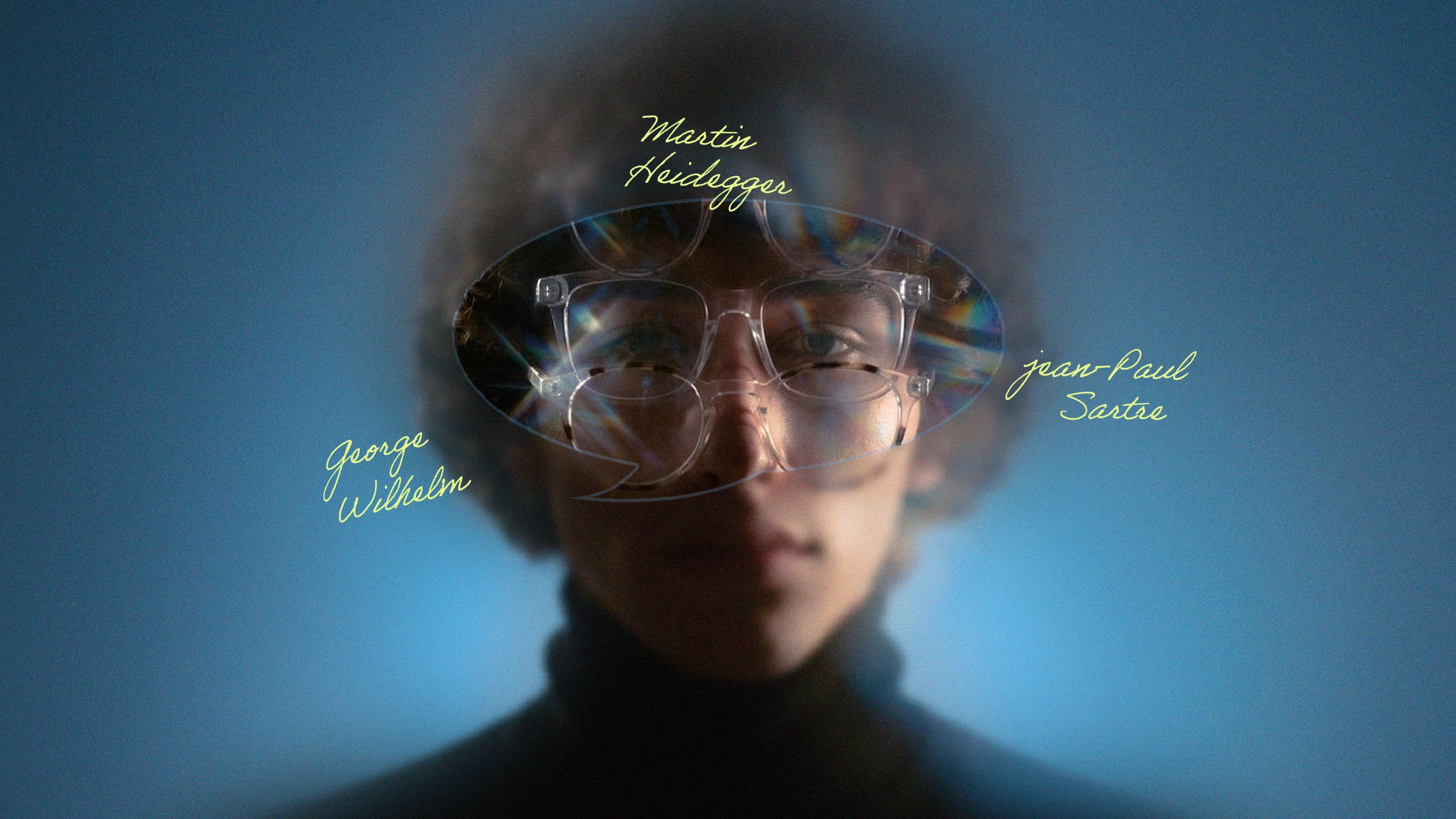
Martin Heidegger was one of the first philosophers to explain the influence of mass media in dominating our thinking. Although he passed away before witnessing mobile phones and social media, he understood their workings through radio, newspapers, and television. He defined this phenomenon as Das Gerede, or The Chatter.
Heidegger described The Chatter as the repeated opinions or discourses, comparable to retweets, viral ideas, or frequently shared posts. These create an illusion that traps us in a set of ideas without deep self-examination.
Social media is the space where The Chatter thrives most. We exist in echo chambers with people we know or follow trusted authorities who guide our thinking. We tend to believe and adhere to these people's thoughts easily. We might not choose vegetarianism out of genuine concern for animal rights, or align with the right or left simply because acquaintances are on that side, or because each side offers us benefits we cannot fully assess in the long run. How can we be sure we are not blindly following others' ideas?
Heidegger proposed that we should live authentically by escaping the inauthentic state of being trapped in media or repetitive thought patterns. He explained that whenever we stop following The Chatter, we experience anxiety—not in a negative sense, but as a worry stemming from lack of guidance. Heidegger said this is positive because it awakens us from illusions and encourages us to take responsibility for constructing our own worldview.
However, seeing things independently is not easy. These are philosophical lenses to guide us and can be adapted to a world full of numerous ideas.
From Jean-Paul Sartre's perspective, thinking "now" does not mean "forever."
Existentialism views adhering rigidly to an ideology like "I am left-wing" or "I am a utilitarian" as bad faith, or self-deception. Thinking this way turns us into objects, easily shaped by textbooks or influential thinkers. Instead, we should focus on action—as verbs—exercising freedom of thought and subconscious choice about what to do at the moment, even if the next day we might choose another side. This may seem like Sartre was capricious, but he wanted us to understand that originally there was no concept of left, right, old era, or new era. If we choose or decide wrongly, we must accept responsibility because the decision was made with our best reasoning at the time.
Viewing through a pragmatist lens means treating philosophy merely as a tool.
William James, a pragmatist troubled by theories and ideological stances like everyone else, argued that we should value ideas by their consequences, or what he called their “cash value.”
In ethics, we often encounter major ethical frameworks like Aristotelian ethics or Kantian ethics. Many ethicists firmly hold their positions on how to judge situations. James solved this by employing all ethical principles but judged by the outcomes—what will happen, whether it will make us good people, and who will be affected in the short and long term. He proposed that philosophy is not something to bind us for life but a tool to be used appropriately for each task.
Seeing through Hegel’s lens means finding flaws to create anew.
Georg Wilhelm Friedrich Hegel proposed the concept of Dialectic, explaining that history changes through a process involving thesis, antithesis, and synthesis.
The thesis is the prevailing idea; the antithesis opposes or stands against it; and the synthesis combines elements of both. For example, in French history, the thesis was pre-1789 France under the Ancien Régime, which limited individual freedom. This led to the antithesis—the Reign of Terror—a revolutionary period restoring freedom but marked by uncontrolled liberty. History then brought synthesis: Napoleon’s era, which ended the chaos and established modern bureaucratic France.
Hegel’s Dialectic can be applied beyond history to any matter because he viewed history and events as linear and sequential. Similarly, political or ideological stances have pros and cons on both thesis and antithesis sides. Our task is to create synthesis by selecting good parts to form a new, more insightful understanding.
When we are trapped by left and right divisions or deciding whom to trust, Hegel suggested that truth never lies solely in one choice. Our role is not to pick a side but to identify flaws in both and envision what the proper synthesis should be.
Of course, even philosophical lenses are ideas like any other, and we must understand that philosophy never claims to be the ultimate truth or an ideology to cling to. Philosophy is neutral ground where everyone can express, distort, or modify ideas if supported by good reasoning. Its role is to provoke reflection, deepen our understanding of the world, and help us survive in troubling times. Besides seeking truth, philosophers also strive to find the best way to live.
References: