

This is not my first time living in Korea. I have previously studied the language in three- and six-month courses, but this time is different because I’m here for a full two-year master's degree program (hopefully not longer)."} ,{
I planned to fully embrace new experiences, but after a while, I noticed that the excitement of culture shock or the feeling of encountering "something new" almost disappeared. When it came time to write about life here, I thought hard about what to share, feeling there was nothing new or interesting to talk about. After speaking with many people, they suggested, "What we find familiar might be new to others."
I then understood that I am no longer in the phase of excitement about this country, but rather in a deeper stage of understanding. This time, I am not just studying the language but enrolled in the main education system alongside native Korean students as the only international student in the class.
Today, I want to divide this into three parts, describing the "process of understanding" of someone who stops asking why people here do things in certain ways—not because they no longer wonder, but because they understand well enough.
One thing I learned since studying Korean is that to understand the language, you must understand the culture, and to understand the culture, you must understand the language. These two are intertwined to the point of being considered one and the same.
At first, language was just an obstacle to overcome. But over time, I noticed that the real complexity is not vocabulary or grammar but the culture embedded in the language, shaped by the way of life that forms Korean people's characteristics. The clearest example is the concept of "language levels." Of course, Thai also has this, but it’s not as intense or serious as in Korean. You might see it in dramas where before the lead couple starts dating, they say something like “말 놓을까요?” meaning “Shall we speak informally?” There is initial awkwardness before quickly becoming close.
Studying at the master's level as an adult with some work experience means you can’t get close with classmates as quickly as in undergraduate studies. At first, I spoke formally (존댓말) to classmates, creating a barrier that kept both sides from fully opening up. But when the timing was right, a classmate told me, “You can speak informally (반말) with me.” That was a signal the barrier was fading. I naturally felt closer to that friend than when we spoke formally. I then deeply understood that choosing formal or informal speech is not just about manners but defines the “distance” between two people. Conversely, if you want to keep distance, you stick to formal speech as a way to signal “don’t cross the line yet.”
All this stems from Confucian thinking deeply rooted in Korean culture, a system emphasizing hierarchy—age, position, even year of enrollment. Seniors just one year ahead require formal speech. This all reflects in the language inseparably. From a Thai perspective, one might not understand why this is taken so seriously, but when you grasp the culture, the language that once seemed difficult begins to make sense, and the culture that seemed strange becomes reasonable. This is truly inseparable.
When starting life somewhere new, the first thing is to establish your own nodes or anchors: the coffee shop to stop by before class, the café for reading or working, the supermarket for groceries, the safe restaurant for days when you don’t know what to eat.
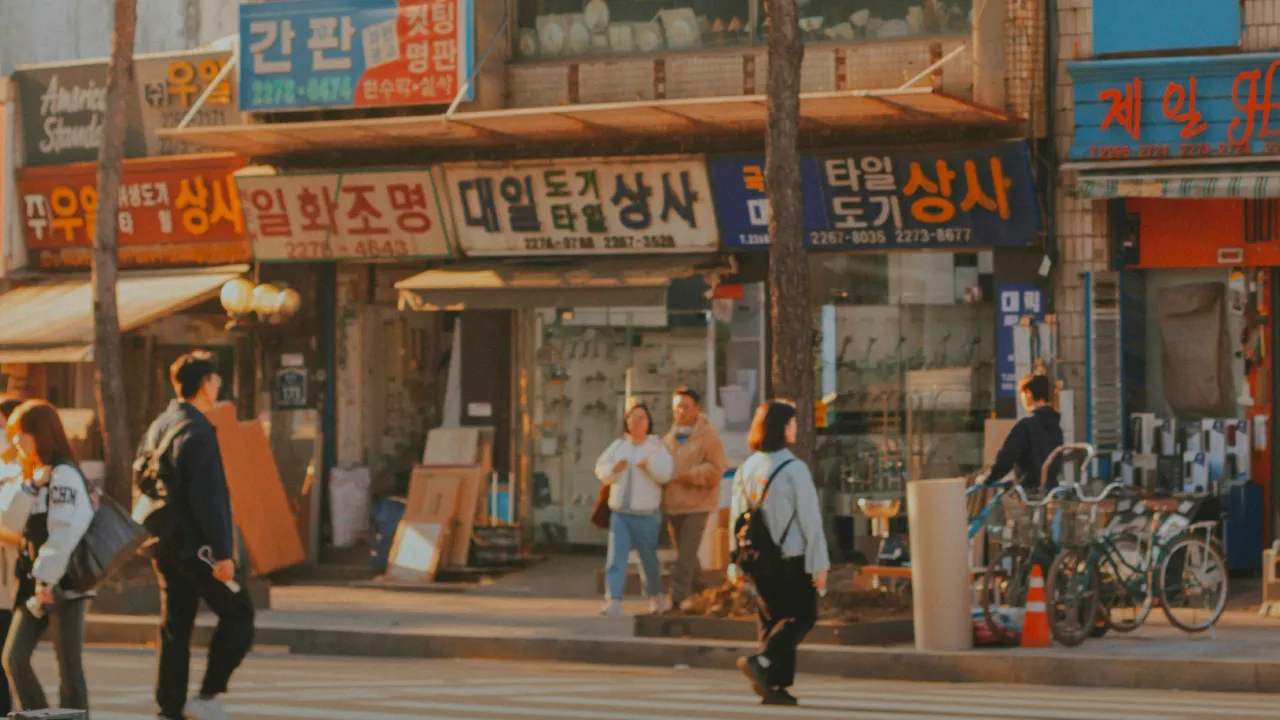
What I observed is that Seoul makes it very easy to create these anchors because almost every residential neighborhood has everything within walking distance: convenience stores, laundries, clinics, eateries, parks, fitness spots. The city seems designed so each neighborhood functions as a small self-contained unit. No matter where you live, the infrastructure for daily life is almost the same.
Tourists might never notice this, as they usually visit popular districts, tourist spots, or reviewed restaurants. But living here and spending time in residential areas reveals that the city is thoughtfully designed so one person can settle in without much struggle.
However, each neighborhood’s pattern is not identical but adjusted to its residents. For example, university districts, where I live daily, have many cafés designed for long study sessions, plenty of seats to stay as long as you want without pressure, affordable restaurants for students eating every day, and drinking and karaoke spots to unwind after exams. It’s like a miniature city built specifically to support student life. Walking toward office or purely residential areas, the atmosphere changes to fit those neighborhoods.
Once these anchors are established and you can navigate without maps, the feeling subtly shifts—from feeling like a foreigner to starting to feel at home.
Everything here seems governed by an invisible clock urging punctuality: pedestrian signals change quickly, so you have to run; subway doors close fast, so you must hurry; good weather means rushing out for a picnic; flowers bloom or leaves change color, so you must see it before it’s gone.
After a while, I realized this urgency is not a personal trait but stems from a country with distinct seasons. Everything has a limited window: flowers bloom for only a few weeks, good weather lasts just a few months, winters are long. Growing up in a culture where nature repeatedly teaches “if you don’t hurry, you’ll miss out,” this urgency permeates all aspects of life.
When everyone feels this way, it becomes a shared social rhythm. When the weather is nice, everyone goes out together; when a trend hits, everyone follows; when a place is popular, everyone goes there. Observing more closely, it’s not just about rushing but about how this society moves: it moves together.
Collectivist values have been deeply rooted in Korean society since industrial development, where national success was placed above individual desires. Though society has changed a lot, traces of these values remain evident in daily life.
Koreans grow up in a society where “we” matters more than “I,” evident even in language. The word 우리나라 (urina-ra), literally “our country,” is heard very often. Living among Koreans, I hardly ever hear the direct term 대한민국 (Daehanminguk) meaning “Korea” in everyday conversation but instead hear 우리나라. This word doesn’t just mean “our country” in a general sense but specifically refers to Korea, as if “we” is embedded in the nation’s identity. Koreans also use 우리 (uri, “we” or “our”) with everything: 우리 엄마 (our mom), 우리 학교 (our school), 우리 남편 (our husband). Even when talking about something belonging to “me,” they use “our,” implying everything is shared in this society.
Understanding this, I also began to see that everyone rushing in the same direction is not because there’s no choice but because society is shaped to move together. Looking back at myself now, I find I run across the street without being in a hurry, simply following others.
When I first thought about what to write, I felt there was nothing new to say. But when I stopped to really observe what’s around me, I found the interesting things hadn’t disappeared; they’d just changed form—from the excitement of a tourist to the understanding of someone adapting to a culture not their own. Stopping the question “why do people here do this or that” doesn’t mean judging better or worse but opening your mind enough to understand where it comes from. Perhaps that’s the real gain from studying for a master’s degree—not new knowledge but a new perspective that understands the familiar more deeply.