

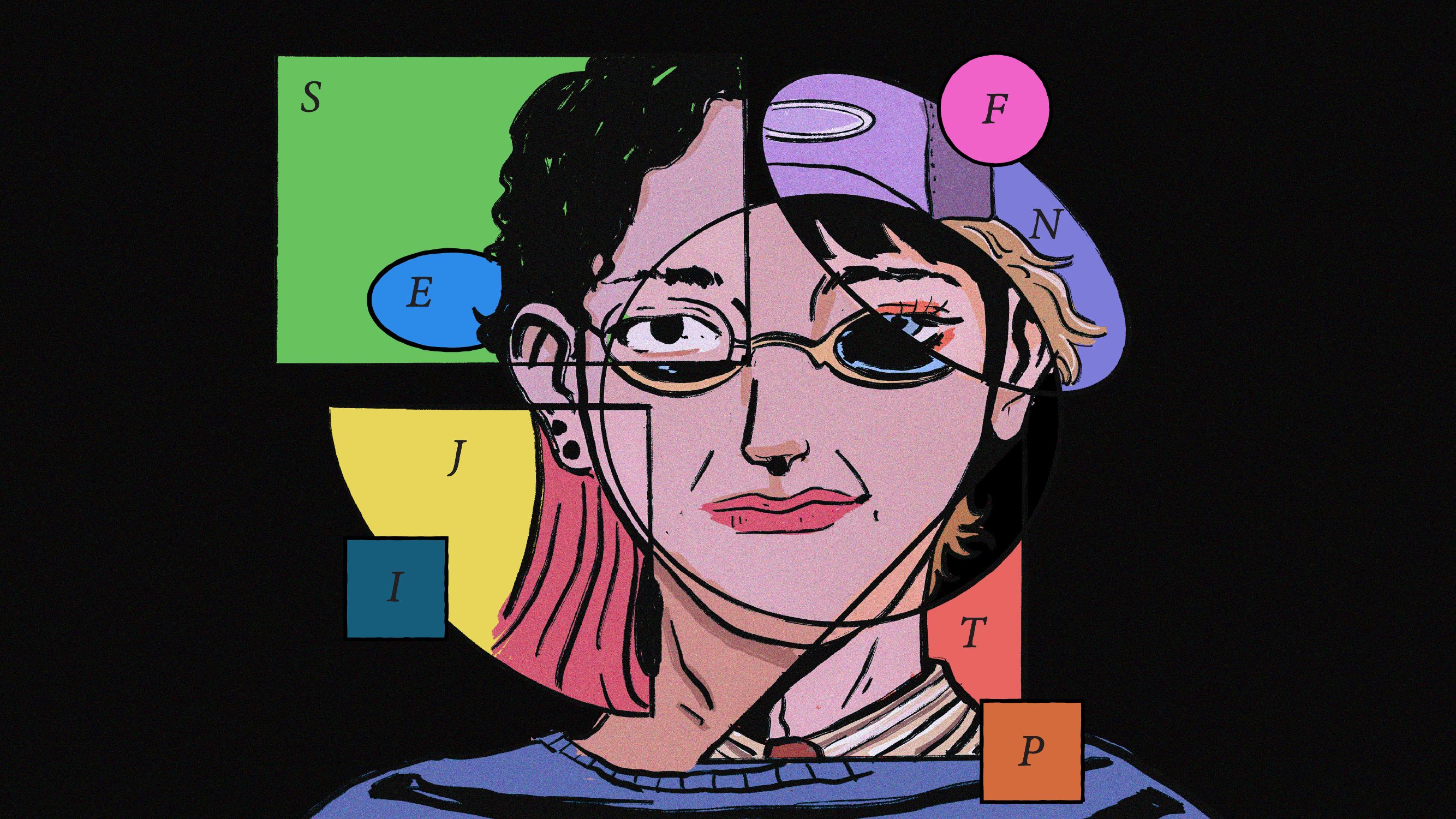
Currently, hardly anyone is unfamiliar with the Myers-Briggs Type Indicator (MBTI) personality test, which has become the most widely taken test and a common topic of conversation. It has inspired numerous memes, videos, and cartoons, and some companies even require employees to submit their MBTI results as a basic personality screening.
It is well known that MBTI was not created by professional psychologists but by Katherine Cook Briggs and her daughter Isabel Myers, both writers with a strong interest in Carl Jung's psychology and personality theory. They studied these topics seriously starting in 1917 and developed the indicator during World War II by testing it on women to identify their personality types for job placement in wartime. Briggs published The Briggs Myers Type Indicator Handbook in 1944, later renamed Myers-Briggs Type Indicator in 1956.
Although MBTI has often been criticized as pseudoscience, its accuracy in reflecting many people's experiences led the Educational Testing Service (ETS) to develop the first MBTI manual in 1962. It received support from the Institute of Personality and Social Research at the University of California, Berkeley, and other U.S. universities.
How does MBTI draw from Carl Jung's concepts?
Briggs and Myers were inspired by Carl Jung's Theory of Psychological Types, which proposed that humans have different modes of consciousness and attitudes. Jung divided consciousness functions into four types:
Sensation: understanding the relationship between the individual and objects, focusing on tangible and real experiences.
Intuition: understanding underlying motives, subconscious drives, meanings, or patterns behind actions.
Thinking: logical analysis used in decision-making.
Feeling: making decisions based on values or empathy.
Jung also divided attitudes into two types: Extravert (spelled Extrovert in some contexts), where energy is directed outward toward the external world, objects, people, or activities, and Introvert, where energy is directed inward toward oneself and internal ideas or thoughts.
Briggs and Myers adapted Jung's core ideas, believing individuals could be categorized by personality types and added two more dimensions: Judging (J) and Perceiving (P). Judging indicates approaching the external world with structured, decided perspectives, while Perceiving indicates a flexible, adaptable approach.
The personality tests we commonly take are based on The Big Five model.
Today, many websites offer personality tests, such as 16Personalities, OpenPsychometrics, and Truity. Most people take the 16Personalities test because it appears first when searching for 'MBTI Test' and is familiar due to its association with personality cartoons.
In fact, 16Personalities and many free online tests are based on The Big Five, a standard psychological model measuring Openness, Conscientiousness, Extraversion, Agreeableness, and Neuroticism—collectively known as OCEAN.
The difference is that while MBTI builds on Jung's personality theory, The Big Five was developed by researchers using the lexical hypothesis, analyzing all descriptive words about human feelings and grouping them into personality categories via computer processing.
Many are unaware that MBTI tests offer binary (two-choice) answers, limiting responses to two options, whereas The Big Five uses a five-point spectrum from strongly disagree to strongly agree, corresponding to the OCEAN traits. Results depend on which side of each spectrum one leans toward.
The only similarity in popular tests is displaying results as abbreviations like ENTP. This usage is not copyrighted and serves marketing purposes, allowing people seeking MBTI tests to take Big Five-based tests presented in MBTI-style, often without explicitly stating they are not true MBTI.
At this point, some may wonder which is original or more accurate: MBTI or The Big Five?
Although MBTI tests often require payment, The Myers-Briggs Company earns millions annually from individuals and organizations because MBTI results offer practical workplace guidance. In contrast, The Big Five better identifies individual personality traits.
It is true that The Big Five is grounded in psychological research, but when taking a test, the system reports percentages across five OCEAN traits—for example, 60% Openness, 20% Extraversion, 20% Neuroticism—as shown in score tables. The Big Five does not categorize people into types like INFP or ISTP, but sites like 16Personalities convert scores to MBTI types because users prefer personality type labels over numeric tables.
The advantage of The Big Five is its ability to display a nuanced and diverse personality profile through percentages rather than a single letter type, showing, for instance, how introverted or analytical a person is quantitatively.
MBTI is especially useful in workplaces because it assumes the brain makes decisions from binary choices, such as thinking versus feeling, providing quick identification of dominant traits. Categorizing people this way helps match them to jobs and fosters group cohesion. MBTI is popular in human resources, with many companies paying for tests to screen candidates and ensure personality-job fit.
In summary, no test is better overall; it depends on what you value. For self-understanding, The Big Five may be ideal. For career suitability and work style insights, MBTI is a good choice despite its less modern psychological basis.
Ultimately, whether using MBTI or The Big Five, knowing yourself is what matters most. Personality tests provide general frameworks, especially for traits like extroversion versus introversion, which remain debated. Overreliance on types can limit personal growth. Therefore, do not let personality tests define your life's direction; instead, define yourself.
References: