

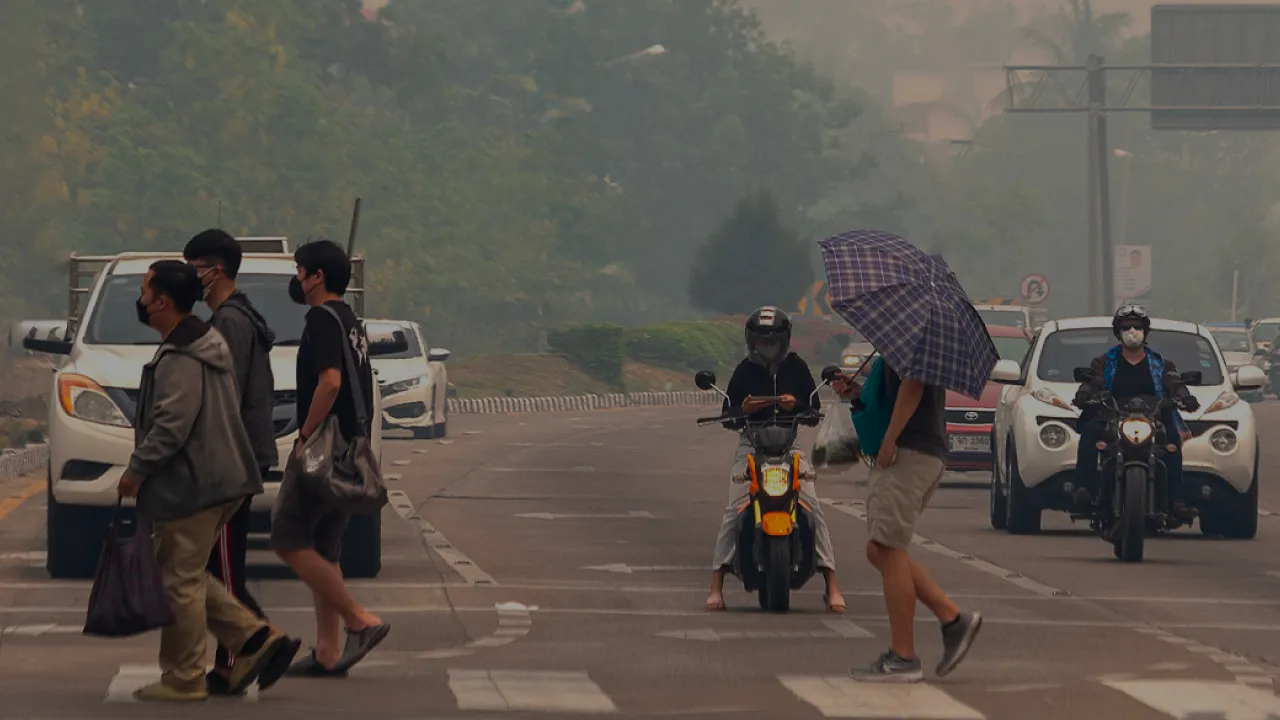
Over the past years, Thailand has faced polluted smog and dust issues nationwide, especially in the north where the problem recurs annually and has intensified. Recently, Mr. Siwakhon Buapong, Deputy Governor of Chiang Mai, declared Samoeng District a disaster area due to severe smog conditions affecting the public, posing dangers to life, health, and property, in accordance with the Disaster Prevention and Mitigation Act of 2007. This situation continues to worsen.
The latest GISTDA report using satellite data identified over 4,750 hotspots in Thailand, with neighboring countries also having many hotspots: Myanmar with 5,505, Laos 2,704, Cambodia 593, Vietnam 489, and Malaysia 51 (data as of 30 Mar 2026 GMT+7).
This data indicates that smog from burning is not only a domestic problem but also originates from neighboring countries, particularly Myanmar and Laos, which are major sources of transboundary smog affecting northern Thailand.
The primary factor directing smog is the wind. When wind direction changes, the affected areas shift accordingly. In ASEAN, monsoon winds have great influence: early in the year, they often carry smog from the north down south; mid-year, monsoons carry smog from south to north. This is a key reason northern Thailand faces recurring smog crises each early year.
Although there is the ASEAN Agreement on Transboundary Haze Pollution to address regional issues, in reality, solutions have been insufficient, and the agreement seems to lack practical effectiveness.
Research on transboundary smog management in Chiang Rai province found that when policies under this agreement are implemented, control is only effective on the Thai side, without authority extending to Laos and Myanmar.
This is because, despite joint smog management approaches, ASEAN’s key principle is non-interference in member states' sovereignty, resulting in regional smog solutions merely setting central standards for countries to adapt independently.
Consequently, the 2020 goal of a smoke-free region and the Chiang Rai action plan to reduce smog in Upper ASEAN have failed to resolve the problem effectively. Differences in political systems among countries further hinder expected progress.
While source countries lose forest resources to burning, recipient countries suffer health damage, increased public health expenditures, and negative economic and tourism impacts in the north, potentially making Chiang Mai an undesirable place during smog season. This reflects that blame cannot rest on any single country; serious legal and international cooperation is essential for solutions.
An example model is Singapore’s Transboundary Haze Pollution Act, enacted in 2014. This law uniquely authorizes the government to pursue civil and criminal actions against corporations, domestic or foreign, involved in burning that causes smog drifting into Singapore.
Singapore’s cross-border punitive legal authority not only helps reduce burning in neighboring countries but also pressures businesses to adopt truly sustainable agricultural practices.
Looking back at Thailand, beyond stricter laws, the government should consider proactive, tangible measures rather than waiting for pollution levels to spike before declaring disaster zones. For example, seriously applying technology and innovations to manage agricultural waste to add value without causing air pollution.
Or even establishing a clean air fund to support local administrations in acquiring effective wildfire suppression tools and installing detailed air quality sensors across all subdistricts for accurate data to plan ahead.
Additionally, elevating regional negotiations to a ‘highest urgent agenda’ with transparent joint satellite monitoring mechanisms could transform policy from paper into effective local action, potentially offering sustainable solutions to the recurring smog crisis faced by Thai people.
Amid the current new government, society continues to question and demand updates on the Clean Air Management Act draft law’s status. As air quality reaches hazardous levels, will the government urgently revive discussions to address the issue?