

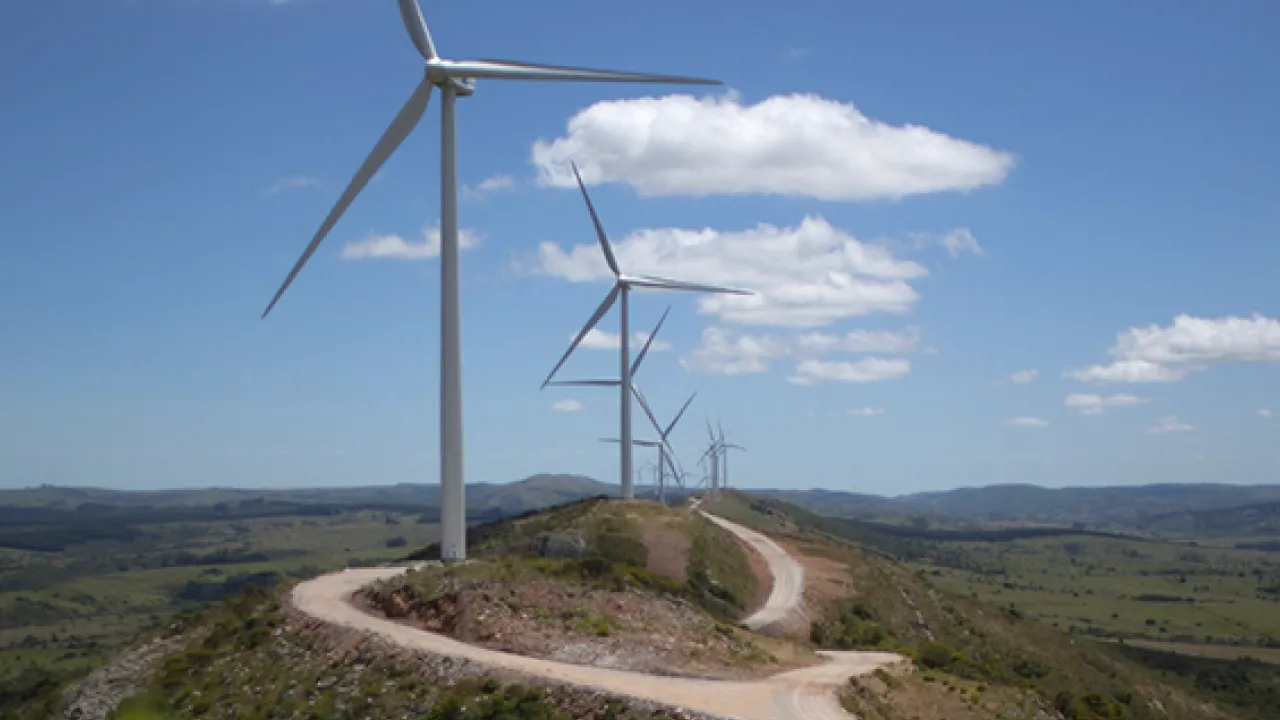
While the world struggles with volatile fossil fuel prices and pressure from climate change, a small Latin American country is standing firm as a pioneering model of progress for the globe.
That country is Uruguay. Once heavily reliant on oil imports and external energy sources, Uruguay now produces 99% of its electricity from renewable energy, reaching levels comparable to Scandinavian nations.
Moreover, Uruguay has transformed into a net exporter of surplus energy to regional giants like Brazil and Argentina.
A key question for the global community is: how did Uruguay realize the energy independence many countries aspire to within just two decades? And can others replicate this success?
Back in the 1990s, Uruguay, with a population of just over 3 million, lacked domestic fossil fuel resources and relied on decades-old hydroelectric dams. Severe droughts reduced water levels, compelling Uruguay to import expensive oil to generate electricity and compensate for the hydro shortfall.
By 2005, over 55% of Uruguay’s energy came from oil, leading to power outages, economic instability, and government realization that a new energy strategy was urgently needed.
"In extreme drought years, energy costs soared to one billion U.S. dollars, which for a small economy like Uruguay represented 2% of the entire GDP,"said Ramon Mendez Galain, Uruguay’s former national energy director.
At that time, Mendez was a university particle physicist without prior energy industry experience but had authored a detailed national energy transition plan. This prompted the president to appoint him as the country’s energy chief.
One factor behind Mendez’s plan’s success was a shift in mindset.
He did not start by emphasizing "reducing greenhouse gases to save the planet" alone. Instead, he advanced the strategy based on "national economic necessity," demonstrating that renewables—wind, solar, and biomass—are not only environmentally friendly but also cheaper, more stable, and free the country from global market price dependence.
Presenting the issue through economic nationalism fostered political consensus, overcoming party conflicts until the energy transition strategy was broadly supported.
This included regulatory reforms and market mechanisms, with the government ending fossil fuel subsidies and auctioning wind and solar projects to encourage competition, thereby lowering energy prices.
Next was fair public-private partnerships. Developing countries often face funding shortages, and even the IMF and World Bank refused to finance Uruguay, doubting that the state would refrain from subsidizing private investors.
Ultimately, Uruguay used the state utility UTE, which monopolizes electricity transmission and distribution, to issue 20-year dollar-denominated PPAs, providing long-term guarantees to private companies investing in wind turbines and solar farms. This gave private investors assured revenues without the state bearing construction costs, while the government retained full ownership and control of the electricity grid.
In many developing countries, renewable energy projects are often criticized for land disputes, indigenous rights violations, or community disenfranchisement—as seen in Morocco, Nepal, and India.
Uruguay’s government involved labor unions early on. Workers from fossil fuel plants slated for closure were retrained to work in wind and solar industries, creating 50,000 new jobs—about 3% of the national workforce.
Today, Uruguay’s energy mix is stable and diverse: 45% hydro, 35% wind utilizing vast grasslands, 15% biomass converting waste into energy, with the remainder solar and only 1-3% natural gas thermal power reserved as emergency backup.
Empirically, Uruguay attracted six billion U.S. dollars in clean energy investments—12% of GDP. The government freed budget funds for education and public services; the economy grew 6-8% annually, and poverty rates dropped from 30% to just 8%.
Some argue Uruguay was fortunate to have favorable conditions: a small 176,000-square-kilometer territory, suitable geography, relatively low electricity demand compared to large industrialized nations, and strong institutional trust.
However, Ramon Mendez Galain disagrees with claims that this model cannot be replicated.
"It’s not because we’re a small country with abundant currents. We have average wind and solar resources. The key is that we understood the need to change the 'rules of the game' to make renewables competitive. When we removed biases and fossil fuel subsidies, renewables emerged as winners,"Mendez said.
Energy sovereignty is not an unrealistic concept but a community right and government vision to control their energy systems without falling prey to uncertain global market volatility.
Uruguay has proven that clean energy is practical and economically beneficial; it requires only the "political courage" to change entrenched rules often obscured by vested interests and the old energy industry's financial influence.
#ThairathPlus #Thairath #Uruguay #EnergyCrisis #OilPrices