

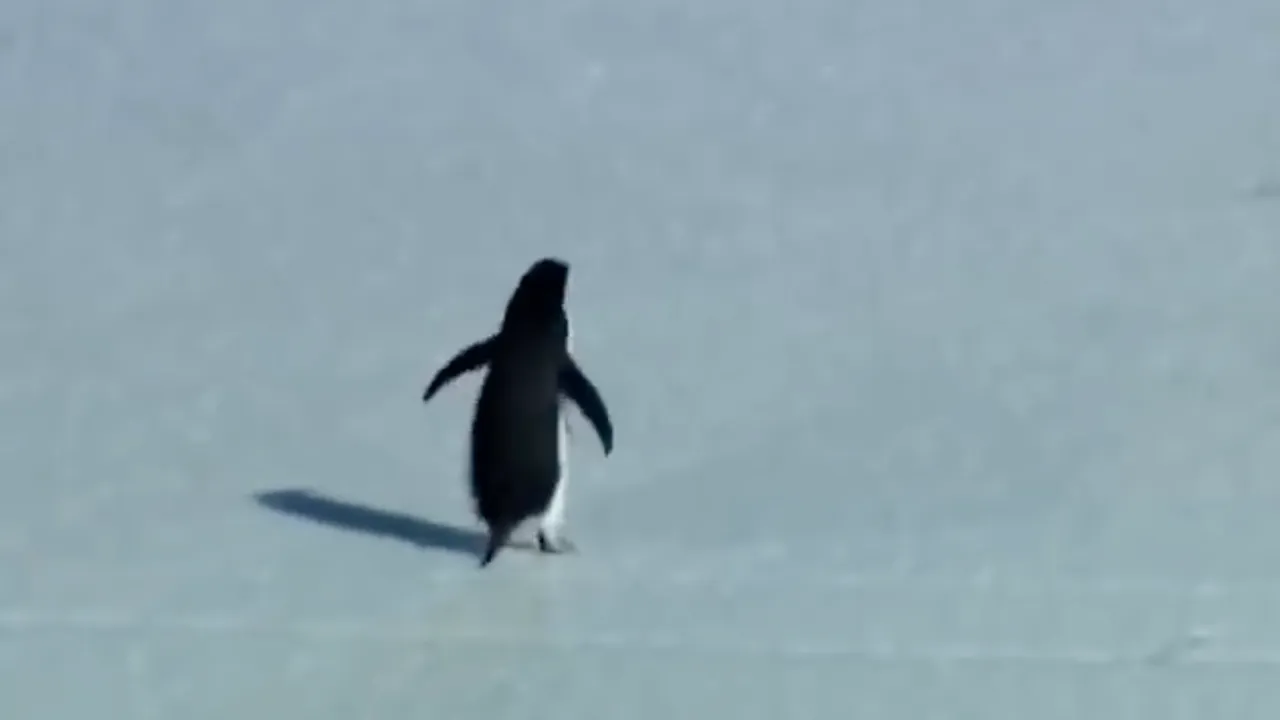
This image originates from the classic 2007 documentary Encounters at the End of the World by German director Werner Herzog, which became a viral meme known as the "Nihilist Penguin." It depicts a penguin separating from its colony, leaving behind the ocean that is its home and food source, and heading alone on foot toward the empty, freezing ice mountains of Antarctica.
On World Penguin Day, 25 April, the image of penguins in 2026 reflects a harsh reality: while humans use penguins as memes to symbolize mental exhaustion, their real lives over the past year have faced terrifying ecological threats, including being officially classified as endangered species and suffering from disruptions caused by the global warming crisis.
In early 2026, social media was flooded with penguin memes derived from the documentary Encounters at the End of the World. These showed an Adélie penguin rejecting its basic instincts, choosing not to head toward the sea for food or live with its colony but instead walking into a distant ice valley.
Many people experiencing burnout, exhaustion, and struggles in a fast-paced world felt connected to this solitary penguin's journey, making the meme so viral that even former President Donald Trump posted an AI-generated penguin image for political purposes related to Greenland's annexation.
Meanwhile, the global AI account ChatGPT Tricks explained that "this penguin clip loudly voiced what many people are thinking."
A crucial turning point in April 2026 was the International Union for Conservation of Nature (IUCN) officially upgrading the Emperor penguin's status from Near Threatened to Endangered on its Red List.
Population modeling data indicate that if current trends continue, Emperor penguin numbers could decline by 50% by the 2080s. Satellite images from 2009 to 2018 already show a 10% population loss—equivalent to over 20,000 fully grown penguins disappearing within a decade.
The primary cause of this rapid decline is the warming planet causing ice sheets to break apart and melt faster than expected, maintaining record low ice levels since 2016.
Naturally, coastal ice sheets serve as nurseries for newly hatched Emperor penguin chicks and as shelter during molting season for adults, whose bodies are temporarily unable to waterproof or enter the sea. Often, this leads to tragic deaths of many chicks drowning in the cold ocean.
Researchers emphasize that even when applying multiple future climate models, the conclusion remains the same: unless humanity drastically reduces greenhouse gas emissions soon, Emperor penguin populations will crash this century, leaving ice and species as lost relics.
Beyond habitat loss, the global warming crisis is unavoidably disturbing the biological clocks of wildlife. Rising temperatures are forcing Antarctic penguins to alter their natural behaviors in unprecedented ways.
A recent January 2026 study in the Journal of Animal Ecology revealed that breeding area temperatures rose by 3 degrees Celsius between 2012 and 2022. This unnatural rapid warming has compelled at least three penguin species to breed 2-3 weeks earlier to survive.
Oxford University biologist Ignacio Juarez Martinez warned, "Penguins are shifting their breeding timing faster than any other vertebrate species on Earth, a rapid change never seen before."
However, this rapid adaptation is not entirely positive. Accelerating chick hatching cycles means chicks are born before the ocean’s peak food abundance, exposing them to starvation risks and potentially accelerating their risk of extinction.
Despite the discouraging 2026 penguin population statistics, humanity continues striving to save this and many other species.
This year, the Global Penguin Society has intensified efforts to protect all 19 penguin species across the Southern Hemisphere by integrating scientific research, education, and conservation. They are pushing for international legal protections, including at the Antarctic Treaty Consultative Meeting (ATCM) in May 2026, aiming to halt industrial krill fishing near breeding grounds. They are also employing satellite technology to track migration routes, identify conservation areas, and minimize human-wildlife conflicts.
Additionally, South Africa’s Southern African Foundation for the Conservation of Coastal Birds (SANCCOB), a specialist organization, continues its mission to rescue and rehabilitate African penguins. This year, their Chick Bolstering Project addresses a 73% decline in breeding pairs by successfully saving and releasing over 7,000 abandoned chicks back to the wild.
Public involvement is also crucial through Oxford University's Penguin Watch project, which invites people worldwide to help count penguins using satellite and time-lapse images, assisting scientists in monitoring populations and assessing climate impacts.
This entire struggle brings us back to the core question on World Penguin Day: as humans, will we allow one of the world's most remarkable creatures to disappear, or will we take collective responsibility for nature before penguins exist only as memories and grim memes without life?
#ThairathPlus #ThairathPlus #Penguin #WorldPenguinDay #NihilistPenguin #GlobalWarming #ClimateChange #Environment