

Although current natural disaster situations are not caused solely by continuous heavy rainfall, they result from various simultaneous natural and environmental factors, leading to flooding in many areas nationwide, especially in Bangkok, where the crisis has escalated to the point of declaring all 50 districts disaster zones.
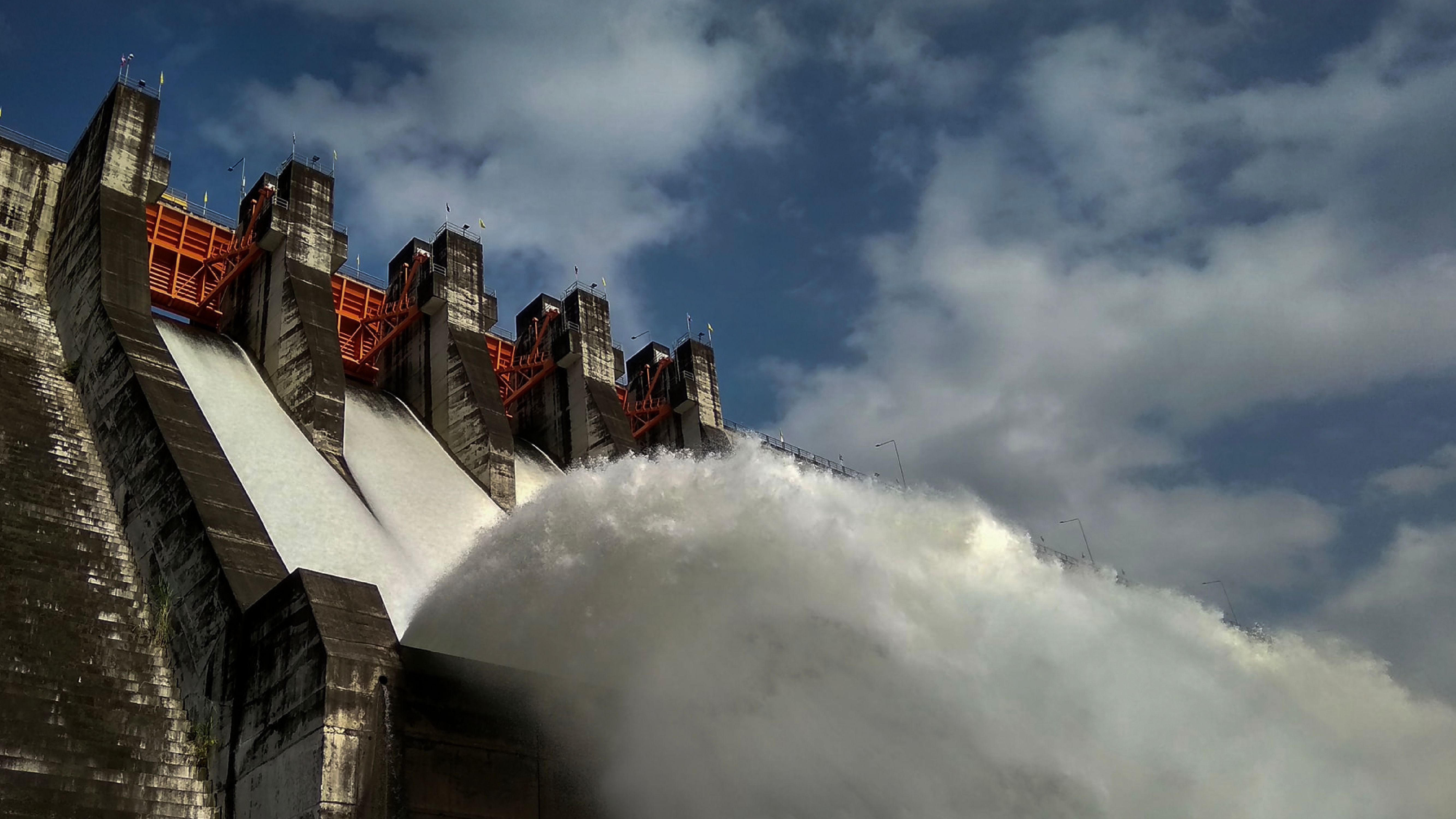
However, images circulating online of the rapid water release from Khun Dan Prakan Chon Dam in Nakhon Nayok Province, while normal in such situations, raise questions about whether the released water volume might exacerbate flooding during ongoing heavy rains. Meanwhile, many who have heard the phrase ‘dams solve flooding’ cannot help but wonder how effective dams truly are in solving flood problems.
With the flood crisis and water levels nearing dam capacity—and several dams urgently releasing water to avoid exceeding their structural limits—Thairath Plus invites readers to question the water management system, the existence of dams, and social fairness between those living upstream and downstream of dams. Ultimately, can ‘dams’ truly solve flooding, or are they merely ‘time bombs’ that only delay the problem?
From an engineering perspective, dams or reservoirs play an important role in ‘slowing’ water flow, reducing the intensity of currents, and extending the time for water to pass through main drainage systems. They also ‘cut peak flood flows’ by temporarily diverting excess water into storage areas to prevent a massive volume from flowing downstream all at once.
However, a key question about dams’ effectiveness in solving flooding lies in their storage capacity—how much water they can hold after rainfall. If a dam is already 70–80% full before heavy rains, the available space to accommodate new inflows is naturally reduced.
Therefore, the crucial challenge in flood management is not the dam itself but the involved parties’ situation assessment: on heavy rain days, how much more water can the dam hold, and how accurately can inflow volumes be predicted? Decision-making cycles include water management before heavy rain, during rainfall, inflow volumes, remaining storage space, decisions on water release, and the resulting impacts on downstream areas and residents.
For dams already at 90–100% capacity, withholding water without releasing it increases immense pressure on the dam structure, risking structural failure. Thus, the higher the water volume in a dam, the more urgently water must be released to protect structural integrity.
Here, ‘time bomb’ does not refer to cracks or damage in the dam but rather to the ‘accumulated risk from management and decision-making’.
During periods of abnormal heavy rain and large inflows, responsible authorities must manage dam water carefully. If they retain too much water, the capacity for upcoming rains diminishes immediately. Conversely, if water is released rapidly, downstream flooding is inevitable. Agencies like the Electricity Generating Authority of Thailand (EGAT) or the Royal Irrigation Department must constantly balance impacts on both upstream and downstream areas.
The problem and risk of the ‘time bomb’ thus extend beyond dam structure or potential disasters; they involve decisions that carry costs and consequences. Whichever path is chosen, some people will inevitably bear the impacts.
Upstream communities may sacrifice reservoir space, while downstream residents face risks from emergency water releases. Farmers need water stored for the dry season; urban and industrial zones require flood-free areas; the energy, water supply, and ecosystems all have differing needs. Water storage benefits some groups in certain situations, but water release transfers risks to other areas. Therefore, water management is truly a matter of public policy and social risk allocation.
For example, the critical situation in the Mae Klong River basin is explained by Assistant Professor Dr. Sitang Su Pilailar, Department of Water Resources Engineering, Faculty of Engineering, Kasetsart University. She notes that rain bands have fully moved into western regions, especially Kanchanaburi Province, directly impacting Vajiralongkorn Dam, which had previously minimized water releases to reduce downstream burden.
However, with continuous heavy rain above the dam causing large inflows, the reservoir can no longer store additional water and must increase water releases, expected to exceed 1,500 cubic meters per second and possibly rise to 1,800–2,000 cubic meters per second.
As a result, the entire Mae Klong basin—from Thong Pha Phum, Ban Pong, Photharam, Ratchaburi City to Samut Songkhram—has been elevated to an orange alert area. Riverside residents must urgently move belongings to higher ground. The risks once held back behind dikes have not disappeared but have been released simultaneously as the dam becomes overwhelmed.
Meanwhile, the Chao Phraya River basin faces similar pressure. Rain moving into the lower northern region, especially Uthai Thani Province, has filled Wang Rom Klao Dam to capacity, causing flash floods into the Sak Kran River that joins the Chao Phraya River before flowing into Chao Phraya Dam.
Dr. Sitang explains that Chao Phraya Dam is a regulating dam, not a large storage dam like Bhumibol Dam, so it cannot hold back water. When heavy rains accumulate in chains of provinces like Chainat, Singburi, Ang Thong, and Ayutthaya, the dam must closely manage water and be ready to raise maximum release rates up to 2,300 cubic meters per second as the upstream situation demands.
In the eastern region, continuous heavy rains with daily totals of 80–90 millimeters exceed normal urban drainage capacities designed for 60–70 millimeters per hour or no more than 120 millimeters per day. This causes severe flooding in Chanthaburi city and the Trat River basin, while Prasae Reservoir in Rayong Province exceeds 100% capacity, requiring urgent water release that immediately floods Klaeng District.
At the same time, Khun Dan Prakan Chon Dam in Nakhon Nayok Province, at 98% capacity, and Kaeng Krachan Dam in Phetchaburi Province, at 94%, require water release to maintain dam stability and safety, preventing structural disasters.
These dam situations illustrate that while dams store and slow water to reduce flooding impacts, during flood seasons when inflows exceed capacity, urgent water releases are necessary. Consequently, the entire downstream basin faces heightened flood warnings, and residents must rush to move belongings to higher ground to cope with overflowing waters.
Moreover, climate change is accelerating and worsening this situation. Traditional statistical calculations of rainfall, flood volumes, and historical data used to predict rainfall patterns are changing. How well can we continue to cope with future weather volatility?
Dr. Sitang disclosed that last year, government agencies predicted when to reduce reservoir water levels or gradually release water to create space for new inflows during the rainy season or heavy storms. However, this year, the government misjudged the El Niño phenomenon, expecting less rainfall than usual. This led to flawed watershed management and inaccurate reservoir inflow predictions, resulting in no preemptive water release to accommodate incoming water.
Conversely, clinging to the belief that ‘having dams means no floods’ may cause us to overlook other equally important water management dimensions—such as preserving natural resources and the environment, restoring upstream forests and wetlands to act as natural sponges that slow water flow.
These include restoring floodplain areas with fair compensation systems for farmers, regulating urban planning to prevent constructions, roads, or debris from blocking drainage, and developing more accurate and timely hydrological data and early warning systems to give people adequate time to prepare.
Ultimately, when we use ‘dams’ as tools to control and manage water, are we genuinely ‘controlling’ the water, or are we simply shifting the timing, location, and the people who must bear the water-related risks? More important than debating whether dams are good or bad is the effectiveness of government water management and public awareness of these issues.
Current events show that no matter how many dams we have or how high the budgets for their construction, if government agencies mismanage water, respond inappropriately, or fail to handle problems promptly, dams become mere ‘time bombs,’ storing water while counting down to a catastrophic release that worsens disasters and harms communities.
Dams have never been the sole solution for flood protection but only one piece of the water management system. If we continue to see dams as the primary tool without improving infrastructure, urban planning, government preparedness and response, clarifying laws and agencies’ roles, public awareness, and developing social systems to coexist with water,