

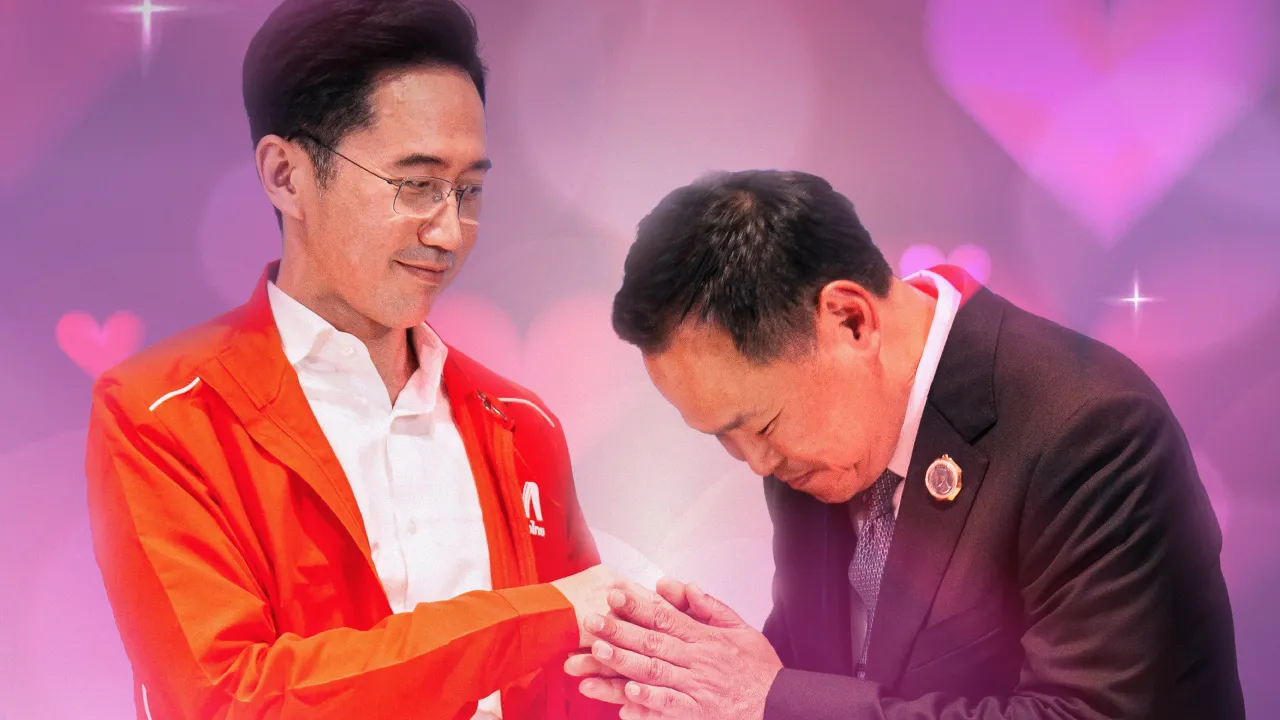
After the 2026 parliamentary election, social media feeds were not only filled with government formation formulas or seat count calculations. Equally viral was the image of Anutin Charnvirakul and Yotchanan Wongsawat shaking hands at a coalition press conference, edited to look like a series poster. Meanwhile, young people on TikTok randomly picked prime ministerial candidates' photos and enjoyed analyzing who was the “seme” and who was the “uke” in Thai politics.
The question is why politics in this era is increasingly interpreted through yaoi culture, ranging from fandoms within the same party to cross-faction pairings, becoming a colorful parallel trend alongside the heated political atmosphere.
Partly because Thailand is dubbed the “capital of yaoi series.” The success of BL and GL content has deeply ingrained the relationship grammar of seme (dominant) and uke (submissive) into popular culture, no longer confined to traditional gender frameworks. This mindset has become a daily lens, making it easy to read political power dynamics—who controls the game, who consents, and who negotiates.
The image of tough veteran politicians clashing with fiery young politicians naturally overlaps with novel plots. Political tensions are reinterpreted as familiar role relationships for the audience.
This phenomenon is not new. Some young people have shifted from being mere “supporters” to becoming “stans” of politicians. We often see light sticks at rallies, trending hashtags, and memes or graphics supporting favored politicians.
Politics thus becomes a space to build para-social relationships between politicians and followers, similar to the bond between artists and fans. Followers feel emotionally connected to representatives beyond ideological voting. Modern political communication teams recognize this dynamic, employing fan service tactics such as posting couple photos or responding casually to comments, as engagement can translate into real political power.
Clear examples include Thirathat Samretwanich and Jiraphorn Sindhupr who are supported by the “P’Im-Nong Nam” fanbase during field visits, sharing encouraging content for both individuals and parties. Jiraphorn acknowledged a younger follower base and welcomed increased youth interest in politics, believing it helps young people learn about politics while enjoying the process.
Similar examples exist abroad, such as the “Resi” fandom in the Netherlands combining Jesse Klaver, former GroenLinks party leader, and Rob Jetten, the country's youngest prime ministerial candidate. Although both deny a personal relationship, moments in parliament and TV shows have been edited into clips with millions of views. Some fans say such edits increase youth engagement with politics.
Relationship psychologists explain that in stressful political contexts, people feel warmth seeing those in power show gentleness toward each other. These images humanize politics, temporarily softening the rigidity of power structures.
In recent years, Thai society has faced economic uncertainty and prolonged conflicts. Consuming straightforward political news can cause burnout unknowingly. Recasting prime ministerial candidates in gentler roles acts as a filter, making newsfeeds easier to digest.
Assigning politicians as seme or uke is thus a process that turns politics into accessible pop culture. Shipping does not imply trivializing politics but can be an emotional motivator that keeps people engaged without being overwhelmed by disappointment or conflict. Softer images make politicians seem more human than mere positions or power structures.
However, some “Resi” fandom members caution that enjoyment should not overshadow facts or truths about personal lives and public duties. Shipping should be based on respect and not reduce scrutiny of policies or performance. Ultimately, shipping can be a joyful way to follow and stay involved in politics without losing sight of reality.
. . .Sanook,Business Insider
#ThairathPlus #ThairathPlus #Election69 #Election2026 #AnotherElection