

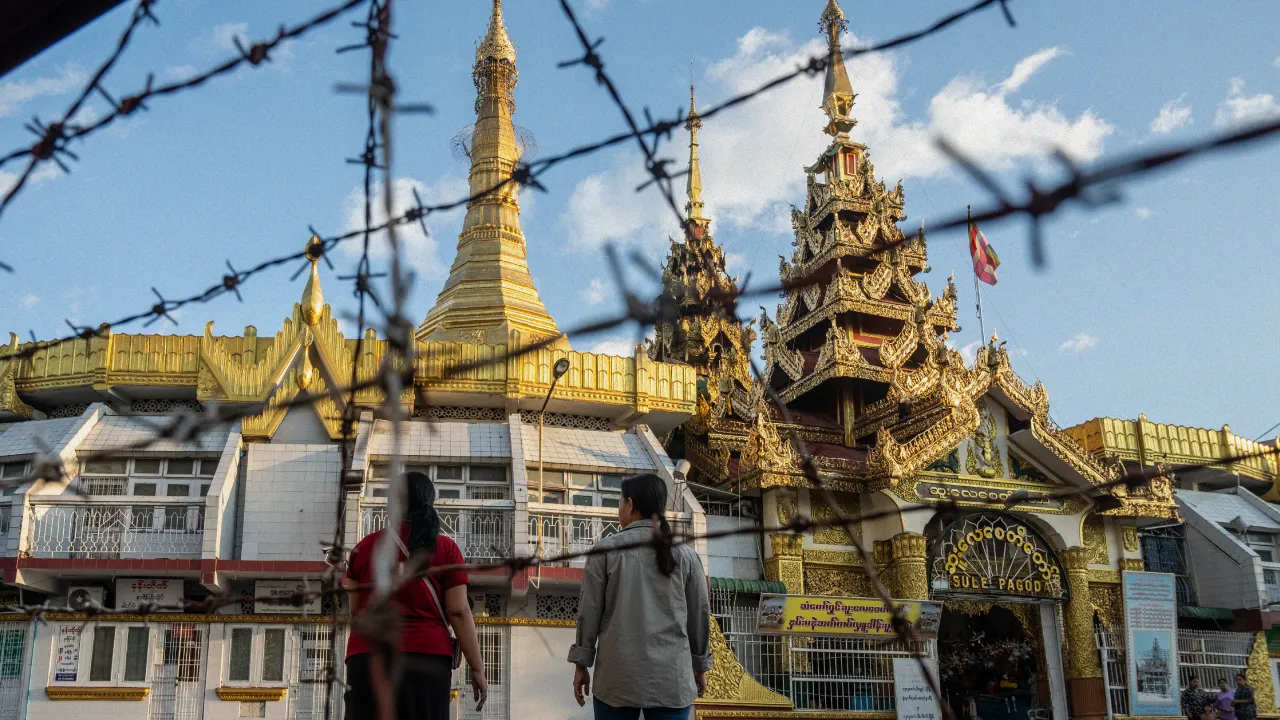
Thailand urgently needs to revise its strategy toward Myanmar because the results of the three-phase elections held last December and January merely demonstrated efforts to legitimize the Tatmadaw's consolidation of power without signaling any prospects for lasting peace or national reconciliation. This means that Myanmar's civil war will continue, and Thailand, sharing a border exceeding 2,400 kilometers with Myanmar, will inevitably continue to face its repercussions.
The elections on 28 December, 11 January, and 25 January were incomplete, with voting conducted in only 263 out of 330 constituencies nationwide. Voter turnout was relatively low, at 13.14 million people or 54% of all eligible voters—a figure that is itself questionable due to an incomplete census from the outset.
Since major parties like the National League for Democracy were disqualified from participating, this allowed the Union Solidarity and Development Party (USDP)—the political facade of Myanmar’s military junta (Tatmadaw)—to secure 739 out of 1,025 legislative seats at all levels nationwide. At the national level, USDP won 232 of 263 seats in the lower house (House of Representatives) and 109 of 157 in the upper house (Senate). When combined with the military's constitutional quota of 25% (166 seats), the military faction controls a total of 538 seats across both houses, more than enough to form a decisive government majority.
Yet, this was not enough to fully assure Min Aung Hlaing, Myanmar’s supreme leader, of his power. Consequently, he established the Union Consultative Council to oversee both the elected government and the military, over which he already holds full authority as Commander-in-Chief. Analysts speculate this extra-constitutional governing body may prepare for his eventual retreat from power to a safe and secure behind-the-scenes position.
The Assistance Association for Political Prisoners in Myanmar reports that since Min Aung Hlaing's coup in February 2021, at least 7,842 deaths have been documented, with an additional estimated 4,000 unconfirmed casualties. The junta has arrested over 30,000 anti-coup protesters and regime opponents; while several thousand have been released, more than 22,000 remain detained, including over 11,000 who have been formally convicted.
Violence continues nationwide, especially in the Sagaing region, a stronghold of the opposition People's Defense Force (PDF)—the armed wing of the National Unity Government (NUG)—and in Rakhine State, where the Arakan Army (AA) has liberated significant territory, prompting the Myanmar military to launch heavy operations to retake control. The latest airstrikes in Rakhine in late February resulted in 17 civilian deaths and 14 injuries.
The ongoing conflict and repression have displaced over 3.5 million Myanmar citizens of various ethnicities, forcing them to flee their homes. Many have crossed borders into Bangladesh, India, Malaysia, and Thailand, constituting a major humanitarian crisis in Southeast Asia.
The five-year-long civil war and instability in Myanmar have had multifaceted impacts on Thailand, Myanmar's immediate neighbor, as follows.
Regarding security, threats stemming from Myanmar include both traditional (conventional) and non-traditional forms. Conventional threats involve deliberate cross-border incursions, such as military operations aiming to encircle territories under Thai sovereignty or disputed border areas, since many sections of the Thai-Myanmar border remain un-demarcated. Additionally, armed ethnic groups like the United Wa State Army (UWSA) have also expanded into Thai territory. There are also risks of stray bullets or unexploded ordnance unintentionally landing in Thai areas, causing damage to civilians and refugees alike.
Newer security threats affecting Thailand from Myanmar come in various forms. These include longstanding issues like drug trafficking and small arms trade, as well as the recent global problem of online scams, which exploit Myanmar’s instability, weak law enforcement, and the need to fund armed groups. This has fostered widespread illicit businesses, including human trafficking networks that lure many—including Thai nationals—to work near the Thai border, creating international problems affecting even distant countries like the U.S. and Europe, in addition to China, which has both perpetrators and victims in these illicit hubs.
Another emerging security concern is transboundary environmental pollution, including seasonal PM 2.5 haze from forest and agricultural burning. More critically, for the past two to three years, heavy metal contamination from gold and rare earth mining in Shan State has polluted several rivers flowing into northern Thailand, such as the Kok, Ruak, and Sai Rivers, adversely affecting the health of populations relying on these waters for consumption and agriculture. Past Thai governments have struggled to address these sources due to their location within territories controlled by Wa ethnic armed groups, beyond the reach of Myanmar’s military government.
In terms of trade and economic issues, ongoing fighting has severely disrupted cross-border commerce between Thailand and Myanmar. Trade routes have been blocked or severed, and various armed groups impose protection fees and tolls on trucks passing through their territories. The Myanmar military government has also ordered border closures—most notably the Mae Sot–Myawaddy crossing, shut for months to cut off support to opposition forces—posing significant obstacles and increasing costs for border traders.
Similarly, Myanmar’s political turmoil over five years has paralyzed its economy. The military government’s unconventional economic policies, such as mandating importers to export goods of equal value, have burdened traders since Myanmar lacks sufficient export products due to ongoing conflict. Additionally, Myanmar’s foreign exchange system is problematic: the official central bank rate is about 2,100 kyat per US dollar, whereas the market rate is above 3,600 kyat per dollar. The junta forces traders and investors to convert hard currency at the official rate, creating obstacles to trade and investment despite some negotiated flexibility to blend official and market rates.
Regarding the humanitarian crisis, Thailand has hosted Myanmar refugees since 1988 in nine camps across four border provinces—Mae Hong Son, Tak, Kanchanaburi, and Ratchaburi—totaling 77,000 people. Additionally, thousands of refugees fleeing fighting enter temporarily under Thai government protection before being pushed out. Beyond refugees, there are an estimated five million irregular Myanmar migrants in Thailand seeking better opportunities. Regardless of their legal status or reasons for migration, these individuals require adequate living conditions, food, shelter, clothing, healthcare, and appropriate education, especially for youth.
Moreover, Thailand and the international community must provide assistance to millions displaced by Myanmar’s internal war. Past aid efforts often failed to reach those in need due to poor cooperation from Myanmar’s military government, dangerous conflict zones, and ineffective distribution mechanisms. Funding constraints have worsened since U.S. President Donald Trump’s administration cut refugee aid, leaving Thailand and humanitarian organizations severely under-resourced.
Over the past five years, Thailand’s response to Myanmar’s crisis has been unsystematic and inefficient. Political instability within Thailand has led to frequent changes in government leadership, with most administrations lacking clear, strategic policies toward Myanmar. Consequently, responsibility has fallen to separate agencies working in isolation, largely reacting defensively to problems rather than proactively addressing root causes.
The new Thai government expected to be led by the Bhumjaithai Party must systematically and proactively revise its Myanmar strategy. It must acknowledge that Myanmar’s civil war will persist, posing long-term structural risks to Thailand’s security, economy, and social stability. Traditional foreign and security policies have proven ineffective, necessitating a shift from reactive short-term responses to comprehensive long-term risk management across multiple dimensions.
First, Thailand should establish a national mechanism to integrate strategies and policies toward Myanmar by creating a coordination center encompassing security, humanitarian, and economic sectors. This would reduce bureaucratic fragmentation and include not only responsible agencies but also private sector, academics, and experts, ensuring actions are based on up-to-date information and knowledge amid rapidly changing circumstances.
Second, border management must be upgraded to address diverse and dynamic threats, incorporating modern technologies alongside cooperation with neighboring countries and ASEAN. This will enhance Thailand’s capacity to counter emerging challenges such as transnational crime, drug trafficking, and the expanding online scam networks fueled by Myanmar’s instability.
Third, Thailand should develop a flexible humanitarian policy with shared international responsibility to accommodate refugees and migrant workers with dignity and alleviate pressure on border communities. Thailand should reconceptualize refugees from conflict and economic migrants as valuable human resources—primarily working-age individuals—contributing to Thailand’s economic development rather than as burdens. They deserve permission to work, adequate living conditions, health care, and education to enhance skills and intellect for productive economic participation benefiting both themselves and Thailand.
Finally, the government should pursue proactive diplomacy with all Myanmar stakeholders across multiple dimensions, moving beyond traditional state-to-state relations. Thailand’s new strategy must balance economic and security interests with a constructive regional role. Without swift strategic adjustments, instability in Myanmar will increasingly erode Thailand’s long-term stability.