

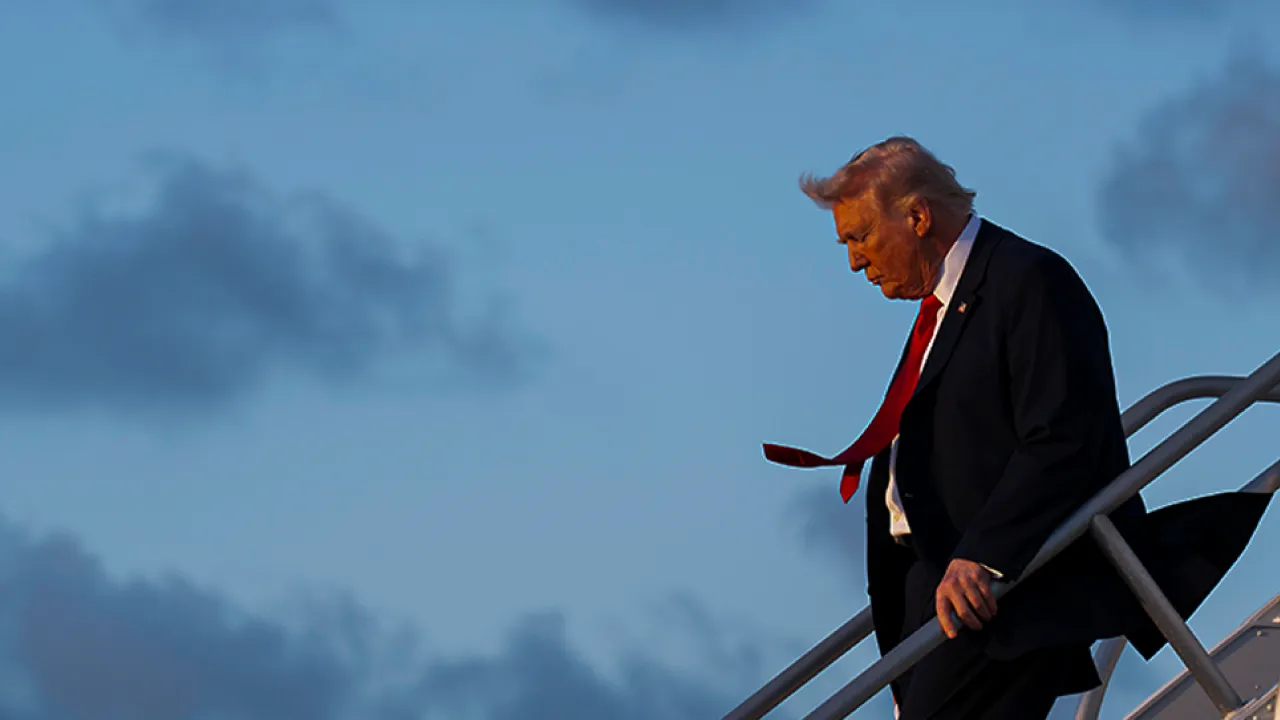
Since Donald Trump returned to the White House for a second term, he has sought to cultivate an image as a “President for Peace,” establishing the Board of Peace (BoP) to rally international support with the aim of reorganizing the world order to replace the United Nations, led by the United States.
However, by March 2026, the U.S. teamed up with Israel to launch a full-scale regime change war against Iran, marking the largest military intervention by the U.S. in a different region in nearly two decades since the Iraq and Libya eras. Analysts question whether the U.S.'s claimed threat of an Iranian attack on Israel is genuine.
This action has not only been criticized as the U.S. leader facing the illusion that Iran would fall as easily as Venezuela did, but it has also shaken the foundation of the Board of Peace to the point that its role may end before it has seriously begun.
A significant phenomenon from this Middle Eastern armed conflict is the expansion of attacks from military or political targets to infrastructure that affects civilians.
Iran has continuously attacked neighboring countries in the Arabian Gulf, citing defense against threats from U.S. bases used to attack Iran, disrupting commercial airports and flight routes for weeks.
Al Jazeera reports that the U.S. and Israel’s decision to initially target oil reserves on the ninth day of the war is not merely an economic weakening tactic but a psychological war designed to instill fear among civilians.
The hidden objective is to pressure Iranians into believing this could be the end, hoping to spark an uprising to overthrow the Islamic Republic regime that has governed for 47 years, in line with U.S. and Israeli goals.
Furthermore, Trump has signaled to the prospective new Supreme Leader of Iran, clearly expressing the U.S. intention to be involved in selecting the leader, which some Iranians perceive as sovereignty interference, further fueling the conflict’s intractability.
Some question why the U.S. strategy this time might lead to a prolonged war rather than a swift leadership overthrow like in South America.
The Guardian notes that the U.S. is emboldened by its overnight success in Venezuela, where it detained Nicolás Maduro and collaborated with Delcy Rodríguez as a new leader Washington views as controllable and aligned with U.S. interests, especially regarding oil production and economic policies, despite her public anti-intervention rhetoric. Trump hopes to replicate this model in Iran.
However, the foundations of these two nations differ significantly. The foremost is Iran’s “anti-Western ideology,” rooted deeply since the 1979 Islamic Revolution, driven by resentment against foreign intervention.
This anti-Western ideology is deeply ingrained, as Ayatollah Ruhollah Khomeini branded the U.S. as the Great Satan. Slogans and murals opposing American imperialism remain prominent throughout Tehran.
Secondly, Iran’s “military structure” means real power does not rest solely with one individual like the president, Masoumeh Pessehsakian, but with the Islamic Revolutionary Guard Corps (IRGC), which has deep networks and military capabilities ready to respond.
Neysan Rafati, a senior Iran analyst at the International Crisis Group, notes that Washington’s preferred outcome is to create change within continuity in Iran by finding allies within the regime willing to accept U.S.-approved conditions, aligning with Trump’s desire to participate in approving Iran’s new leader.
This has led some online critics to accuse Trump, the initiator of the Board of Peace, of contradicting its purpose by using military force to intervene in the Middle East. Recently, Indonesia, once an enthusiastic member cooperating with the U.S., immediately suspended activities with the Board of Peace due to pressure from Muslim populations supporting Palestine and skepticism toward Trump’s initiative from the start.
This situation has led many analysts to disregard the Board of Peace’s potential outcomes, as a peace mechanism loses significance when its founding nation becomes a primary combatant in the war.
Ultimately, the use of psychological warfare and the Venezuelan model in Iran may prove a strategic miscalculation by the U.S., underestimating the Middle Eastern context.
Instead of being remembered as the creator of the Board of Peace that set new norms in the international order, Trump may be writing a new chapter as the leader who dragged the U.S. back into prolonged Middle Eastern conflict, challenging the peace mechanism he personally established from the outset.
ReferencesAl Jazeera,The Guardian,The Guardian
#ThairathPlus #ThairathPlus #Iran #War #Trump #Israel #MiddleEast #Oil #OilPrices