

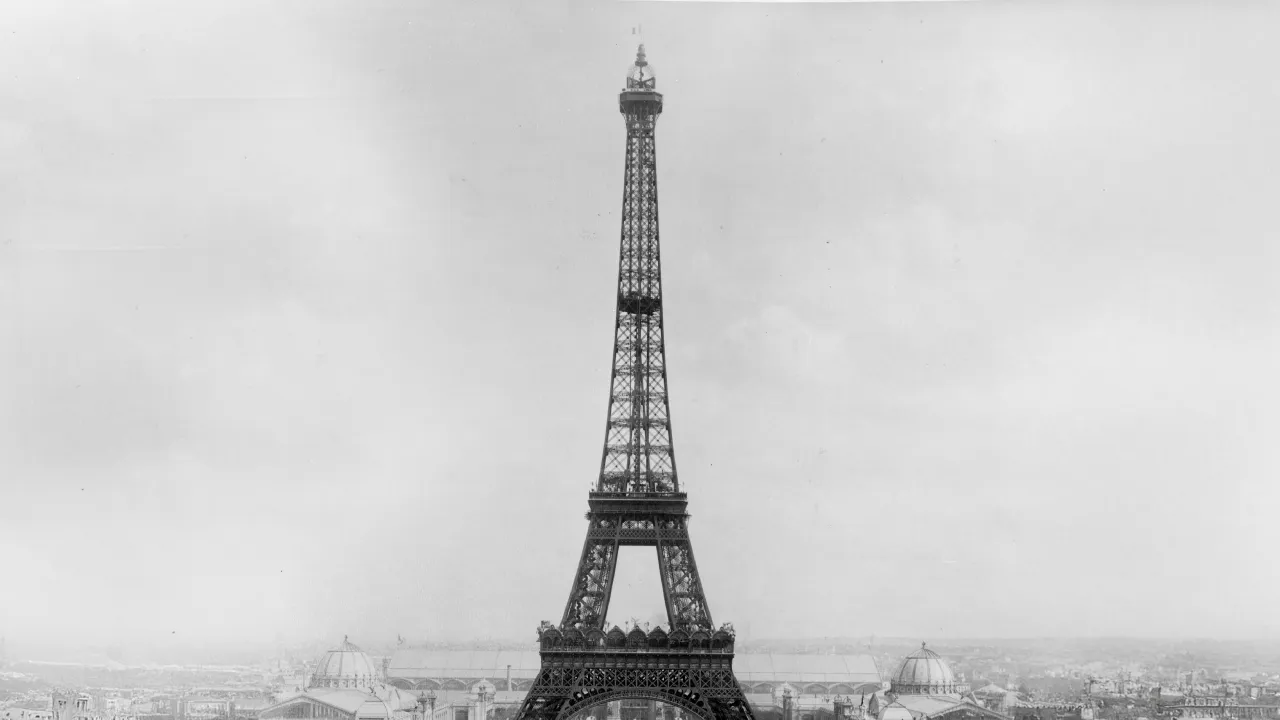
“Like an unfinished factory pipe, a remnant awaiting stone or brick cladding, resembling a bone and a perforated rod,” French writer Joris-Karl Huysmans described his first impression upon seeing the Eiffel Tower.
“Like a sad street lamp post,” French poet Leon Bloy added his voice expressing dissatisfaction with the towering iron structure.
These opinions were not exaggerated, as in the 19th century, French aesthetics were still rooted in the Belle Époque, seeking new forms of beauty. Suddenly, a plain iron tower appeared, lacking traditional French beauty, designed by bridge engineers Maurice Koechlin and Émile Nouguier.
Given this, why did a tower so widely disliked end up in the heart of the Champ de Mars park?
In the Western civilization entering the Industrial Age, factories and machinery were highly praised. Tall buildings were difficult due to the lack of advanced structural technology to withstand weather. Thus, the concept of a steel tower over 300 meters tall was a great challenge, perfectly suited for the 1889 World’s Fair to demonstrate France’s steel construction capabilities.
This World’s Fair celebrated the 100th anniversary of the French Revolution and showcased industrial achievements. Inventors, engineers, and scientists displayed their creations. Lasting about six months (5 May - 31 Oct), it drew 32 million visitors from across the continent to see 60,000 exhibitors from France and abroad. Among ten major attractions was the Eiffel Tower, completed on 31 March 1889 and named after Gustave Eiffel, head of the company responsible for the project. Eiffel then purchased the design patents to fully own the rights.
Originally intended as a temporary structure to be dismantled in 1909 (20 years after the Fair), Gustave Eiffel, feeling attached after completion, sought to prove the tower’s future usefulness to Paris. Later, the Eiffel Tower became a structure housing signal masts for scientific studies in physics and meteorites, served as an effective radio antenna, and helped intercept German radio transmissions during World War II.
After years of criticism, people gradually became attached and accustomed to the iron tower, which transformed into an important landmark and a symbol inseparable from the identity of Paris and France.
References: