

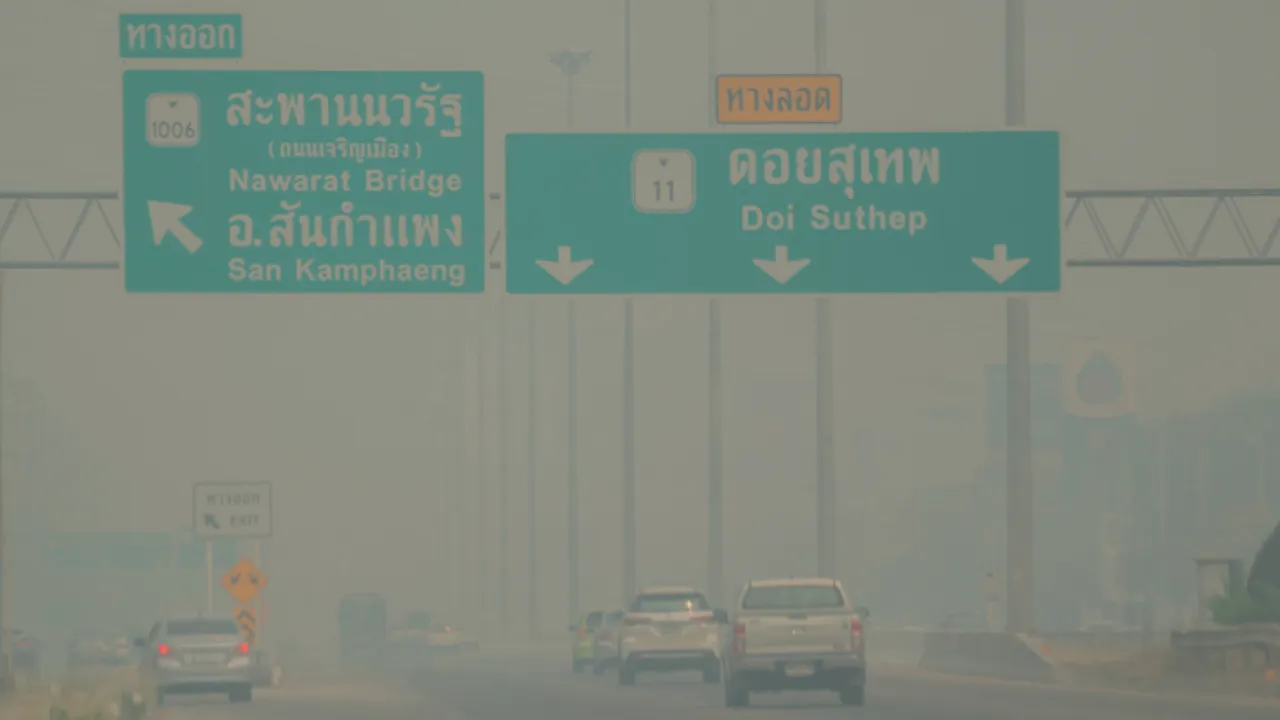
The particulate matter crisis has become a defining image of Northern Thailand’s upper region from February to April. Once a bustling tourist city full of life, it is now covered every year by a toxic smoke veil, turning it into a quiet, deserted city.
The PM2.5 situation affects not only health or declining hotel bookings but also impacts "the loss of economic opportunities" from capable groups ready to flee the dust and "forced evolution" of many local residents who have no choice.
It is well known that Chiang Mai is a city with charm attracting digital nomads, young entrepreneurs, and travelers worldwide, thanks to its nature, accommodations, shops, pubs, leading hospitals, and international schools for families seeking to settle down, allowing a western lifestyle blended with Lanna culture in many city areas.
Joanna, a blogger from The Blond Travels page who has lived and worked in Chiang Mai for nearly 10 years, said, "The air here is very good almost all year except March to May. The smoke is so thick you can barely see the sunlight. If you have respiratory issues, you should move away during that period. Large-scale forest and agricultural burning destroys air quality and pushes temperatures so high it becomes nearly unbearable."
Similarly, some YouTube bloggers have titled their content, "Poor air quality makes Chiang Mai the worst place to live for foreigners."
These experiences align with academic work published in the International Journal of Environmental Research and Public Health (IJERPH) in 2022, which clearly states that dissatisfaction with air quality directly influences migration, especially among young people who tend to move more than other groups.
Moreover, stress from the toxic environment accelerates decisions to leave the area. Recent research from the Journal of World Business in 2026 also indicates that local air pollution significantly reduces multinational enterprises’ deployment of skilled workers to these regions.
The unseen cost of this phenomenon is not just lost tourism revenue but potentially the destruction of the creative economy’s foundation due to the loss of talented human resources and diminished long-term competitiveness.
Furthermore, in an era when many young people seek to disperse from Bangkok and its metropolitan area to escape recurrent floods or pursue better quality of life outside the capital, persistent dust pollution may cause some to exclude Chiang Mai from their future list of livable cities.
From those with resources to move, to local people without the right to choose.
We see northern provinces permanently transforming urban development. Houses, public buildings, daycare centers, and many schools now include "clean rooms" as part of their infrastructure.
Chiang Mai University’s Faculty of Architecture has initiated a pilot project converting operational buildings into clean room prototypes to reduce heat and PM2.5 so students can learn year-round.
Modern architecture in the north must abandon the idea of solely natural ventilation and instead focus on calculating wind directions, dustproof insulation, and even installing green walls to filter the air.
Certainly, the painful impact falls on the "dust generation" children who grow up deprived of summer vacation enjoyment, confined to playing in enclosed rooms alongside air purifiers.
The same IJERPH research highlights that urban air pollution harms children’s cognitive development and academic performance, impairs adults’ cognitive function, and increases the risk of dementia in the elderly. It also reduces work efficiency among laborers and office workers alike.
From a mental health perspective, exposure to toxic dust is linked to psychological stress, depression, and higher suicide rates.
What is frightening is that even when dust levels are not critically toxic, the mere perception and awareness of pollution are enough to cause annoyance and illness.
The smog crisis in northern Thailand reflects real-world inequality, where clean air is no longer a basic right but a luxury good with costs that filter residents from livable cities.
If the government and stakeholders cannot integrate solutions addressing the root causes at both national and cross-border levels, many provinces currently engulfed in dust may become cities inhabited only by elderly and low-income residents who lack the resources to relocate, trapped among buildings sealed off from dust every first quarter of the year.
We still hope to see Chiang Mai and many provinces in Thailand return to being cities livable for everyone, embracing all lives with the right to access pure air, breathe deeply, and sustain hope.
#ThairathPlus #Thairath #Dust #Wildfire #PM25Dust #ToxicDust #CleanAir #ChiangMai