

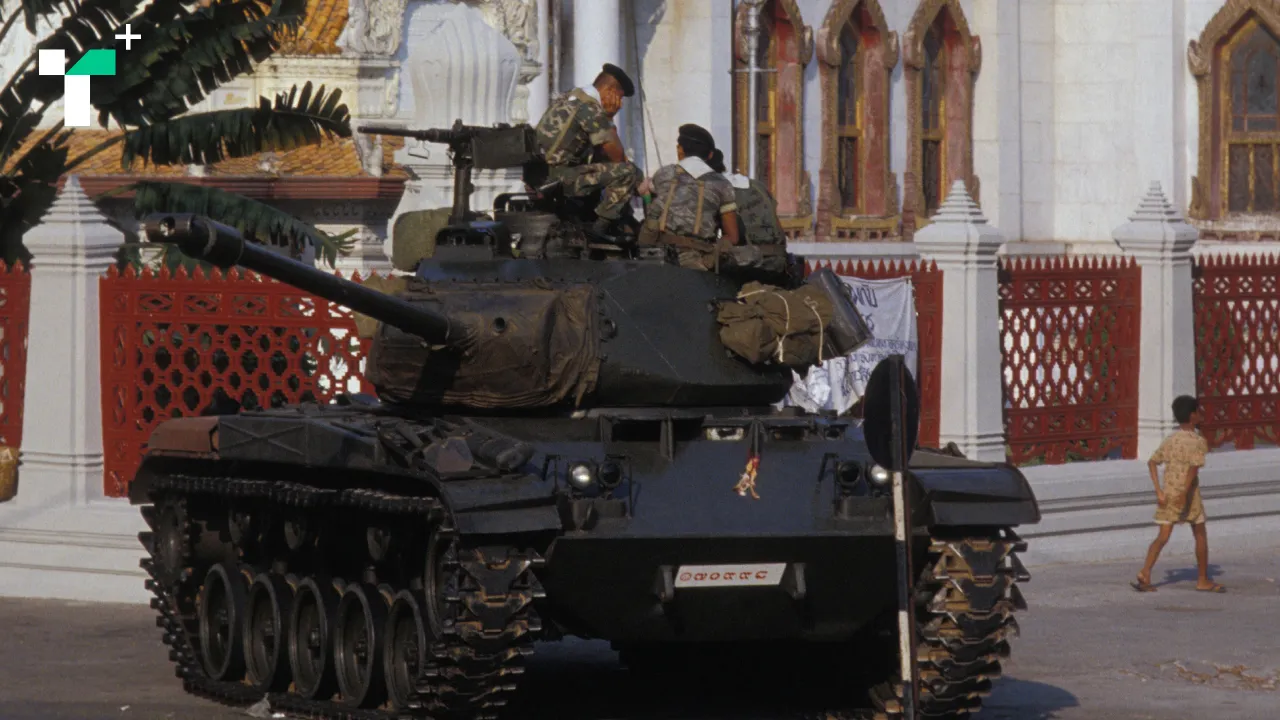
When discussing the key factors behind a successful coup, weapons like guns, tanks, and large numbers of troops typically come to mind. However, in Thailand, this equation does not always hold true. In our contemporary political history, there is one event that completely shattered this belief and changed the perception of the Thai state's power structure to what we understand today.
Looking back to the dawn of 1 April 1981, a group of officers known as the 'Young Turks' mobilized 42 battalions—the largest military force ever used in a Thai coup. They deployed tanks to seize strategic points in Bangkok decisively. At first glance, this appeared to be a perfect coup.
Yet this powerful force was utterly defeated in less than three days.
In mainstream history, the origin of this story stems from internal conflict within the Young Turks military faction (Chulachomklao Royal Military Academy Class 7), who had previously helped General Prem Tinsulanonda become prime minister. Over time, disagreements arose over the extension of General Prem's military service and governance policies, leading this group to decide to stage a coup against him.
Thus, in the early hours of 1 April, the rebels attacked the Si Sao Thewet residence. While exact details remain unclear, media reports indicate they attempted to pressure General Prem to resign and become the head of the coup against himself.
However, General Prem refused to surrender. He established his position at Suranaree Camp in Nakhon Ratchasima and brought King Rama IX and members of the royal family there. He then set up a command center to counter the coup, receiving support from Major General Arthit Kamlang-ek, then deputy commander of the Second Army Region.
Additionally, General Chavalit Yongchaiyudh, a close associate of General Prem at the time, recorded that that night he had police awaken a printing shop in the Nakhon Ratchasima market to urgently produce a large number of leaflets, which were then flown over Bangkok the following day.
The leaflets stated that the rebels lacked loyalty and had caused the royal institution to leave the capital. General Chavalit noted that both the Young Turks controlling the forces and the coup's leadership were demoralized and became the defenders rather than the aggressors.
Moreover, Queen Sirikit issued a royal message at that time expressing trust in General Prem and calling on all military factions to unite for the country's peace.
On 3 April, General Chavalit led just six battalions of government troops by C-130 plane to Don Mueang Airport. When they confronted the vastly superior rebel forces, the rebels surrendered without any fighting, marking the coup's failure.
Modern historians’ interpretation
Amid the Young Turks' defeat, modern historians argue that the reason lies in Thailand's political structure, which is not sustained solely by military force but supported by 'hegemony'.
Professor Dr. Kesiara Tejapira defines this as domination by consent—not through coercion but through legitimacy and cultural acceptance, leading society to willingly obey and comply.
Therefore, this event is a crucial milestone revealing Thailand's political structure clearly: coups cannot succeed without consensus and legitimacy tied to the nation's highest institution.
The April Hawaii Rebellion can be seen as paving the way for a new power order. Historian Asa Khampha notes that the upheaval acted as a catalyst, dramatically strengthening the 'network monarchy' power structure.
To simplify, the 'network monarchy' resembles a large political ecosystem centered on legitimacy from the highest institution, surrounded by networks including the military, senior bureaucrats, business elites, and social elites who depend on one another. The military and bureaucracy protect and govern for the center, while receiving legitimacy from it to sustain their own power.
Why 'April Hawaii'?
Because the defeat ended quickly and coincided with 1 April—April Fool’s Day—journalists at the time humorously nicknamed the coup the 'April Hawaii Rebellion,' likening its easy conclusion to people casually wearing Hawaiian shirts in summer rather than a bloody power grab.
Ultimately, looking back on the Young Turks’ defeat underscores the unique and fascinating nature of Thai politics.