

The recent social media trend #BanHongsawadi has sparked questions about adapting historical figures—especially elite or royal rulers from ancient kingdoms in Thailand and neighboring countries—into fan fiction or ships in contemporary culture.
In liberal democracies, this is viewed as a form of creative imagination and expression. However, in the Thai context, it raises concerns about distorting mainstream history or, more seriously, violating Section 112 of the Criminal Code.
If we step back and look at Western history, there's an ironic fact: shipping heads of state was not merely fan fiction but a political strategy that truly changed the course of wars.
Back in the 19th century, there were two powerful emperors in Europe: Napoleon Bonaparte of France and Tsar Alexander I of Russia.
On 25 June 1807, French and Russian armies faced off on opposite sides of the Neman River in the city of Tilsit, marking the border between the spheres of influence of the two empires.
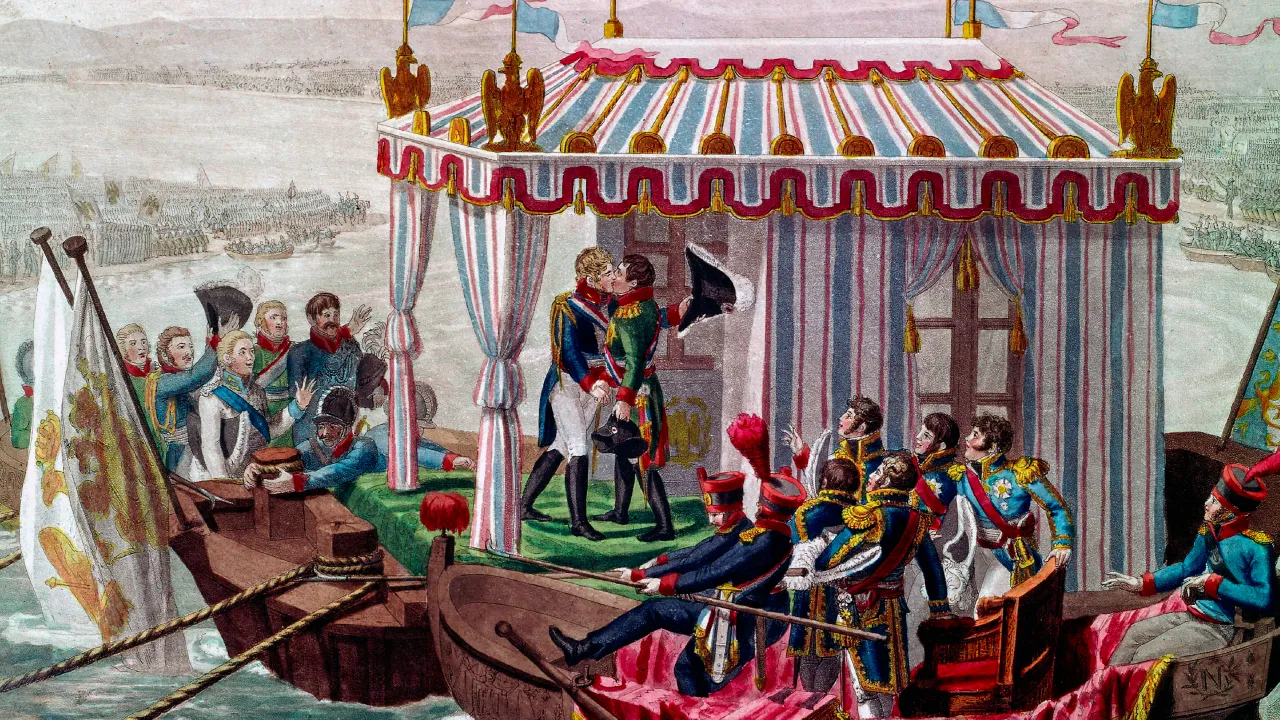
At that time, Napoleon had just decisively defeated the Russian army at the Battle of Friedland during the Fourth Coalition War, forcing Alexander to negotiate peace. The two emperors met on a floating raft in the river.
As the Russian Tsar stepped onto the raft to greet the French emperor, Alexander immediately said, "Sire, I hate the English as much as you do." Napoleon replied with satisfaction, "Then peace shall prevail."
The two powerful men bonded instantly. Several historical paintings depict them kissing. At that time, such displays were not unusual but symbolized respect and close friendship between two monarchs.
Napoleon was captivated by the youthful charm of the Russian Tsar, even writing to his wife Josephine, "If Tsar Alexander were a woman, I would take him as a concubine."
Napoleon saw Alexander as a naive younger brother and used this personal infatuation as leverage to pressure Russia into joining the Continental System, an economic blockade against England that severely damaged Russian merchants and landowners. This enabled Napoleon to consolidate power and reorganize Europe.
However, this political saga had a twist: in the end, Tsar Alexander was the one who deceived Napoleon.
The Russian emperor played the role of loyal friend, accepting disadvantageous terms and enduring domestic unpopularity, with citizens accusing him of wasting Russian lives. But in truth, he was buying time to reform and rebuild his army.
When they met again in 1808, Alexander began to distance himself, and when war resumed in 1809, Russia did not send troops to support Napoleon as promised.
Some argue that Alexander may have genuinely been enamored with Napoleon at first, but the Russian elite opposed the treaty and pressured the Tsar to withdraw later.
The Napolexander relationship reflects how romance was another piece in the global political power game.
Returning to the present, why do younger generations enjoy shipping historical figures?
One reason might be a desire to explore complex interpersonal dynamics in history, creating content for entertainment and imagining new possibilities.
This helps dismantle the hardened war hero narratives built on patriarchy and remoteness, transforming them into ordinary humans with emotions, love, flaws, and vulnerabilities.
This can be seen as similar to historical films or period dramas that adapt characters and settings to make stories more engaging emotionally.
Some netizens question more deeply: Did ancient elites ever include sexual diversity? If so, why do chronicles never give space or representation to those identities?
Is the absence of LGBTQ+ in ancient kingdoms because they never existed, or because such identities were erased or hidden in the nation-building process that sought sacred, perfect power?
Through this lens, modern fan fiction uses imagination to reinterpret stories excluded from mainstream narratives.
Comparing Thailand with the West, mocking, reinterpreting, or shipping leaders is widely accepted as freedom in the West. But in this region, elite histories are tightly linked to state security and moral issues, making alternative portrayals risky and seen as challenges to state authority.
All this leads us to consider that a history allowing people to question and imagine may be a living history that evolves with the times, especially as young people increasingly seek to study the past.
. ReferencesBritannica,Napoleon Series,The Collector
#ThairathPlus #Thairath #Napolexander #Repeal112