

Although Matrilocality involves the groom moving into the bride's family home, it does not necessarily mean that women always hold governing power. Often, men—such as the husband, elder brothers, or maternal uncles—continue to play significant roles in household decisions, differing from Matriarchy, where women hold the highest decision-making authority across family, community, and political spheres.Matriarchyis a social system granting women supreme authority in decision-making at family, community, and even political and administrative levels.
Given the historically arid geography of Northeast Thailand, and in some areas still today, people have relied heavily on seasonal rains. From past to present, agriculture—rice farming, crop cultivation—has been the main livelihood, with great emphasis placed on labor and land.
The requirement for the husband to move into the wife's household is a strategy to preserve the woman's family's power base and resources, especially for the youngest daughter, or 'luk sao la,' who typically inherits the family's last house and land.
This is based on the belief that the eldest daughter marries first and moves out with her husband, potentially limiting her ability to care for aging parents. The responsibility to look after parents thus falls to the youngest daughter. The son-in-law's move into the household adds a primary labor force to support the household economy and ensures the woman is not abandoned after marriage.
'Kin Dong' is the traditional wedding custom of Northeast Thailand, involving a celebratory feast marking the marriage and the forging of kinship ties between two families. Here, 'dong' signifies the bonded relationship between relatives. 'Kha Nam Nom' is part of the bride price, symbolizing the groom's gratitude to the bride's mother for entrusting her daughter to build a new family with him. Thus, Kin Dong represents both a social contract and an economic pledge whereby the groom must prove himself worthy of joining the bride's family.
The 'foot-washing ceremony' before entering the bride's house occurs in some Northeastern areas. Traditionally, the 'house' is sacred, surrounded by the bride's ancestral spirits. For an outsider to cross this threshold and live there, he must undergo foot washing by the bride's siblings, symbolizing respect, welcome, and purification of impurities before becoming a new family member. Since feet contact the earth and dirt, they must be cleansed to maintain the sanctity of the bride's household.
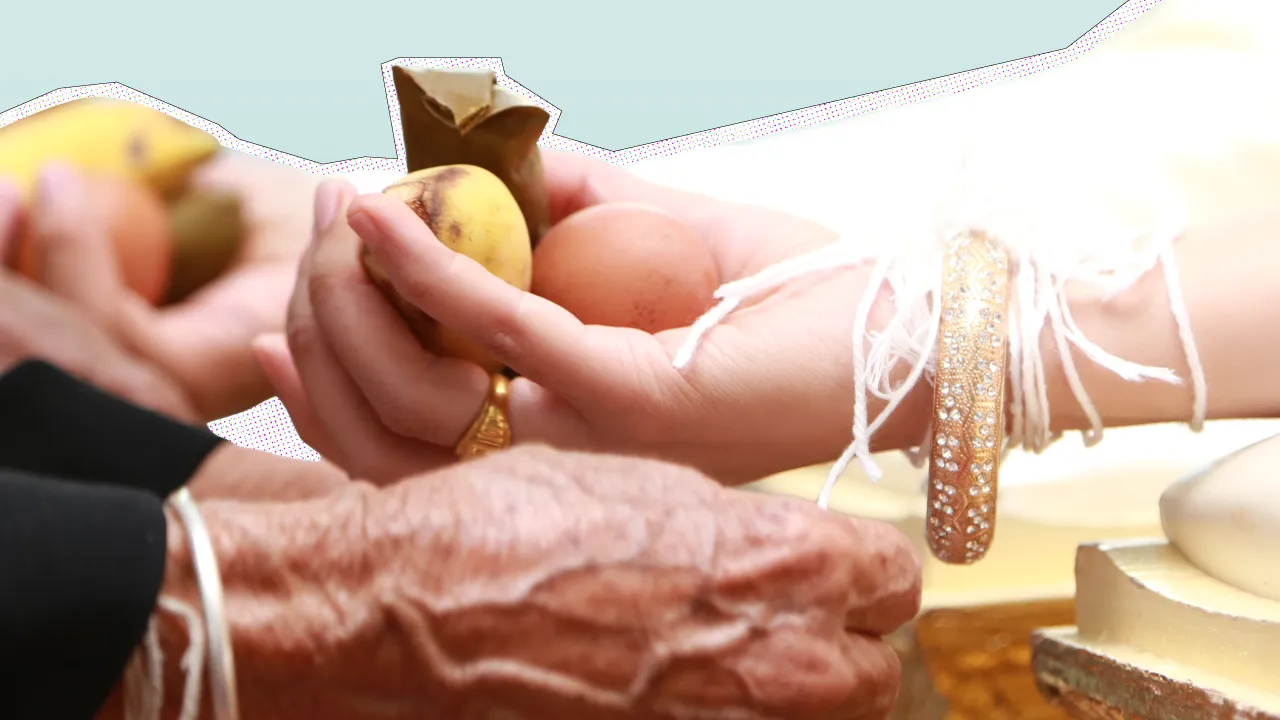
The heart of a Northeastern wedding is the Bai Sri Su Kwan ceremony, a sacred folk ritual rich in symbolism reflecting beliefs about the soul and spirit. The Bai Sri tray, carefully arranged in a tall conical shape, represents Mount Meru, the cosmic center in ancient belief systems, calling the spirit and blessing the couple for happiness, prosperity, and auspiciousness before starting their married life.
Also included is the arm-tying with cotton threads, symbolizing spiritual bonds that secure the soul to the body. When senior relatives tie the groom's arm, it conveys tangible blessings and marks the groom's official acceptance as a new family member, witnessed by villagers and supernatural powers alike.
Another sacred ritual in Northeastern weddings is 'Somma'—a ceremony of apology and informing the spirits—representing an agreement with supernatural forces. If the groom is to join the bride's family, he must apologize to the bride's ancestral spirits to request permission to become part of the family. Violating these customs is considered 'breaking the spirits' and gravely affects the household's happiness. This respect for ancestors regulates the son-in-law's behavior, ensuring he honors the wife and her parents highly.
Although modern society has shifted toward nuclear families, traces of Matrilocality remain deeply ingrained in Northeastern consciousness. Weddings in this region still emphasize the bride's family home, and the Kin Dong tradition is a power structure that secures women's stability, albeit with heavy responsibilities. It grants rights to family land and a kinship network that supports and provides a safe space.
Women's central role in resource inheritance under Matrilocality is a double-edged sword, as the power seemingly held actually comes withcostswomen must bear in the form of duties and lost life opportunities.
While siblings and men may enjoy freedom to engage with the outside world, daughters—especially the youngest who inherit the family homeand land—are often bound by invisible obligations to care for parents, husband, and household tasks, potentially sacrificing personal development and the pursuit of dreams.These binding responsibilities limit their freedom and opportunities.
The practice of marrying into the bride's household and Northeastern cultural beliefs and lifestyles that assign primary roles to women reflect that the security women gain from this system often comes at the cost of bearing the family's and society's expectations. Men's strength is for mutual support, not oppression. Women's gentleness and unseen power may be the key to genuinely overseeing family well-being.