

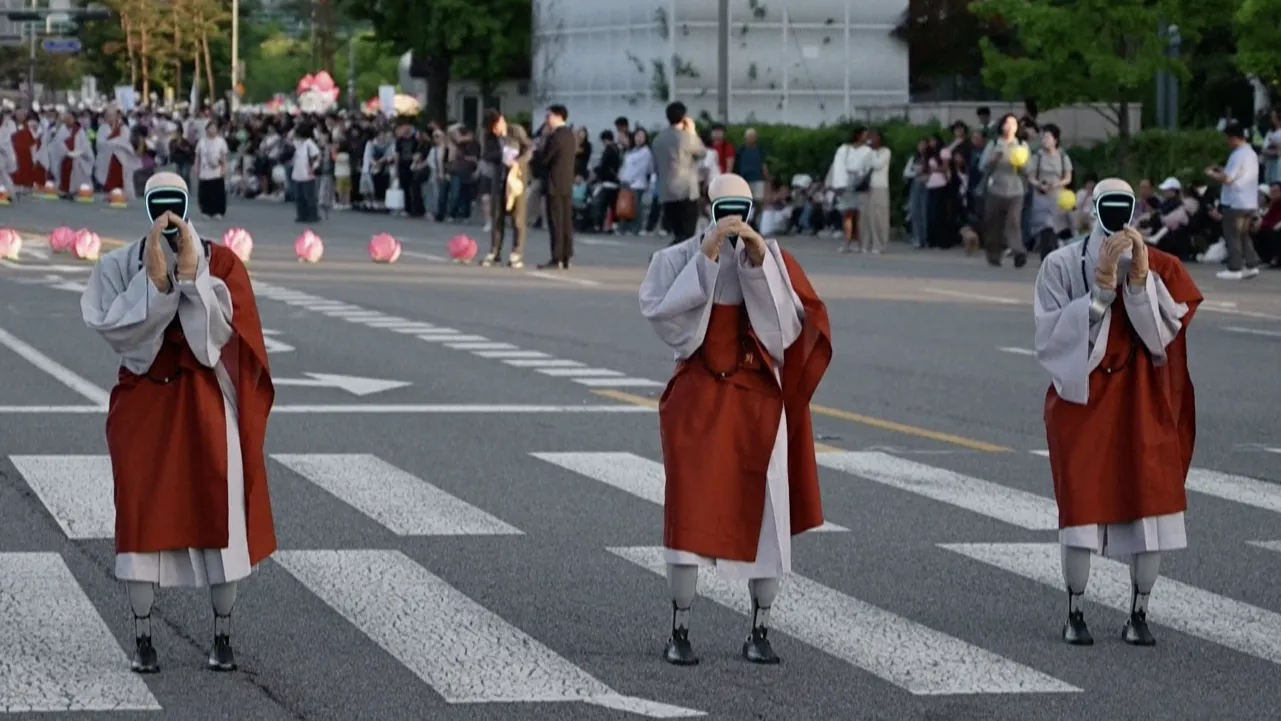
The highlight of this year’s grand Yeondeunghoe lotus lantern festival in central Seoul was not just the dazzling lanterns but also the robot monks leading the parade in front of more than half a million spectators.
Images of humanoid robots dressed in traditional monastic robes leading the monks have gone viral worldwide, sparking amazement. Thairath Plus poses the question: Is South Korea’s Buddhism trying to send a message to Korean society and the global community?
Originally, the lotus lantern festival is a tradition over 1,300 years old, recognized as an intangible cultural heritage by UNESCO. This year’s event was held under the slogan “Peace in the mind, Harmony in the world” to celebrate the birth of the Buddha according to Mahayana tradition, marking the eighth day of the fourth lunar month, which differs from the Theravada observance of enlightenment and parinirvana.
Seongno Street was adorned with hundreds of thousands of lanterns. Over 50,000 parade participants, including foreigners from Thailand, Nepal, Bangladesh, and Myanmar, carried lanterns shaped like lotus flowers, elephants, and deities, commemorating ancient rites dating back to the Goryeo dynasty.
The appearance of four robot monks named Seokja, Mohui, Gabi, and Nisa, clad in long robes (Jangsam) and kasaya, with brightly glowing blue faces, led the procession alongside other automated robots displaying words like “healing” and “hope.”
Introducing robots at the forefront of the parade reflects how Buddhism in South Korea adapts to multiple challenges, including a severe shortage of monks in the Jogye Order. Incorporating AI and robotics is a way to preserve cultural space and attract Korean youth by presenting religion as accessible, friendly, and compatible with digital lifestyles.
A clear example is the ordination of the robot Gabi, which underwent an actual monastic ceremony at a Jogye temple, receiving adjusted precepts for machines such as prohibitions against harming living beings, deception, and requirements to conserve energy.
The image of robot monks leading the procession thus conveys South Korea’s social context: a nation at the forefront of technology choosing not to abandon its spiritual roots but to integrate them intriguingly.
Event organizers emphasize that the Buddha’s teachings fundamentally embrace and accept all things as they truly are, including artificial intelligence (AI).
As Ven. Jinwoo, head of the Jogye Order, stated at the opening ceremony, “We should light the lamp of peace within ourselves and raise the lamp of harmony to dispel the darkness of the world. We must seek wisdom within and use it for the benefit of humanity and the planet.”
This year’s Yeondeunghoe festival is thus not only a remembrance of the past but also a projection into the future, showing the world that sacredness need not be frozen in time; humans of flesh and blood and robots born from circuits can walk side by side on the path to inner peace in harmony.
ReferencesKorea Herald,Korea Joongang Daily
#ThairathPlus #Thairath #SouthKorea #News #InternationalNews #VisakhaBuchaDay #VisakhaBucha #AI