

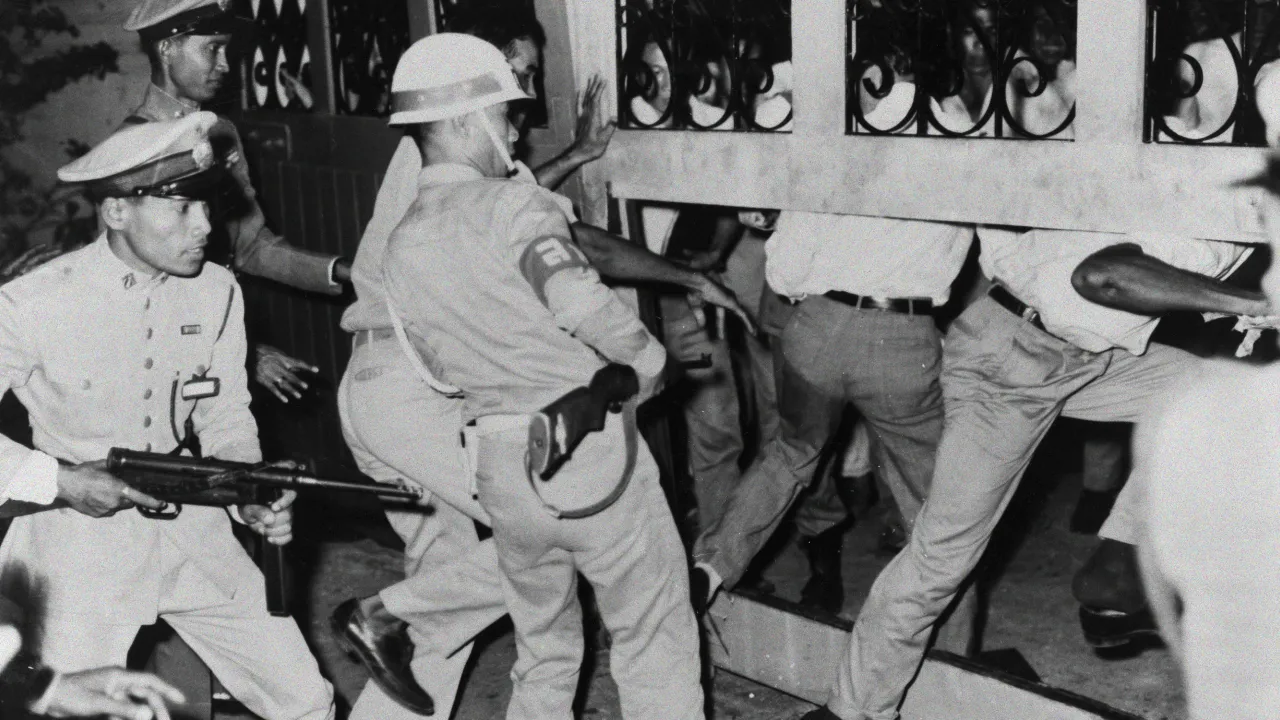
Marking the 69th anniversary of the dirty election on 26 February 1957, this costly lesson from a non-transparent election, which was meant to resolve conflicts, instead became the source of a complex and prolonged crisis in Thai society for the following decade.
Looking back at the political atmosphere before 1957, some compared Field Marshal Plaek Phibunsongkhram to a brilliant “star,” which later diminished to a mere “planet” lacking its own light after surviving three assassination attempts, a near-fatal rebellion, and ultimately seizing power through a coup.
Before the 1957 election, Thai politics was dominated by a three-way power struggle involving Prime Minister Field Marshal Plaek, the rising power of Field Marshal Sarit Thanarat, the army commander building his political influence, and Police General Phao Sriyanond, head of the police force with substantial arms, backed by the United States.
Field Marshal Plaek’s government announced the 1957 election intending to retain power by relying on popular votes. This election was a high-stakes gamble that the government knew it could not afford to lose. The path to victory was fraught with corruption, as M.R. Seni Pramoj and the Democrat Party documented, describing the blatant use of state power to pressure officials into serving as vote agents and the mobilization of thugs to intimidate voters into supporting the ruling party.
Various fraudulent tactics were employed, including “marked ballots” illegally pre-crossed, and the practice of “umbrella voters” repeatedly casting ballots multiple times. Some polling stations counted more votes than registered voters, and during vote counting at Lumphini Park, a power outage occurred; when the lights returned, government votes surged instantly.
When the results defied expectations, a crisis of trust erupted. Although Prime Minister Field Marshal Plaek avoided calling it a rigged election, calling it merely “disorderly,” the public regarded it as an unacceptable “dirty election.” Tensions peaked within a week as university students from multiple institutions marched to the government house demanding the election be annulled and rerun, amid the declaration of a state of emergency.
Negative government coverage, opposition protests, and public dissatisfaction, especially from students, pushed the political elite to a breaking point. On 16 September 1957, Field Marshal Sarit led a military coup that ended Field Marshal Plaek’s power following the dirty election, replacing it with a paternalistic autocratic regime that lasted 16 years.
Returning to the present, voter turnout this year was only 65%, the lowest in 25 years, possibly signaling political despair and apathy. This is compounded by nationwide controversies over ballot barcode litigation that could potentially annul the election, raising questions about the credibility of the Election Commission, which manages elections with a budget exceeding 7.8 billion baht.
Although there has been no coup or establishment of a dictatorship like in 1957, the price paid for the 2026 election may manifest as widespread distrust in political institutions, replaced by a new norm where lack of transparency is accepted. This may push younger generations to seek futures in societies that respect their rights and voices more directly.
#ThairathPlus #Thairath #Election69 #Election2026 #OneMoreElection #Election1957 #DirtyElection #Politics #ThaiPolitics #ElectionCommission