

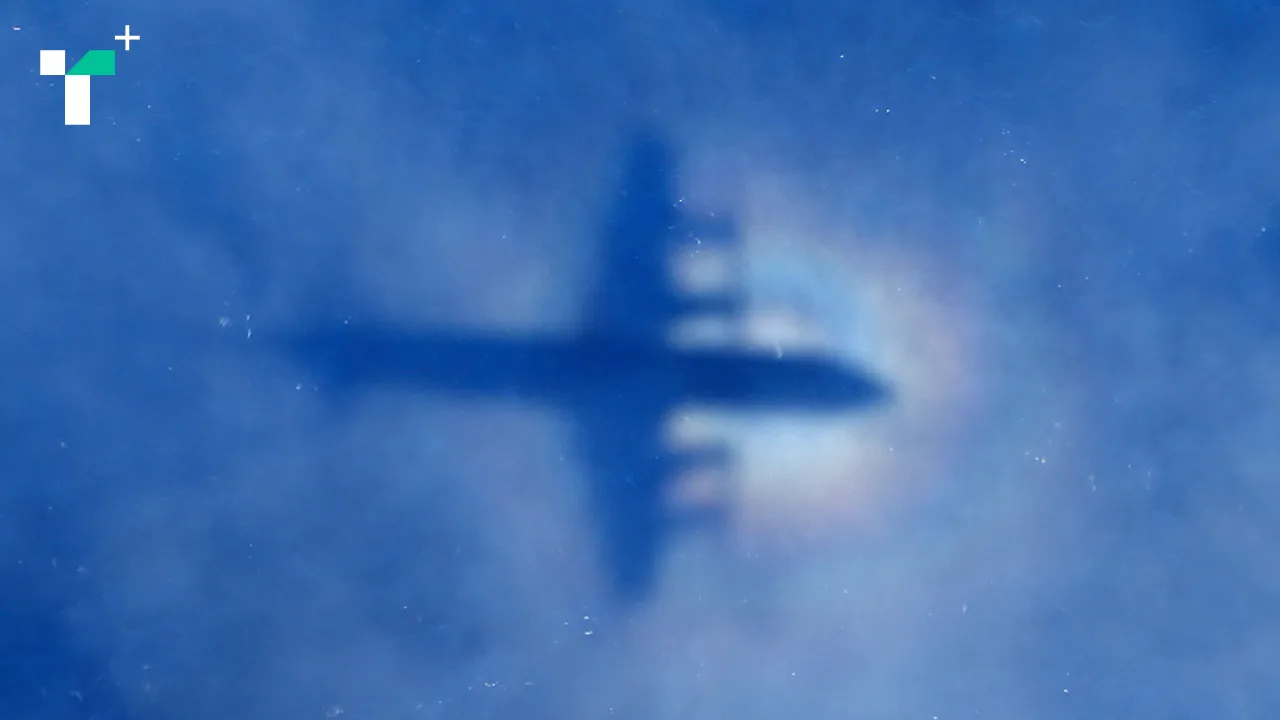
In the early morning of 8 March 2014, the world was shocked when Malaysia Airlines Flight MH370, carrying 239 passengers and crew traveling from Kuala Lumpur to Beijing, vanished from radar while flying over the South China Sea.
Initially, many believed it was a routine accident, but looking back at that day reveals several strange clues, including indications that systems appeared to have been deliberately turned off, and data showing the plane had reversed direction and continued flying for another 7 hours after losing contact.
Tracing anomalies from radar data
Examining radar and satellite data shows that the events of the early morning of 8 March 2014 were not a brief accident but a continuous anomaly lasting more than 7 hours.
After Flight MH370 took off from Kuala Lumpur International Airport at 00:41, the first irregularity appeared at 01:07 when the aircraft’s real-time data transmission system (ACARS), which reports fuel levels and system status, mysteriously ceased operation, followed shortly by the transponder being turned off. Aviation experts noted this might have been a deliberate sequential shutdown.
However, even without the main position-identifying systems, the satellite communication unit onboard continued operating in the background, sending automatic 'handshake' signals to ground stations via a satellite over the Indian Ocean.
The first handshake signal started at 02:28 and continued hourly until the final complete signal at 08:11, after which incomplete signals were received minutes later, causing experts(Note: This part is a fragment—'experts'—so the translation is accordingly partial.)to analyze that this pattern resembles an electronic system attempting to reboot after an engine failure due to fuel exhaustion. At 09:15, the expected next handshake time, silence prevailed in the skies.
The fruitless search efforts
In the first week after the plane disappeared from civilian radar, international forces deployed ships and aircraft to sweep the South China Sea and Gulf of Thailand—the last known contact area—but found no trace.
A turning point came when the UK telecommunications company Inmarsat revealed satellite handshake data indicating the plane had turned around and flown southward, ending in the southern Indian Ocean. Search operations shifted to the western coast of Australia, initially focusing on using towed pinger locators to detect underwater signals from the black box batteries, which have a 30-day lifespan, but no signals were found.
When acoustic detection failed, Australia, Malaysia, and China jointly launched a deep-sea scanning mission led by the Australian Transport Safety Bureau (ATSB), deploying side-scan sonar and autonomous underwater vehicles (AUVs) to search the '7th Arc'—a calculated path from the last satellite handshake—in the southern Indian Ocean. However, this extensive search yielded no results.
Although underwater searches failed to locate the fuselage, physical evidence emerged when debris washed ashore on La Réunion island, a French territory near Madagascar’s east coast, in July 2015. French authorities confirmed it was part of MH370’s wing, confirming the plane had crashed somewhere in the Indian Ocean.
Subsequently, over 30 other debris pieces washed up on shores of several Indian Ocean countries including Madagascar, Mozambique, South Africa, Tanzania, and Mauritius, consistent with ocean current patterns.
In 2018, the Malaysian government authorized the US deep-sea exploration company Ocean Infinity to resume the search under a 'no find, no fee' agreement, promising a $70 million payout only if wreckage or black boxes were found. However, the operation ended in May 2018 without success.
The mystery surrounding MH370 has sparked numerous theories and conspiracy claims online over the past decade, ranging from cyber hijacking of flight controls to military shooting down the plane over airspace confusion.
The theory most supported by aviation experts and investigative media is intentional pilot action, focusing on Captain Zaharie Ahmad Shah. FBI data recovered from his home flight simulator showed flight paths resembling the final trajectory of MH370 toward the southern Indian Ocean, though Malaysian authorities have refrained from officially confirming this theory to avoid unfounded accusations.
Amid ongoing uncertainty, the victims’ families group 'Voice370' has persistently pressured authorities, resulting in renewed hope when, in late 2025, the Malaysian government approved Ocean Infinity to begin a third official underwater search, again on a 'no find, no fee' basis.
On 30 December 2025, Ocean Infinity deployed advanced unmanned survey vessels and fleets of AUVs to scan the southern Indian Ocean seabed once more. As the 12th anniversary approaches, the world watches anxiously to see if this high-tech operation can finally resolve one of aviation’s greatest mysteries.
References: