

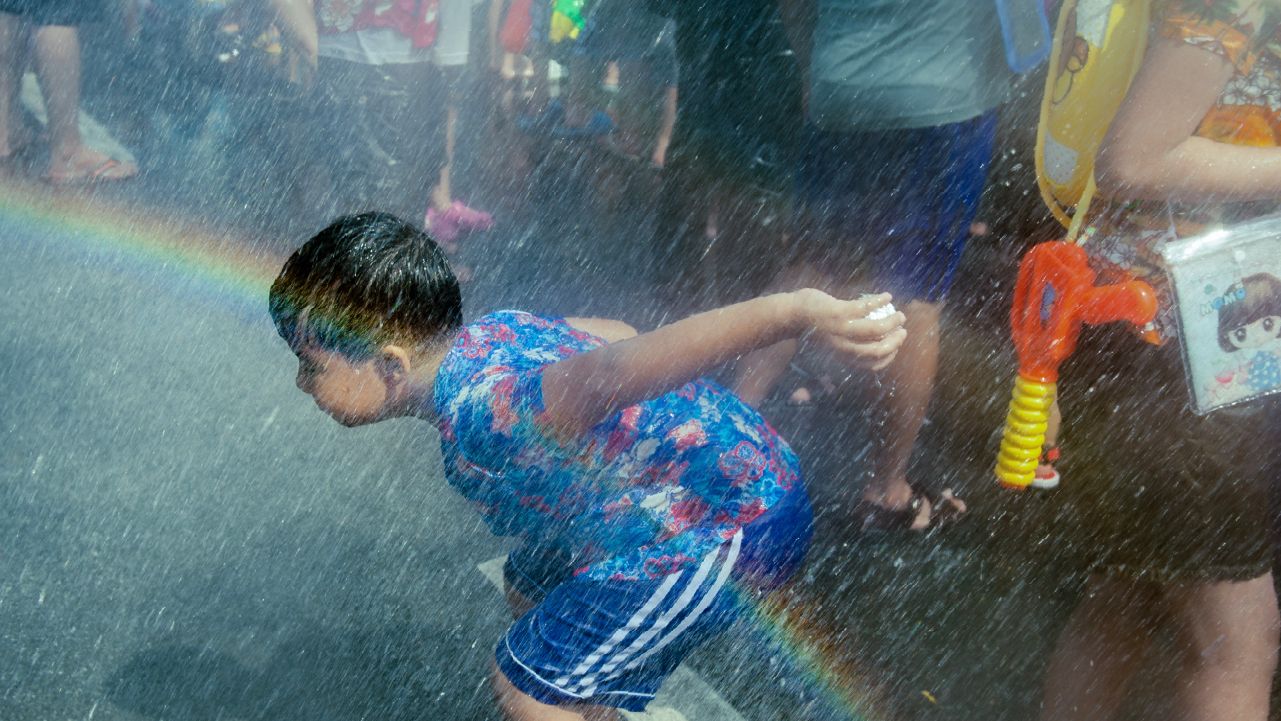
Songkran has long been the New Year festival of Southeast Asian peoples, with origins difficult to trace precisely. Originally, it was a custom where younger generations paid respect and asked for blessings from their elders while pouring water to show reverence. However, as times changed and the weather grew hotter, Songkran evolved into a water-playing festival to cool off, alongside a new belief that it symbolized cleansing away negativity to start the New Year anew.
An interesting aspect of Songkran is that it serves as a case study for a festival that temporarily suspends or removes social status or hierarchy, placing people in a liminal state between duty and leisure, allowing them to experience happiness for a time. This is not to suggest Songkran explicitly dismantles social hierarchies, but the fact that everyone wears the same floral shirts and can play water freely with anyone seems unique to this festival alone.
Every year during Songkran, a clear image emerges of people returning to their hometowns or diaspora communities, especially from Bangkok, which is filled with migrant workers not only from the labor class but also from the middle class. Thus, Songkran is an ideal time to observe these groups returning home to rest or visit elders. Anthropologists define the status of these people as being in a liminal threshold space Applied to Songkran, those working in new places occupy an ambiguous status—neither fully urban nor entirely local. During Songkran, they can blur these statuses, feeling a true sense of belonging and ultimately returning to their original communities (after Songkran) with a renewed identity.
This concept was developed by Arnold van Gennep and further elaborated by Victor Turner. Van Gennep, a folklorist studying human political and cultural transitions, provides a framework applicable to Songkran as a ritual where everyone sheds their masks to abide by the same rules. This can be explained through the principle of liminality, which consists of three stages:
Preliminal rites (separation): Temporarily relinquishing one’s status or social rank to enter a shared ritual, symbolized by shedding one’s mask—perhaps by wearing floral shirts or being in spaces where people play water or gather with family.
Liminal rites (liminal phase): The time of water play and pouring blessings when former identities become blurred but people share unconditional joy regardless of class. Social hierarchies lose significance, producing a fraternity (communitas).
Postliminal rites (reincorporation): Returning to the working world with a 'new self' revitalized by spiritual renewal, clearer goals reaffirmed through honoring one’s roots. Everyone gains a renewed identity through participation in rituals and understanding the values of paying respect to elders—interpreted as a boost to morale, courage, or new life objectives.
Van Gennep explained that the core of liminality is fraternity, or communitas, as seen in the liminal phase. It is a state where people feel connected as 'equal humans,' suggesting that strong societies must provide spaces where people from different classes can feel equal at times, or else social tension will become too great and cause rupture.
Thus, Songkran functions as a healing space for 'diaspora' individuals who live ambiguously between 'urban' and 'rural' identities, feeling disconnected from any place. Songkran acts as a milestone helping them reconnect with themselves and their families, repairing fractured identities caused by hard work in big cities.
For many living between the capital city where they earn a living and their hometown, feelings of alienation and uncertainty about their place can gnaw at their hearts. Understanding Songkran through van Gennep’s concept reveals that the liminal space where they stand is a normal human condition, and Songkran is a crucial marker embracing this ambiguous status.
Returning home during Songkran is not merely a physical journey but a reaffirmation of identity—that one still has roots, people waiting, and a safe space. After passing through this joyous ritual, the morale gained from family and the water ceremonies reconstructs a stronger new self, emboldened with renewed courage and purpose to return to work. Thus, we do not return to work simply as ordinary diaspora but as diaspora with clear goals, aware of what we are fighting for.
References:
van Gennep, Arnold (1977). The Rites of Passage. Routledge & Kegan Paul. p. 21. ISBN 978-0-7100-8744-7.