

“The Olympic (Titanic’s sister ship) could never sink, just as the Titanic would not have sunk if it had been used for operations. Both vessels could be cut in half, and each half would still float for a long time.” This sentence is commonly but mistakenly attributed to Captain Edward J. Smith, the Titanic’s captain.
This misunderstanding shows how people in the early 20th century tried to view the event as a colossal disaster caused by nature, and regardless of whether the Titanic was unsinkable or not, on 15 April 1912, an unexpected tragedy occurred. It became an event remembered forever, reshaping the understanding that no human invention can escape the forces of nature.
RMS Titanic was a large British passenger liner named after the Titans of Greek mythology, built in Belfast, Ireland. It was the second of three ocean liners constructed by Harland & Wolff. Measuring over 269 meters long—almost the length of three football fields—and powered by the most advanced steam technology of its era, the Titanic was considered a great industrial-age human achievement. It was designed to carry wealthy passengers, featuring swimming pools and restaurant-like dining rooms, all luxuriously decorated in Louis-style design.
Titanic set sail on 10 April 1912 from Southampton, England, heading to New York City, USA. Everything proceeded smoothly until the night of 14 April at 11:40 p.m. Frederick Fleet, a lookout on the ship, spotted a large iceberg drifting nearby. He rushed to sound the bell three times, shouting, “Iceberg ahead!”
Officer Murdoch was ordered to immediately reverse the ship, but it was too late. The iceberg grazed the side of the ship. Due to the ship’s massive size, passengers felt only a slight vibration, so subtle that some thought it came from the engine itself. Meanwhile, ship designer Thomas Andrews and Captain Smith realized the danger after learning that water was flooding five of the ship’s sixteen compartments. Normally, flooding in four compartments could still allow the ship to reach shore, but flooding five compartments meant Titanic was doomed to sink.
At midnight on 15 April, the communications team began sending SOS distress signals. The nearest ship, SS Californian, was about 10 to 20 miles away, but its radio operators were off duty and everyone on board was asleep.
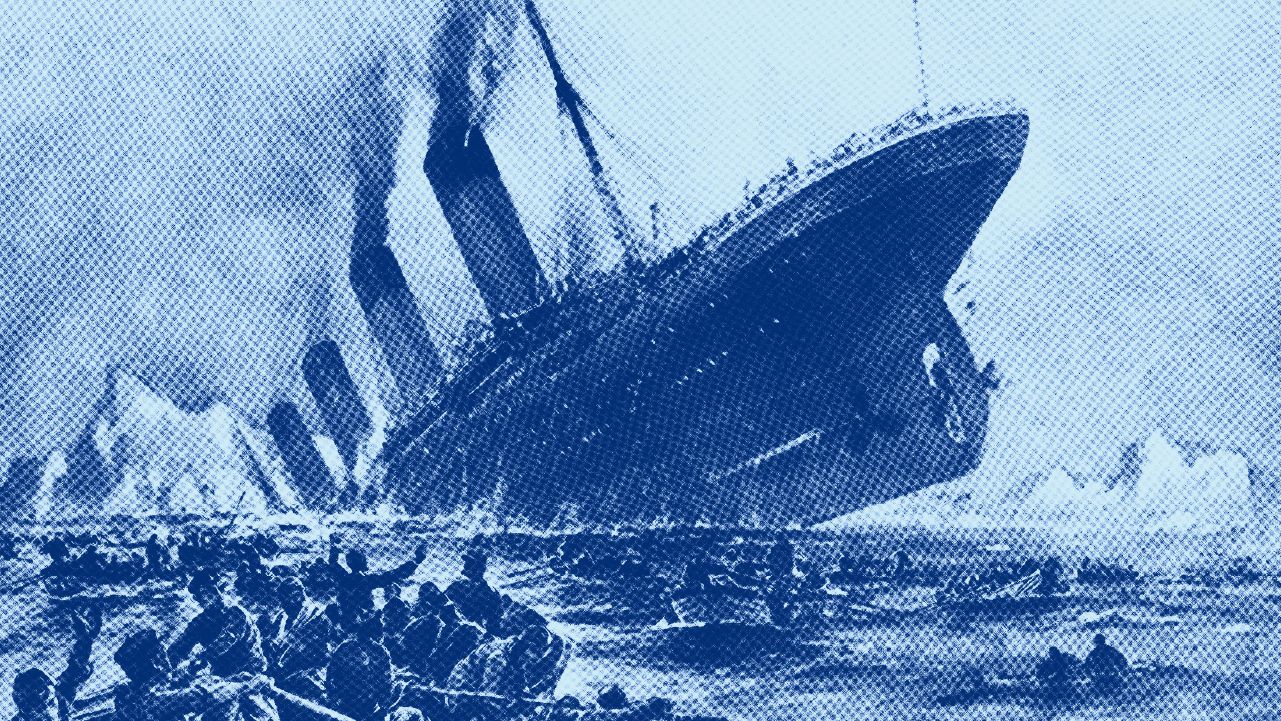
The familiar command “women and children first” was given by Captain Smith to load women and children onto 20 lifeboats, which could carry approximately 1,178 people out of the total 2,224 crew and passengers. The band, led by Wallace Hartley, began playing music to calm everyone aboard. While the ship was sinking, crew members fired eight distress flares. The SS Californian’s crew saw the flares but took no action. Later, the Californian’s captain explained he mistook the flares for signals between ships and did not realize they were calls for help.
At 1 a.m., panic grew as water flooded the ship’s lower decks. Many third-class passengers drowned below decks—some trapped behind watertight doors sealed by water pressure, others lost in the ship’s vast interior. Meanwhile, passengers above deck gradually boarded lifeboats. As the ship sank further, the interior lights went out, and the ship’s stern rose into the air. Reports indicated some lifeboats were swamped by waves. Then, Titanic broke into two sections and slowly sank to the ocean floor. The entire disaster lasted about two hours and 40 minutes.
Approximately 1,500 passengers were left drifting in water at -2 degrees Celsius. Those in lifeboats tried to keep as far away as possible, fearing struggling survivors in the water might capsize the boats. At 4 a.m., RMS Carpathia arrived to begin rescue operations.
About 711 people survived the Titanic sinking, while approximately 1,517 were lost. Carpathia brought survivors back to New York on 18 April amid crowds and mourning. The tragedy became a lesson about human negligence, especially criticizing the SS Californian’s captain for ignoring the situation.
The Titanic disaster inspired the 1997 film Titanic, directed by James Cameron and starring Leonardo DiCaprio and Kate Winslet. The film won the Academy Award for Best Picture and ensured the tragedy remains unforgettable, serving as a reminder of the dangers of overconfidence and negligence that obscure risks—much like Captain Smith’s assertion that the Titanic was unsinkable.
/