

Looking back to the May 22, 2014 coup, the first image many recall is the declaration of martial law nationwide. Television and radio signals were cut to display a still image of the National Council for Peace and Order (NCPO), followed by orders summoning politicians, protest leaders, and academics to report to military camps. Many were taken for attitude adjustment, and the strictest enforcement at that time was the prohibition of political gatherings.
However, while public spaces for expression were completely shut down, an interesting contradiction emerged near Victory Monument, where security forces themselves organized mass gatherings.
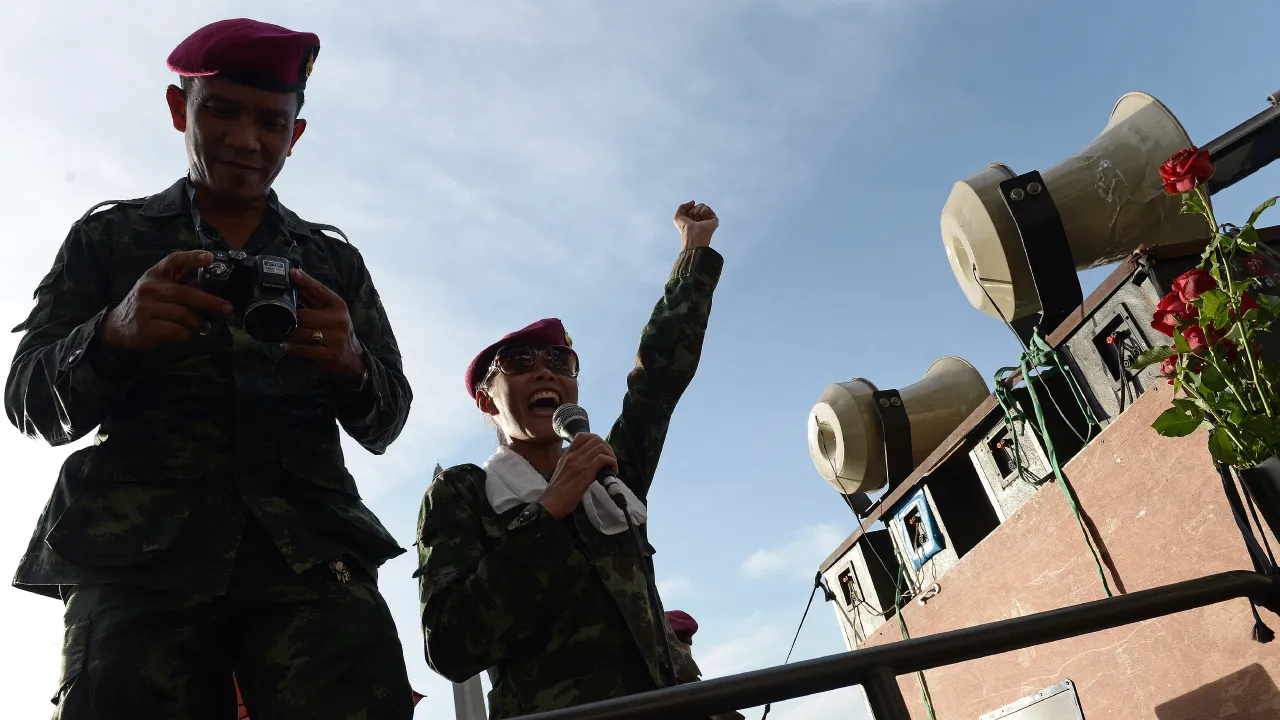
Less than two weeks after the takeover, the then Permanent Secretary of Bangkok revealed cooperation between the Bangkok Metropolitan Administration, the 2nd Cavalry Division King's Guard, and Metropolitan Police Division 1 to host a concert under a name that would be remembered in Thai society for years: "Return Happiness to the People."
The event took place on June 4, 2014, featuring a full lineup of entertainment activities, including performances by the army and police orchestras, a traditional Pong Lang performance by the Bangkok administration, a marching band from Rajavinit Mathayom School, and celebrity meet-and-greets.
Additionally, there were free health check-ups from Phramongkutklao Hospital, complimentary food and drinks, and a highlight show featuring horses from the 2nd Cavalry Division King's Guard.
On that day, media reported that the event aimed to "reduce tension" between the military and the public. Yet, beyond the smiles and music, eight riot control companies were deployed, firmly securing all four directions around Victory Monument. Detention vehicles were also on standby nearby to prevent and respond to any anti-coup protesters attempting to cause unrest.
From a political communication perspective, the military's concert was not merely entertainment to ease the situation; it was a political tool used by the junta to legitimize their rule and diminish social resistance to a government that was unelected.
Since the NCPO assumed power, the military’s image has been systematically reproduced and disseminated through media. We have heard the song "Return Happiness to Thailand" played every morning and evening, and the program "Moving Thailand Forward" was compulsorily broadcast on all TV and radio channels under NCPO Announcement No. 97/2014. Moreover, the government has supported entertainment media, including dramas and films, that clearly promote security and the military’s image.
Holding the concert at Victory Monument—a usual public transport hub and a key site for protests—was a physical occupation of space to signal that the country was now peaceful under military oversight.
Simultaneously, the junta occupied the "mental space" by displaying large vinyl banners on stage stating "Return Happiness to the People," crafting a narrative that the junta was the force calming the political crisis between former government factions and the People's Democratic Reform Committee (PDRC).
This "camouflaged spectacle" phenomenon reflects deeply the Thai state’s mindset and power management strategy during this transitional period. Using music and entertainment as political tools is not new globally; authoritarian regimes often use such "sweetened poison" tactics to divert public attention from lost rights and freedoms.
What makes Thailand’s case distinctive and memorable is the contradiction of the military government attempting to monopolize the definition of "happiness" for the people according to the state’s terms, while the event’s periphery was heavily guarded by riot police and detention vehicles.
This image is now etched in Thai political history as a symbol of an era when the state tried to feed happiness to the people in exchange for freezing freedoms and democratic development—leaving scars and continuing to impact Thailand’s political structure and social mindset to this day.
#ThairathPlus #Thairath