

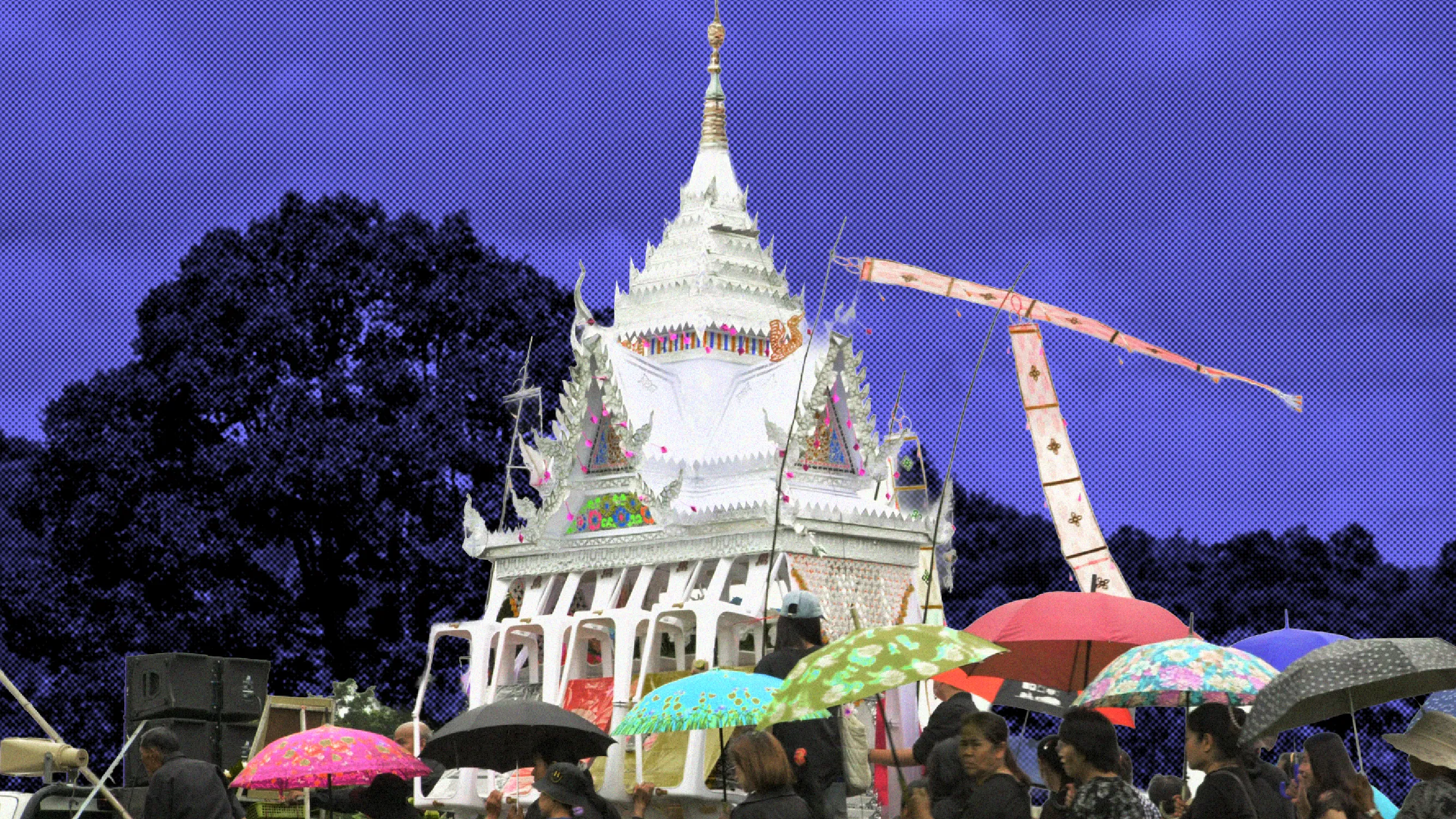
In the Isan region, a rare cremation ceremony involves sending the deceased to heaven using the Nok Hasadeeling funeral castle, also known as the Noksakkadailing. This ritual was reserved for senior high-ranking monks or nobles with titles and ranks. Mourners witness the exquisite Lan Xang art in the form of a castle shaped like a mythical creature with a trunk and wings. The ceremony includes performances depicting hunters pursuing the legendary bird before it serves as a vehicle to transport the body to heaven. This ritual holds great cultural importance in Isan, particularly in Ubon Ratchathani Province, where records show the funeral castle was dragged for three to five days before cremation. Historical chronicles note that Ubon Ratchathani's rulers descended from the rulers of Chiang Rung, or present-day Xishuangbanna.
However, the funeral sending ritual involving the Nok Hasadeeling is not exclusive to Isan. More accurately, it represents a shared culture between Lan Xang and Lanna, jointly tracing back to Chiang Rung. Today, although funeral castles are rare, the tradition continues in some Lanna or northern Thai communities. These castles are categorized from commoners to high-ranking nobles or monks (similar to Isan), with commoners’ castles smaller but still embodying local artistic beauty. The overall ritual is called “Song Sakarn” or “Song Sakaan,” as termed by the Lanna people.
Tracing the origin of the term, “Song Sakarn” derives from the Sanskrit word “saṃskāra” (pronounced sangsakarā), meaning the mind, disposition, or behaviors impressed from birth forming one’s identity. This term appears in important Hindu philosophical texts. Hindus have “Song Sakarn” ceremonies not only for funerals but also for weddings. Thus, “Song Sakarn” does not simply mean sending the body to another realm but celebrates the transition phases of a person’s life, of which death is part.
This ancient Lanna and Lan Xang ritual combines Buddhist and Hindu beliefs, reflecting the long-standing spread of these faiths. It is believed that the Lanna people embraced this fusion easily due to local beliefs in “kwan,” or the spirit, which is sent off after death. Therefore, the Song Sakarn or funeral ceremony blends local beliefs, Buddhism, and Hinduism, representing a unique Southeast Asian cultural identity.
For the Lanna people, upon a death, they commission specialized craftsmen to build a funeral castle and prepare the Song Sakarn ceremony following custom. After assembly, like the Nok Hasadeeling ceremony, the castle is dragged to the burial or cremation site (pa Hew) for an open-air cremation. The procession includes three-tailed flags (tung sam hang), fast rice baskets (thong khao duan), fire pots, monks on litters, litters bearing funeral offerings, novice monks leading the body, the funeral castle, the procession leader, and torchbearers, all accompanied by traditional music.
Because the ritual continues in only a few northern communities, the Song Sakarn ceremony and funeral castle construction are rare and face the risk of fading away soon. Urupong Raksat, a documentary filmmaker known for capturing rural Thai life, aimed to present an unseen perspective on the traditional Lanna farewell ritual in a small Chiang Rai community.
“In my childhood home, I had two photographs of funeral processions, both showing funeral castles. These images deeply influenced my thoughts and dreams. They are beautiful, mysterious, and hold traces of a past to explore. Now, I have returned to that area to convey these stories through a documentary film,” Urupong said.
Urupong is recognized in Thailand and internationally for documentary films exploring human relationships, nature, labor, and social change through a simple yet emotionally powerful cinematic language. His dedication involves immersive fieldwork, interviews, and community integration. His notable works include Agrarian Utopia (2009), The Songs of Rice (2014), and Worship (2022), documentaries that explore the relationship between belief, religion, and people who pursue faith without question.
In the upcoming documentary “Song Sakarn,” premiering on 10 Sep 2026 GMT+7, viewers will encounter the daily lives of a team who produce and deliver funeral castles in northern Thailand. The castle is cremated alongside the deceased, symbolizing the community’s beliefs and death customs. Frequently, questions arise amid diverse funeral scenes.
“Song Sakarn” is a documentary that brings viewers close to the farewell ritual in this small community, inviting them to see death from a perspective they may never have considered before.