

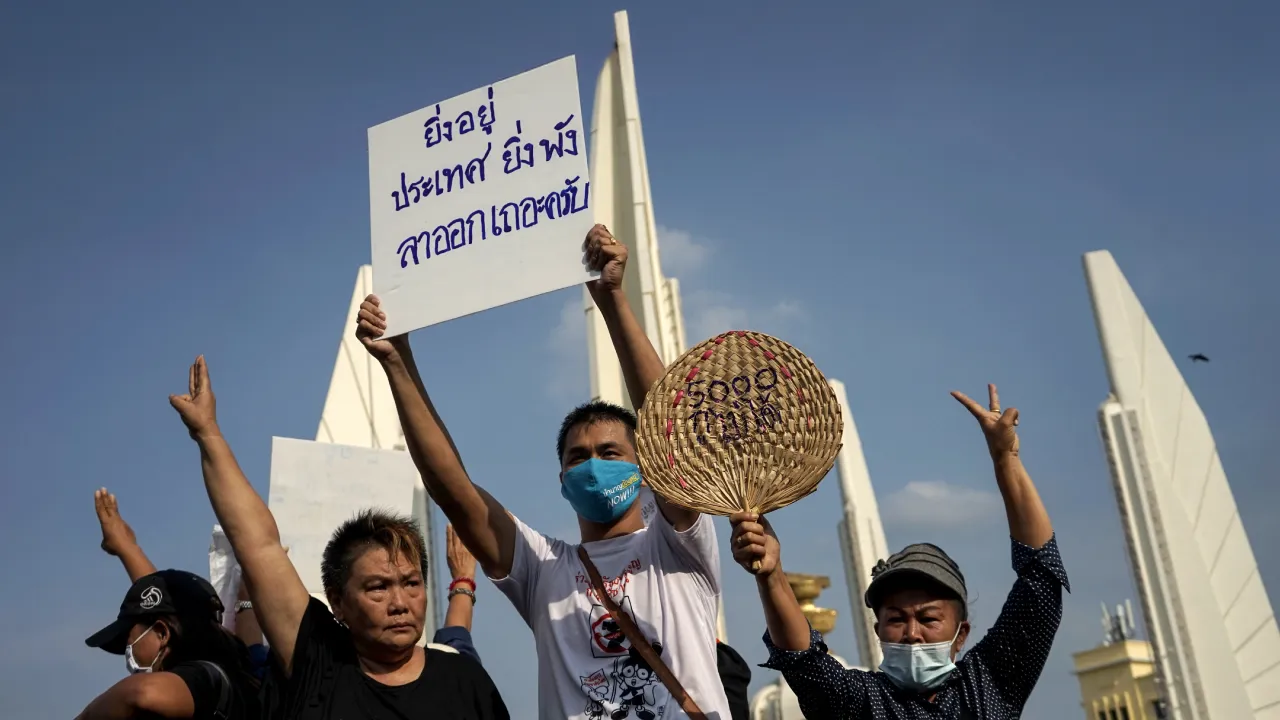
6th Anniversary of 18 July 2020 GMT+7 The day when the group ‘FreeYOUTH’ raised three fingers in front of the Democracy Monument, creating a historic image that sent shockwaves throughout Thai society.
That day's event was recorded as the first major youth and student rally following Thailand’s latest coup, marking a milestone ‘ignition point’ for a wave that created ‘momentum’ leading to varied protests and sharp demands in contemporary society.
Today, questions arise as to why the mass energy that surged then seems to have faded from public discourse through successive governments. Thairath Plus revisits the status of those demands this year.
Starting with the initial demand of "dissolving parliament" this has been practically achieved since General Prayut Chan-o-cha's government dissolved parliament in March 2023, leading to general elections and a transition to a new government.
However, that dissolution was seen as a political timing management by the established power before term expiry, exploiting constitutional provisions allowing MPs to switch parties within 30 days before elections. It was more a strategic preparation for the polls than a response to protesters' demands nearly three years earlier.
The second demand was "drafting a new constitution" Over six years later, this remains in an initial phase without success.
Although on 8 February 2026, over 60% of the public approved a referendum for a new constitution draft, obstacles remain. The cabinet under Anutin Charnvirakul allowed a pending constitutional amendment bill to lapse, citing a focus on economic issues first, forcing the process to restart from scratch.
Civil society criticized the government’s lack of sincerity to honor the referendum’s intent. Moreover, the drafting framework does not touch Chapters 1 and 2, unlike protesters' calls for a full rewrite.
The third demand, "stop harassing citizens" remains a painful issue, especially after the House of Representatives on 8 July 2026 approved the Act Promoting a Peaceful Society (political amnesty law) but excluded cases under Criminal Code Section 112. This means at least 30 Section 112 detainees, such as Anon Nampa, remain imprisoned.
Looking back at the movement dynamics after 18 July 2020, the wave sparked nationwide flash mobs blending pop culture with politics—for example, the 'Hamtharo run' mocking the government, or the FreeTayPlus group pushing for gender equality.
By October 2020, the movement escalated under the name ‘The People's Group’ which occupied key city areas and raised demands for General Prayut’s resignation and monarchy reform, leading to ongoing prosecutions.
After leaders were arrested, the movement shifted to ‘leaderless’ protests in 2021, including the REDEM group coordinating via Telegram, the Thalufah group establishing communities and protests, and intense clashes between independent protesters and riot police at Din Daeng intersection lasting months.
As time passed and political contexts changed, with General Prayut stepping down after the 2023 election, street protests and Din Daeng clashes gradually ceased. Remaining groups like Thalufah adapted to focus on structural, economic, and legal issues alongside ongoing court battles.
The question of why such momentum faded might not mean the mass energy disappeared entirely but shifted from streets to parliamentary mechanisms and civil society. The hopes of the 2020–2021 youth have become a vital voting base and driving force that enabled the democratic parties to win overwhelmingly in 2023. Though street protests are less visible now, a culture of questioning has permeated many societal sectors.
The conclusion on the 6th anniversary of the FreeYOUTH movement is that it is a phenomenon worthy of study in Thailand’s modern political history. Although many demands remain unfulfilled legally, the movement created cultural change, breaking the silence ceiling.
Issues like institutional reform, marriage equality, ending compulsory military service, and social welfare have become mainstream topics openly debated, with many political parties proposing more progressive policies.
Whether one supports or opposes these movements, one widely accepted fact is that the protests changed the mindset and political culture landscape of modern Thailand in unprecedented ways, potentially laying a foundation for future social progress.
#ThairathPlus #Thairath #News #PoliticalNews #FreeYOUTH #ThaiPolitics #People’sGroup #Democracy #ThaiSociety #Protests #Demonstrations