

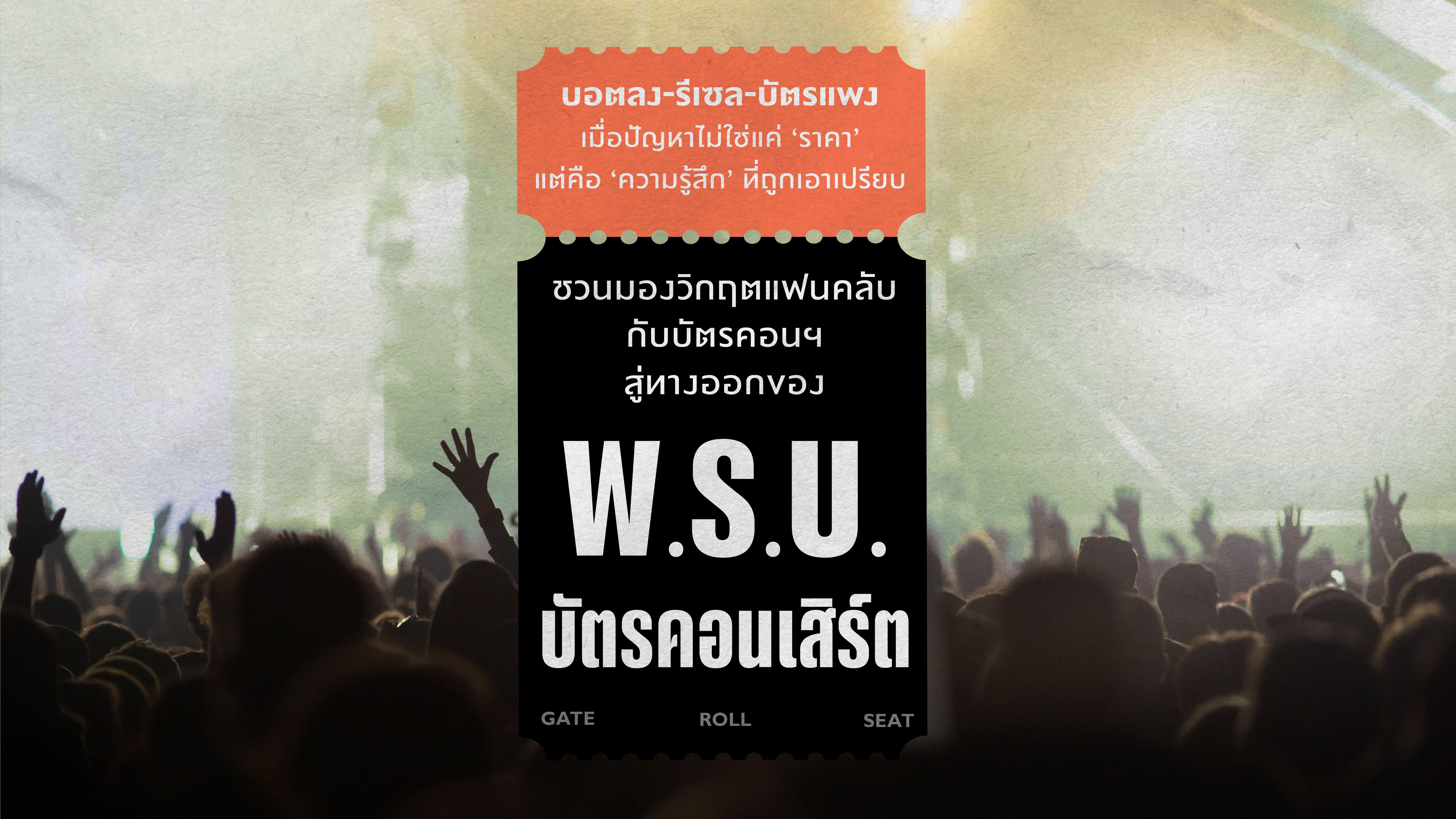
Because the problem is not just about ‘price’ but the ‘feelings’ of fans being exploited by the system, Thairath Plus examines the issues occurring between fans, ticket buyers who resell at inflated prices, and the current system. It also questions how the upcoming 'Concert Ticket Act' will regulate problems in the entertainment industry—such as ghost tickets, bots sweeping purchases, and fraud—and whether it can provide solutions.
High demand to attend concerts exceeds available capacity, so the normal ticket sales system cannot accommodate all fans, especially students and young people who must save money to see their favorite artists. They may turn to alternatives such as buying resale tickets or using ticket-buying services operated by outsiders unrelated to the artist’s label or official distributors. Additionally, membership systems that allow members to buy tickets earlier, controlled directly by labels and distributors, contribute to fans feeling that seeing their favorite artists is priced unrealistically high.
This situation creates a large loophole that enables exploitation by outsiders, turning the ticket sales system into a platform for profiteering and fraud. Nisara Kaewsuk, assistant secretary to the subcommittee on general goods and services at the Consumer Protection Board, revealed that from 2021 to July 2026, over 8,058 victims suffered from ticket sales, online ticket-buying scams, and related entertainment industry problems, resulting in losses exceeding 33 million baht. However, consumers only recovered 11 million baht.
The problem is that when fraud occurs, pursuing legal action to recover money ‘is difficult and time-consuming’ because most transactions happen person-to-person through online accounts. Beyond the lost money, fans suffer more from missed chances to attend concerts, feelings that cannot be recovered.
Meanwhile, a key factor causing tickets to sell out unusually fast is not only fans purchasing manually but also technological interference—especially the use of scripts, automated programs, or 'bots' placing massive orders within milliseconds. This prevents ordinary buyers from accessing the system equally.
The technological advantage of those bulk-buying to resell disrupts fair and equal ticket distribution, enabling outsiders to seize profit-making opportunities. Genuine fans are forced to buy overpriced tickets on the secondary market. Relying solely on online queue systems or basic seller detection measures is no longer sufficient to handle increasingly sophisticated technology.
Although many might think Thailand’s Consumer Protection Act and the Consumer Protection Board (CPB) already oversee these issues and that strict enforcement of existing laws would suffice without new legislation, structural limitations remain in current consumer protection laws.
For example, consumer protection laws are designed to regulate relationships between ‘business operators’ and ‘consumers.’ But most resale ticket sales happen person-to-person on social media, with sellers claiming individual status, thus falling outside the legal definition of business operators. This means the CPB has no direct authority to regulate resale prices set by individuals.
Moreover, the Consumer Protection Act lacks penalties for developing or using bot programs and cannot compel ticket sellers to implement minimum technical safeguards or certified platforms for ticket transfer. Existing laws only address problems after they occur and cannot break technical cycles like bot control or regulate the secondary market by penalizing overpriced resellers.
Several countries with large entertainment and sports industries enact specific laws controlling ticket sales and resale, considering government intervention essential to maintain fairness.
For instance, South Korea and Taiwan criminalize the use of automated programs or bots for bulk ticket buying. Japan prohibits resale above face value and requires identity verification for attendees.
In the U.S., the federal BOTS Act penalizes interference with online ticket sales, while several Australian states cap resale prices at no more than 10% above face value to cover reasonable fees. These examples show that regulating the secondary market is a policy tool many countries use to promote transparency and fairness.
To fill legal gaps, Nithikorn Boonyakulcharoen and citizen groups drafted the 'Act on Regulating the Purchase and Sale of Tickets for Performances and Entertainment Activities B.E. ....' to propose to the House of Representatives. It consists of six main chapters:
- Chapter 1 sets a resale price cap not exceeding 10% above face value, bans bulk buying for profit, and prohibits advertising tickets in violation of these rules.
- Chapter 2 mandates technical measures banning the use, development, or sale of bots for ticket purchases and requires sellers to implement security systems to detect and report irregularities promptly.
- Chapter 3 allows event organizers to issue named tickets requiring identity verification under the PDPA law and mandates systems for ticket returns or resale if buyers cannot attend.
- Chapter 4 requires resale to occur through certified platforms with price caps, identity verification, and immediate ticket transfer systems canceling the original ticket to prevent double sales.
- Chapter 5 establishes a supervisory committee chaired by the Minister of Commerce, including related agencies such as the Ministry of Digital Economy, CPB, the Office of the Consumer Protection Board, and the Royal Thai Police.
- Chapter 6 provides criminal penalties including imprisonment and fines, extending liability to company executives involved in offenses.
Nithikorn explained that currently, Thailand lacks specific laws systematically regulating ticket sales. The draft law aims to cover bot prevention, bulk buying, identity verification, resale regulation, and enabling those unable to attend to return tickets into a verifiable system.
Currently, the draft law is in the signature-gathering phase from eligible voters via https://fairticket.org/ as part of the constitutional citizen law proposal process, where details and comments are available on the website.
The push for the 'Concert Ticket Act' reflects an effort to create new rules balancing technology, market mechanisms, and consumer protection. Although details like appropriate price caps and platform readiness remain under parliamentary consideration, this Act could be a good starting point to review fair trade structures for Thailand's entertainment and sports industries.