

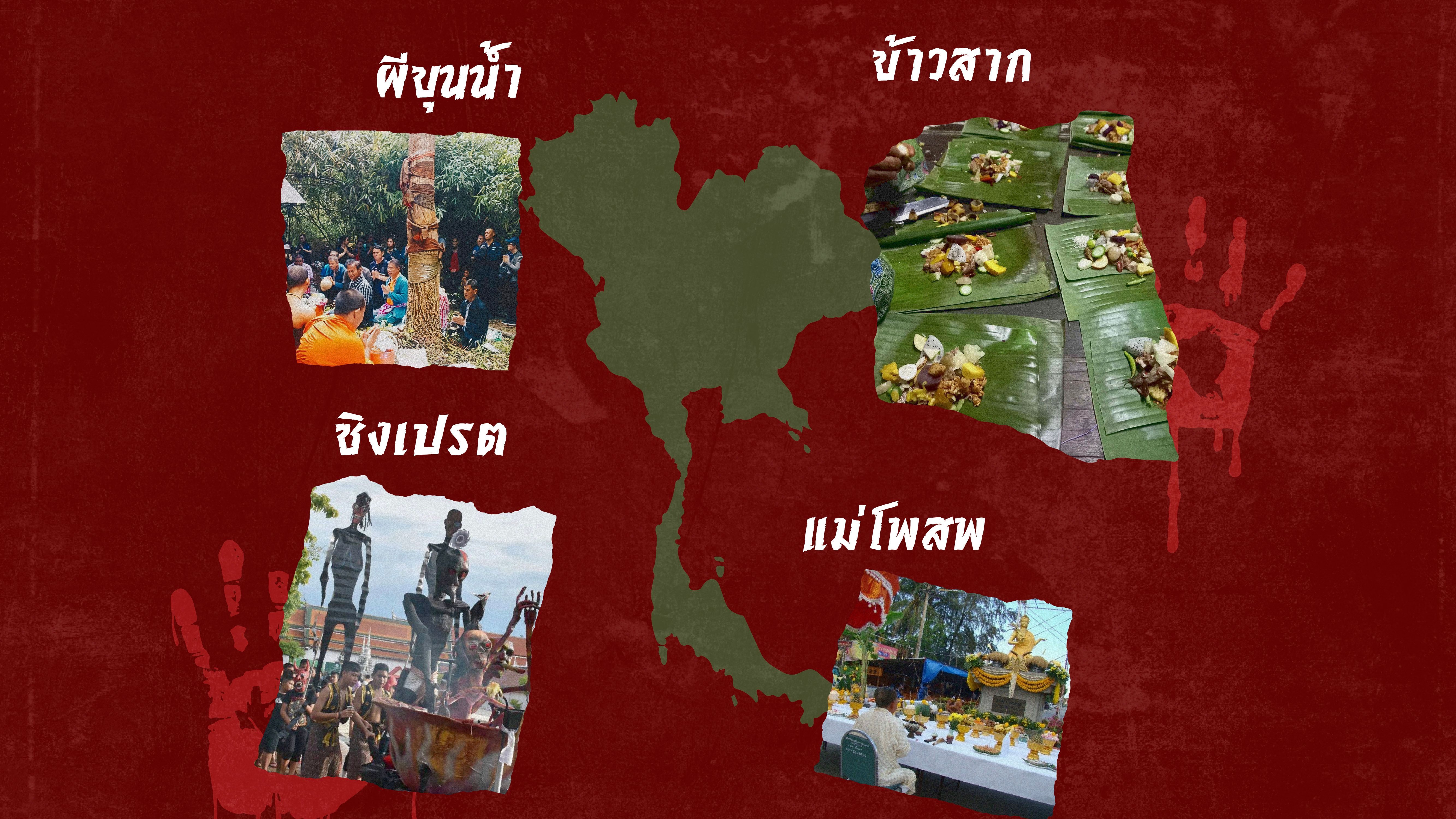
Thairath Plus invites an exploration of traditions intertwined with culture, beliefs, and spirits across the four regions, from the Water Lords’ spirit ceremony of the North, the Khao Sak merit in the Northeast, the Mae Phosop rice blessing in the Central Plains, to the Ching Pret ritual of the tenth lunar month in the South, uncovering the wisdom embedded and how these relate to our psyche and way of life.
This is a traditional ritual and belief of the Lanna people and ethnic groups in the North, held during the eighth or ninth lunar month (May to June annually) before the rice planting season, to pay homage, worship, and give thanks to the guardian deities or spirits of the forest headwaters and water sources.
The Lanna people believe that streams and water sources are vital for terraced rice farming and agriculture, protected by guardian deities or spirits. Anyone who cuts trees or pollutes water will be punished by these spirits, causing drought, illness, or flash floods.
Mala Khamchan, a Lanna scholar, recorded that originally the Water Lords’ spirits were not singular nor benevolent, but groups of fierce spirits inhabiting mountains. Ancient wisdom employed strategies to build shrines at headwaters and invite these spirits to reside there, assigning them the duty to protect the streams. Thus, spirits that once harmed humans were transformed into public servants guarding and protecting the community.
Beyond promoting environmental stewardship and water source conservation, the Water Lords’ spirit ceremony reflects social structures of fair communal resource management and societal rules for coexistence.
For example, pork allocated for offering to the Water Lords’ spirits required families to send laborers to help dredge irrigation canals proportional to their household size. Families exploiting the community by refusing to work without valid reasons would lose their canal water rights and be socially sanctioned by having water cut off from their fields, a severe social penalty at the time affecting family survival and crop yield.
This ritual takes place in the tenth lunar month according to the twelve customs of the Isan and Lao people, on the 15th day of the tenth lunar month each year. It honors the merit of deceased ancestors and pret (ghosts of the departed). Villagers prepare paired bundles of Khao Sak rice containing various savory and sweet foods and betel with tobacco, offering them to monks and then hanging the bundles on tree branches, eaves, or rice fields while calling ancestors' spirits to receive the offerings.
The wisdom behind this merit-making is to give alms indiscriminately (apadaya dana). Devotees cannot choose which monk or novice receives their food. This creates equality among monks, contrasting with class or patronage systems where wealthy donors selectively offer good food only to senior monks, ensuring novices and newly ordained monks receive equal nourishment.
Socially, before the ceremony, villagers send Khao Sak—bundles of rice and dry food—to living relatives. This sharing ensures families with poor or no harvest still have food to survive, reflecting community food security and strong kinship bonds within Isan society.
After offerings, the bundles are placed around the temple grounds or fields, called 'Yai Khao Sak' (meaning placing bundles at intervals). This dedicates merit to deceased relatives and feeds 'Ta Haek,' spirits believed to inhabit the fields per Isan and Lao beliefs. The term 'Haek' corresponds to 'Raek' in Central Thai, as in the well-known Raek Na Khwan rice blessing.
Importantly, offering food to ‘Ta Haek’ in one’s own fields encourages farmers to inspect their rice paddies during the critical grain-filling stage, noting any damage by pests like rats, snakes, or frogs. This indicates biodiversity, chemical-free cultivation, and ecological health. The Khao Sak merit thus strengthens community ties while embedding scientific principles of agriculture in Thai society.
In the fertile lowlands known as Thailand’s rice bowl, beliefs about spirits are closely tied to nature. The 'rice blessing' or 'Mae Phosop' ceremony venerates the rice goddess, a traditional deity symbolizing abundance, growth, and the livelihood of rice farmers in Thailand and Southeast Asia.
Performed when rice begins to ‘bear grain,’ villagers offer incense, talcum powder, bananas, sugarcane, and sour fruits believed to be food for pregnant beings, accompanied by soothing chants. They avoid loud noises, rice threshing, or bringing sharp tools near the fields during this time.
Symbolically and strategically, this ritual prompts farmers to treat the rice as if it were a pregnant woman, exercising special care during the flowering stage when pollination occurs, which critically affects grain development.
Notably, offerings such as Thai scented water, kaffir lime, and saponaria used in the ceremony contain terpene compounds that naturally repel pests like aphids and leafhoppers, reducing reliance on harmful chemical pesticides.
Historically, this ceremony was reserved for women to perform and safeguard seed rice, preventing men from selling, gambling, or exchanging seeds for alcohol, reflecting gender roles and power dynamics in a male-dominated society.
A major merit event in the South, believed to open hell’s gates for ancestors and pret spirits to receive merit offerings sent by descendants. Elders say a ‘pret stall’ is set up outside temples where people compete ('Ching Pret') to seize sweets like Khanom La and Khanom Pong, based on the belief that sharing merit grants blessings to those who win.
Socially, this ritual embodies wisdom of sharing food equitably throughout society. Setting pret stalls outside temple grounds allows outsiders and the poor easier access to food. The term ‘Ching’ (to seize) transforms the image of the needy from passive recipients to active participants, preserving their dignity.
Moreover, Khanom La and Khanom Pong, while symbolically representing food consumed by pret spirits and serving as a bridge between ancestors and the living world, are also traditional preserved foods designed to last long without spoiling, preparing communities for floods and natural disasters in the South. This tradition operates independently of government budgets or laws, relying on cultural practice to help people survive hunger and natural calamities together.
These four regional traditions and rituals, rooted in faith and belief, also embed symbolism and wisdom concerning water management, agricultural science, food security, and community psychology. Through culture, beliefs, and spirits, they enable ecosystems and societies to sustain survival across centuries.
Ultimately, ancestors likely did not create ‘ghosts’ to instill fear but to prevent human selfishness. Behind the faith and beliefs lies the preservation of wisdom, empathy, social coexistence, and environmental stewardship, which continue to operate through ‘fear’ to help us endure in this fractured society.
From 30 October to 1 November 2026 GMT+7
At Alive Park Hall, Ground Floor, Future Park Shopping Center
Free admission with no charge
Come and share this thrilling experience together!