

As someone who closely follows South Korean entertainment media, I started noticing in 2024 that the film Exhuma (파묘), about feng shui and shamans, surpassed 10 million ticket sales in South Korea and drew massive interest from audiences in Thailand both in cinemas and on streaming platforms.
That same year, the documentary Shaman: 귀신전 achieved the highest viewership among original documentaries, and the dating variety show Possessed Love (신들린 연애), featuring shamans and astrologers searching for true love, also gained significant attention.
Dramas featuring shamans as main characters, such as The Haunted Palace (귀궁) and Head over Heels (견우와 선녀), appeared continuously, along with the popular animation K-Pop Demon Hunters, whose characters are based on shamans and spirits of ancient Korea, adapting old beliefs to be more accessible.
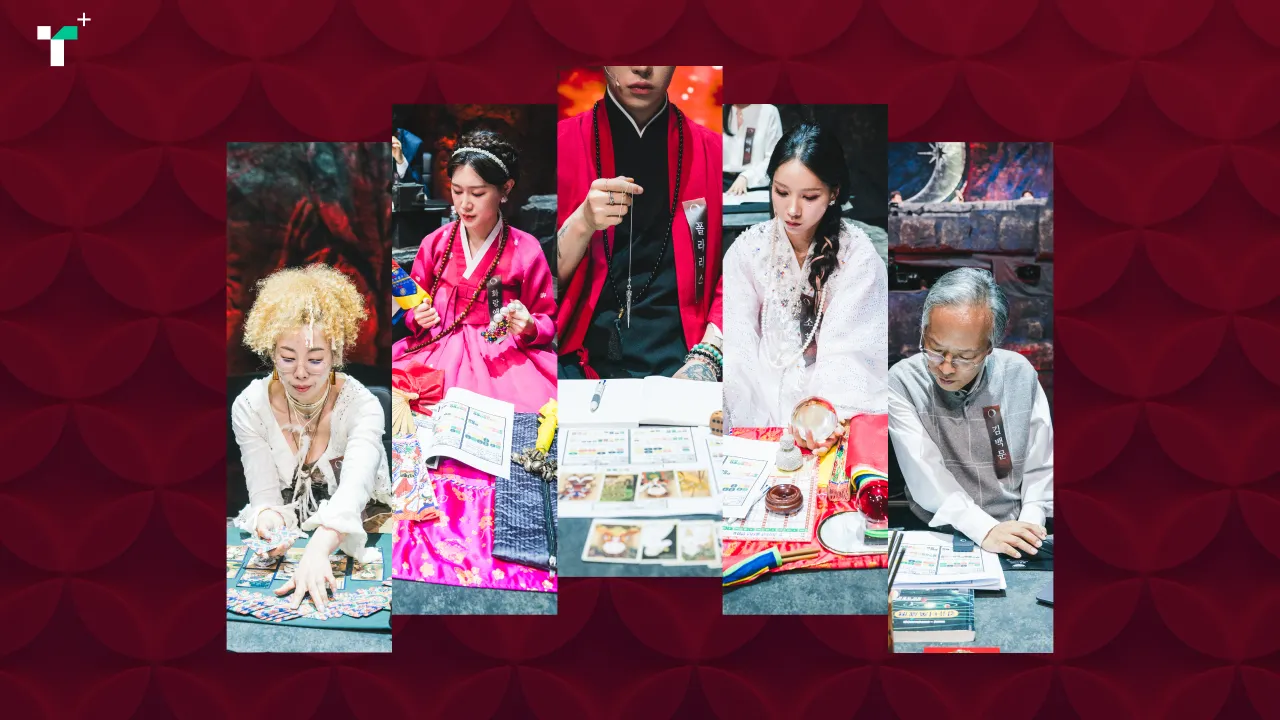
Most recently, Battle of Fates: The Arena of Master Diviners brought together four divination disciplines with 49 expert fortune tellers competing.
These included shamanism (무속인—those serving as intermediaries with sacred spirits according to centuries-old folk beliefs), saju (사주/四柱—Korean birth time divination), tarot cards, and physiognomy, competing to find the most accurate predictor for a prize of 100 million won.
Battle of Fates has attracted strong interest both within South Korea and in several countries including Thailand. This article delves into why, in one of the world’s most technologically advanced societies, the practice of fortune-telling has resurfaced as a trend.
Story 1 – Beliefs Never Disappear
While K-POP may be the first thing people think of regarding Korea, it is not just that. K-POP acts as a gateway for people to experience the deep roots of Korean culture in many aspects, including astrology.
What has changed is not the existence of these practices but their elevation from personal beliefs into content, trends, and culture that attract more people to explore them. In fact, shamans, saju, physiognomy, and tarot have never disappeared from South Korea. In Seoul alone, thousands of fortune-telling shops cluster in busy neighborhoods full of young people.
Therefore, fortune-telling is not new, but it is becoming more visible again.
When shamans appear in popular movies, hit series, and global streaming platforms, they are no longer dismissed as mere superstition because shamans and saju have long been deeply rooted alongside Korea’s cultural development.
Looking back, Korean shamans, or mudang (무당), are not beliefs that emerged randomly but are tied to geography and folk beliefs that sanctify nature, especially "mountains," regarded as the abode of Sanshin (산신), the mountain guardian spirit.
Saju itself is a system Korea adopted and developed in daily life. The term saju (사주) literally means “four pillars,” referring to birth year, month, day, and hour, which are converted into five elements—wood, fire, earth, metal, water—within a yin-yang framework to interpret a person’s life structure and its tendencies.
It is not just about predicting who will be rich or unlucky.
Rather, it is a language to see what is "excess" and what is "lacking."
And how to adjust one’s life rhythm to achieve balance.
The same framework exists in Korean feng shui (풍수지리), which reads relationships between people and places to create energetic balance in areas—such as important city planning—that can be explored further in the story of Seoul’s development.
Therefore, what we see in Battle of Fates is not a revival of superstition.
It is the cultural roots being retold in the language of the digital age.
Story 2 – Generation Z and Insecurity
Over the past 3–4 years, interest in divination practices has clearly increased among people in their 20s.
Some statistics indicate this group is the most "believing" or at least the most "open".
This is not superstition but relates to the life situations of young people—namely, the "insecurity" (불안) in a society where outcomes do not always match effort.
South Korea is known for its intense competition: college entrance exams, landing jobs at big companies, social mobility, happy families, and a beautiful retirement—all tied to success.
But in an era of volatile labor markets, unimaginably high housing costs, and reduced social mobility, looking ahead to the "future" feels very uncertain for the new generation.
Divination thus serves not only to say whether one will be wealthy but acts as a "listening space." Some explain that young people do not fully believe but seek someone who listens without judgment and at least provides some guidance on how to navigate an unclear path, so they don’t get lost. Even AI is used as a fortune teller, where birth details typed into chat may not reveal future answers but offer explanations that help make today more understandable in a dark society.
In a highly competitive society where opportunities are unevenly distributed and effort does not guarantee results, divination functions like a psychological mechanism to organize uncertainty into something more comprehensible. In an age with no guarantees for the future, belief becomes a tool to support the heart to keep going.
Story 3 – When Belief Becomes a Commodity
From K-Drama, K-Beauty, and K-Food, we have arrived at the era of K-Shamanism. Belief no longer dwells only in small fortune-telling booths but has become a marketable product and service.
Shamans fluent in English,
online platforms offering saju readings for the new year,
and temple stays at famous Buddhist temples full of foreigners turning religion into an appealing experience for modern people.
These reflect how "belief" has been reconfigured into purchasable, bookable, and reviewable experiences. Previously, main reasons to visit Korea were shopping, food tours, and concerts, but now traveling there for fortune-telling is no longer strange.
K-Shamanism is thus not just a folk belief but is transforming into a spiritual experience positioned between culture, local experience, and emotional healing. In modern tourism, people seek not just places but stories and meanings to connect with, or simply put, storytelling—a Korean specialty—that makes tourists feel they have truly "connected" with the place rather than just passed through.
Belief has been rebranded as hip and cool while also made accessible and contemporary. This is astrology’s adaptation in a digital capitalist world.
Returning to the Battle of Fates show,
it emerged amid a societal trend where divination is becoming visible again.
South Korea is not just a country of dramas but also boasts diverse and experimental variety shows that allow viewers to learn about many professions and spotlight often overlooked areas.
Battle of Fates is thus not only entertainment or a competition to see who gets eliminated but provides a platform for "marginalized professions" to tell their own stories.
Viewers see not only divination results but also the behind-the-scenes of each fortune teller—their thinking, training, and worldview.
In this sense, the show is not only about fate but extends the modern wave of belief, turning it into entertainment, cultural space, and part of the content economy.
What the show reflects is not just the question of "who is most accurate" but why stories of fate can endlessly be told in one of Asia’s most technologically advanced countries, South Korea.
Author:
Panisara Songthamjitti (Jeans)
Meatykorea
References:
한국민속대백과사전
[Today, Faith and Culture] These days MZers are more interested in Saju than MBTI?
Source -Kookmin Ilbo
"Totally hip"…Foreign MZers hooked on K-Shamanism line up at Inwangsan shrine
Source -News1
How did fortune-telling and tarot become the core trends of 2025?: M
Why Generation Z is serious about shamanism Source -newneek