

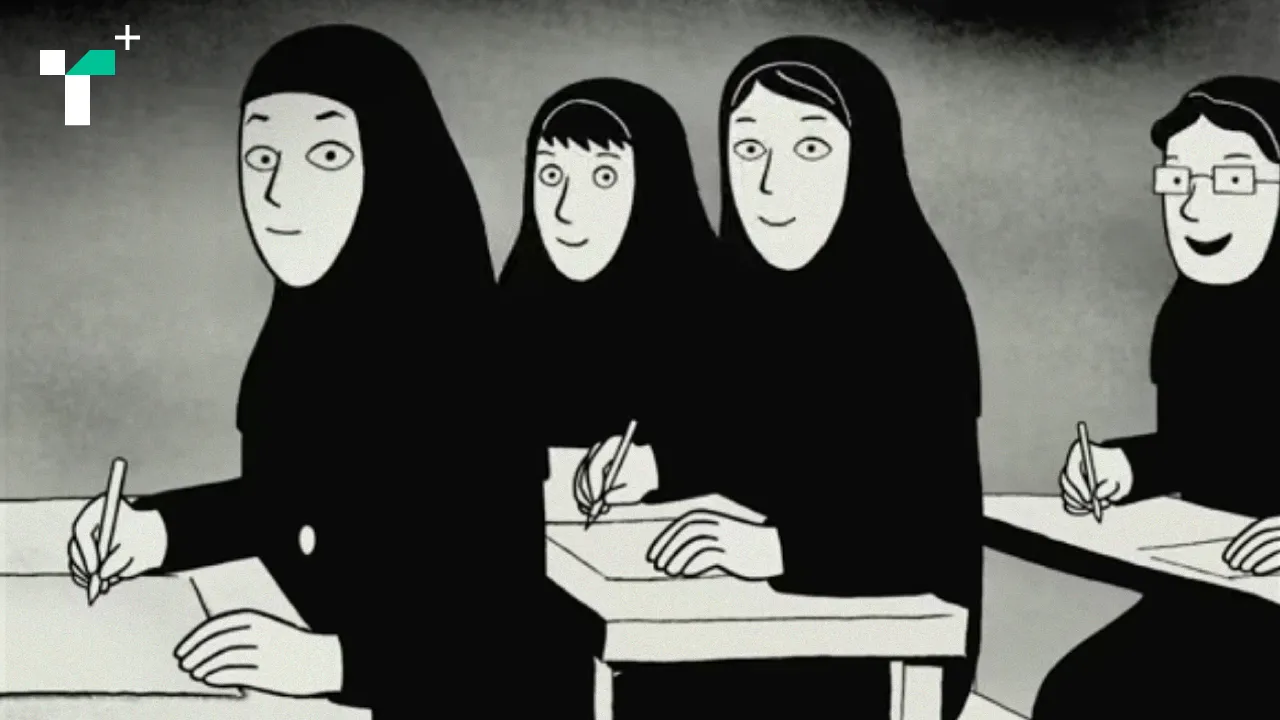
When we try to understand Iran’s turbulent history, what usually appears are lists of leaders, regimes, or dates marking major changes. Yet what outsiders often miss is how these histories leave scars and wounds on ordinary people’s lives. With every power transition, the country’s trauma is not only recorded on paper but lives on in the minds and hearts of those growing up amid political upheaval that cannot be separated from the shocks of governance shifts.
To grasp this complex context, the animated film Persepolis (2007) serves as a crucial window into Iran’s history seen through the eyes of a child. This work is adapted from Marjane Satrapi’s acclaimed graphic novel, which she co-directed with Vincent Paronnaud. The film won the Jury Prize at the Cannes Film Festival and was also nominated for the Best Animated Feature Oscar.
Persepolis narrates the dramatic life of Marjane, a girl growing up during Iran’s transition—from a monarchy to a society strictly controlled under an Islamic state regime.
Marjane’s life runs parallel to national events: starting from childhood in Tehran, then being sent to study in Austria where she faces alienation and personal breakdown, returning home to heal emotionally, and ultimately choosing exile in France, never returning to her homeland.
Marjane’s coming-of-age story clearly shows that when powers clash over political space, ordinary citizens bear the heaviest impacts. To understand this ripple effect more deeply, mapping Marjane’s life onto Iran’s political timeline reveals the human dimension of these wounds most vividly.
1. Pre-Islamic Revolution Era: Childhood under the Shadow of Dictatorship
Marjane grew up in an upper-middle-class family with progressive views and social awareness. Her childhood was surrounded by political awakening, a relatively free life, openness to Western culture, and innocent dreams typical of a child.
Historically, before the 1979 revolution, Iran was ruled by Shah Mohammad Reza Pahlavi under a monarchy closely supported by Western powers, especially the United States, for geopolitical interests and vast oil resources.
From the outside, Tehran might have appeared civilized, filled with impressive buildings and capitalist lifestyles. Yet this material progress was a veneer masking social decay. Authoritarian rule restricted freedoms, and severe economic inequality fueled widespread anger among students, leftists, and religious leaders, all waiting to erupt.
2. Islamic Revolution: From Hope to a Changed Direction
Marjane, her family, and Iranians celebrated on the streets the fall of the old regime, dreaming of democracy and freedom. But they soon faced unexpected strict religious laws imposed with harsh enforcement.
In reality, this period saw a major uprising initially uniting leftist intellectuals, students, and religious groups. Ultimately, the religious faction led by Ayatollah Khomeini seized full power, officially establishing the Islamic Republic.
The state then closely monitored citizens’ behavior. Basic freedoms—listening to Western music, dress codes, even private house parties—were heavily restricted. Mandatory hijab laws for women became a severe source of tension for the younger generation.
3. Adolescence Amid War’s Flames
As Marjane became a teenager, bombings became a recurring reality. People fled to basements in fear. Amid this tension, a silent youth rebellion began. Marjane resisted state rules by secretly buying rock music tapes and wearing punk jackets as symbols of struggling to preserve her identity.
This corresponds with the 1980 crisis when Iraqi President Saddam Hussein exploited Iran’s political instability by invading, sparking an eight-year war that killed millions. For the newly formed Islamic government, the war was both an external threat and a 'legitimate excuse' to enforce strict social order and silence political dissent.
4. Exile: Seeking Refuge from Pain Abroad
When chaos peaked, Marjane’s parents sent her to study in Vienna, Austria, trading safety and future opportunities. However, she faced loneliness, alienation, and stereotyping by Westerners, revealing that the image of a free world was not as flawless as she had imagined.
This aligns with a large wave of Iranian emigration. Many, especially youth and those with resources, fled war and life restrictions, creating a significant diaspora in the West. Many immigrants faced feelings similar to Marjane’s.
Ultimately, Marjane’s life story is not just one girl’s tale but represents countless people growing up amid clashes of state power, ideology, and war. While leaders battle politically, it is the people who are shattered.
The country’s wounds are not only death tolls or revolutionary dates but also in the stolen innocence of children, the silent resistance of youth, and the painful decisions to leave one’s homeland for survival.