

The Origin of The Help AlbumTags: charity album, music collaboration, War Child, fundraising
In late November 2025, Abbey Road Studios was once again bustling with activity and chaos. Rich Clarke, the music management and fundraising head at War Child, recalled that time: Tags: Abbey Road Studios, War Child, music fundraising, Rich Clarke
“I remember the studio was packed with artists, even the dining room. I looked up and saw Green Chattin from Fontaines D.C. chatting with Carl Barât of The Libertines. Looking another way, Damon Albarn of Blur and Gorillaz was waiting for food with Oscar-winning filmmaker Jonathan Glazer. Suddenly, I saw the entire band Pulp queuing for their ordered lasagna.” The first thought wasn’t about food or how hungry the artists were, but rather how they managed to gather together like this.Tags: artist gathering, Fontaines D.C., The Libertines, Damon Albarn, Jonathan Glazer, Pulp
These were just some of the artists who came together to work on the HELP(2) charity album, with all proceeds donated 100% to War Child UK. The album's opening single, 'Opening Night,' was Arctic Monkeys' first new song since 2022, delivering a vibe that was cool, edgy, and captivating, featuring one of Alex Turner's most mature and deep vocal performances.Tags: HELP(2), Arctic Monkeys, charity single, War Child UK, Opening Night
Despite its cool and seductive sound, the song hides underlying feelings of fear, anxiety, and a yearning for global peace amid intense international political conflicts that lead to pointless wars causing loss and suffering. The greatest victims are innocent children, who are uninvolved in adult disputes and battles.Tags: war impact, children victims, political conflict, emotional themes
War Child was founded in 1993 by two British filmmakers, David Wilson and Bill Leeson. While documenting the Bosnian war in Yugoslavia, they witnessed not only the destruction of cities and families but were deeply affected by the cruelty inflicted upon children. These haunting images made them realize that merely recording the events was insufficient.Tags: War Child founding, David Wilson, Bill Leeson, Bosnian war, child suffering
Continuing the MissionTags: War Child mission, charity foundation, child welfare
Upon returning to England, they established War Child to raise funds to aid children traumatized physically and emotionally by war. These children urgently needed basic necessities like water, food, and shelter amid the battlefields of Bosnia and Herzegovina, as well as vital mental health support and long-term education.Tags: War Child goals, child trauma, humanitarian aid, basic needs, education
Such aid required substantial funding, prompting War Child to conceive the idea of producing an album where all sales proceeds would support children affected by war. David Wilson and Bill Leeson leveraged their connections in the British music industry to gather musicians to record songs for this charitable project.Tags: charity album, fundraising strategy, music industry connections
From this modest initiative, The Help Album, released in 1995, became a landmark charity music project. It featured bands like Radiohead, Blur, Oasis, Portishead, Manic Street Preachers, Suede, Sinéad O’Connor, as well as Paul McCartney, Noel Gallagher, and Paul Weller forming a special supergroup called The Smokin' Mojo Filters. This album raised approximately £1.25 million.Tags: The Help Album, charity music, supergroup, fundraising success
“That album was a milestone that showed the world music's immense potential to fundraise for charity,” Rich Clarke said. “At that time, the funds helped supply basic necessities to war-affected people behind the frontlines in Sarajevo, significantly expanding War Child’s reach and support. The world recognized that what empowered War Child most was the money raised through fundraising.”Tags: music fundraising impact, War Child support, humanitarian aid
Children Are the Most Affected in Every BattlefieldTags: war impact, children victims, conflict zones
No matter where conflicts erupt or their scale, children inevitably suffer the most. War Child continues its ongoing efforts to aid these children in war zones. In 2022, inspired by Russia's invasion of Ukraine, the idea for the second charity album, HELP(2), began to take shape.Tags: War Child ongoing aid, HELP(2) album, Ukraine war, child protection
“Since then, we have witnessed the shameful devastation war has inflicted on people in many Middle Eastern countries. We’ve also seen civil war in Sudan, which is arguably one of the greatest humanitarian crises globally. Few have witnessed the scale personally, but global charity statistics show about 15 million children urgently need humanitarian assistance. This stark figure highlights how terrifying the Sudan civil war is,” Rich Clarke explained. He added, “Many artists involved are political activists who had already formed communities, ready to do something to help children.”Tags: humanitarian crisis, Sudan civil war, child aid, artist activism
James Ford, Lead Producer of HELP(2)Tags: James Ford, album producer, HELP(2)
Development of the new Help album project gained momentum in late 2024 when James Ford, songwriter and producer from The Last Shadow Puppets and Simian Mobile Disco—known for working with Arctic Monkeys, Depeche Mode, Foals, Haim, Geese, and more—took charge of the entire project. “Whatever James touches seems to turn to gold,” said Arctic Monkeys drummer Matt Helders in Rolling Stone magazine. He added, “If he brings something interesting together, we know immediately it will be extraordinary and, most importantly, high quality.”Tags: James Ford, music producer, HELP(2), artist collaboration
James Ford’s role as lead producer involved assembling artists to create songs for HELP(2), a challenging task given the limited time to coordinate songwriting, recording, mixing, and mastering—all meticulous crafts that usually require ample time to ensure top-quality music.Tags: album production, James Ford, project challenges
Arctic Monkeys joined the project early because they had previously performed at Royal Albert Hall, donating concert proceeds to War Child in 2018. A live album from that concert was released two years later, with sales proceeds also supporting children affected by war. Combined donations from tickets and album sales contributed at least £1.5 million (about 64 million baht) to War Child.Tags: Arctic Monkeys, War Child support, live album, fundraising
Remarkably, the dedicated recording sessions for HELP(2) at Abbey Road Studios took less than seven days (excluding rehearsals and song development discussions with producers), despite the complexity of coordinating dozens of artists and the visual work led by Creative Director Jonathan Glazer. This compressed timeline created significant pressure, compounded by unforeseen challenges.Tags: recording sessions, Abbey Road Studios, project pressure, Jonathan Glazer
About a week before official recording began, James Ford became seriously ill and was rushed to the ICU. Diagnosed with acute leukemia in late 2024, he required immediate treatment and a lengthy recovery. However, the booked studio time was fixed, and artists’ tight schedules couldn’t be shifted. The team faced the dilemma of how to proceed.Tags: James Ford illness, leukemia, project challenges
After a tense meeting, the team devised a solution by enlisting experienced producers and sound engineers skilled in working under tight time constraints to assist James Ford. This group, overseen by Toby L, co-founder of Transgressive Records, managed daily operations at Abbey Road Studios, handling sound checks, track sequencing, and artist development coordination (A&R), core responsibilities originally held by Ford.Tags: project management, production team, Toby L, studio coordination
“Everyone worked tirelessly to keep things moving forward,” Rich Clarke said. “What emerged from this adversity was positive, showcasing the unity of the UK music community—especially notable since contemporary music industry work often happens in isolation.”Tags: teamwork, music community, adversity, project success
Once James Ford’s condition stabilized, he was moved to recovery and, eager to contribute, requested transfer to a general ward to resume producing remotely via real-time Zoom sessions. He fully engaged in tasks such as arranging notes, overseeing mixing to achieve desired sound dimensions, and managing production with the team.Tags: remote production, James Ford, recovery, digital collaboration
“As a patient, focusing intently on remote work made me feel part of the world again. It gave me strength to fight my serious illness. Completing this album was my will—it anchored and healed me,” Ford said. “Taking full responsibility for the album’s quality transcended my personal situation. I refused to let my illness burden anyone involved. I was heartbroken not to be in the studio or meeting rooms at Abbey Road, missing chats and hangouts with artists, which I loved most.”Tags: personal resilience, James Ford, album production, emotional commitment
“It felt like missing a private Glastonbury Festival just for me.”Tags: personal reflection, James Ford, illness impact
The Book of Love: A Song of HopeTags: The Book of Love, Olivia Rodrigo, cover song, hope
James Ford praised Olivia Rodrigo for her excellent, fresh take on covering The Magnetic Fields’ 'The Book of Love,' which featured Graham Coxon on guitar. “I discussed the recording process with Olivia in detail. We agreed to approach the song in a Frank Sinatra style—vocals with string orchestra. She was highly professional, confidently walking into the studio and nailing everything perfectly.”Tags: Olivia Rodrigo, cover, James Ford, Graham Coxon, production
The song was selected as the album’s closing track, summarizing how amid war's cruelty, children see the world differently than adults, creating safe spaces through pure hearts and friendship to engage in various activities. Every child carries a heavenly gift, capable of joy regardless of the destruction around them.Tags: song meaning, children’s perspective, hope, innocence
War Child Records’ music video showcases children in Gaza, Yemen, Sudan, and Ukraine playing joyfully, laughing, and finding beauty amid ruins. Their spirits remain unbroken. These videos were shot by the children themselves with cameras provided and overseen by Jonathan Glazer, who controlled production after receiving the footage. The acoustic strings and music in this cover blend seamlessly with the children's genuine innocence.Tags: music video, child perspective, conflict zones, Jonathan Glazer
The song reflects love in its simplest form, reinterpreted from the complex, conditional adult world to a sincere, fragile hope for humanity. This 'Book of Love' is no longer a collection of clichéd or boring love theories but, in the war context, carries a heavy burden.Tags: song interpretation, love, hope, war context
Despite a world filled with violence and anger, the children's joyful laughter—viewing adult conflicts that devastate cities—cannot extinguish their hope. A clear line separates the adult and child worlds. Tangibly, children play amid ruins and the lingering smell of explosives.Tags: innocence, resilience, children, war aftermath
Pulp and the Song 'Begging for Change'Tags: Pulp, charity music, Begging for Change
Pulp has long had a strong relationship with War Child. Their 1996 album Different Class won the Mercury Prize. Jarvis Cocker praised War Child’s work for children in war and donated the £25,000 prize money to support the cause. Invited by James Ford to rejoin for HELP(2), Jarvis immediately agreed, seeing it as a great platform to pursue a bigger mission.Tags: Pulp, Jarvis Cocker, War Child, Mercury Prize, charity
“Childhood is a crucial time—the first when we all learn to be human. That’s not easy, especially for children living in war zones,” Jarvis Cocker said. “Kids growing up amid chaos or attending unsafe schools with constant danger feel fear deeply. As adults and artists, we must do everything possible to provide moments of joy, peace, and mental respite so these children can escape their harsh realities.”Tags: childhood, war impact, mental health, Jarvis Cocker
To convey war’s harshness, Pulp’s 'Begging for Change' employs aggressive post-punk, proto-punk, and garage rock sounds, a rare departure from their usual melodic indie rock style.Tags: Pulp, Begging for Change, music style, post-punk
Jarvis Cocker masterfully uses wordplay on 'Change,' meaning both 'small coins' and 'transformation.' From a child-in-war perspective, 'Begging' carries dual meanings: pleading for survival, emphasized in the song’s closing lines—"I beg to live. I beg to breathe. I beg for food. I beg to exist"—a plea for life's basics.Tags: song lyrics, wordplay, survival, war impact
It also expresses a desire to change one’s fate (changing the storyline), since their futures have been destroyed by missiles reducing buildings to rubble. Children ask adults to create spaces of hope instead of devastation. The song references changes like renaming or raising one’s voice, symbolizing escaping the war victim identity to be a normal child who can play and learn without fear. The biting lyric "You pay with your life, they pay with their card" critiques how powerful adults play political games—buying and selling weapons for economic and political gain—while children pay the ultimate price with their lives.Tags: song themes, fate change, war victims, political critique
Without fundamental structural change, pleas for transformation risk eternal cycles of conflict. History will repeat if those in power value profits from arms trade and territorial conquest over human life.Tags: structural change, war cycles, political power, arms trade
Jarvis spent considerable time refining the song before reconnecting with Johnny Marr, former guitarist of The Smiths, whom he hadn’t seen in years. He also met spoken word artist Kae Tempest, Green Chattin of Fontaines D.C., and Carl Barât of The Libertines. All four joined Pulp’s choir for the track, a rare collaboration.Tags: collaboration, Johnny Marr, Kae Tempest, Fontaines D.C., The Libertines
Returning to James Ford, coordinating artists needing detailed creative input was challenging while producing from a hospital room. “I barely took my headphones off. The Space Bar key was magical—it let me talk to everyone in the studio instantly. It was surreal and comforting, maybe due to anesthesia or deep feelings. I’m proud we all persevered and completed this together.”Tags: remote production, James Ford, creative process, teamwork
All artists involved donated their original song copyrights unconditionally to War Child Records. Beggars Group played a crucial role coordinating logistics to realize the project. Rich Clarke said everyone gave their all to make the album a special contribution to the world, with labels and stakeholders waiving distribution fees.Tags: copyright donation, project logistics, Beggars Group, charity album
James Ford stated, “The modern world is rife with conflict. Completing this album with true unity and generosity creates rare hope amid capitalism’s collapse. You know how broken the world is now. We must ask if any hope remains. Honestly, nothing else gives me hope but music. It profoundly gives meaning and value. If this feeling reaches others through this project, that’s the best outcome we could hope for.”Tags: hope, unity, music, capitalism, James Ford
Visuals 'By Children, For Children'Tags: visual art, child perspective, War Child
Adults often stereotype children as naive and unprepared for violence. This misrepresents children in war-torn countries, who are fighters. Although scared, lacking political extremes, they naturally remain centered, learning to find joy in places the world deems hopeless. These children shine as humanity’s brightest hope.Tags: child stereotypes, war children, resilience, hope
War Child’s concept is to portray children respectfully, honoring their vitality and youth’s power. They never use images of injured or psychologically scarred children. This is reflected in HELP(2)’s cover, featuring a boy running through water—a symbol many wonder about.Tags: child imagery, album cover, respect, War Child
The boy’s fast run captures a moment of breaking limits and escaping harsh reality. Children worldwide possess this talent, discovering hope and light even in darkest corners. Though the image reflects war’s cruelty, it also glows with the child’s radiant spirit—a celebration of youth. The cover’s soft color grading conveys unburdened happiness, joy, light, and water symbolizing life.Tags: album art symbolism, childhood, hope, innocence
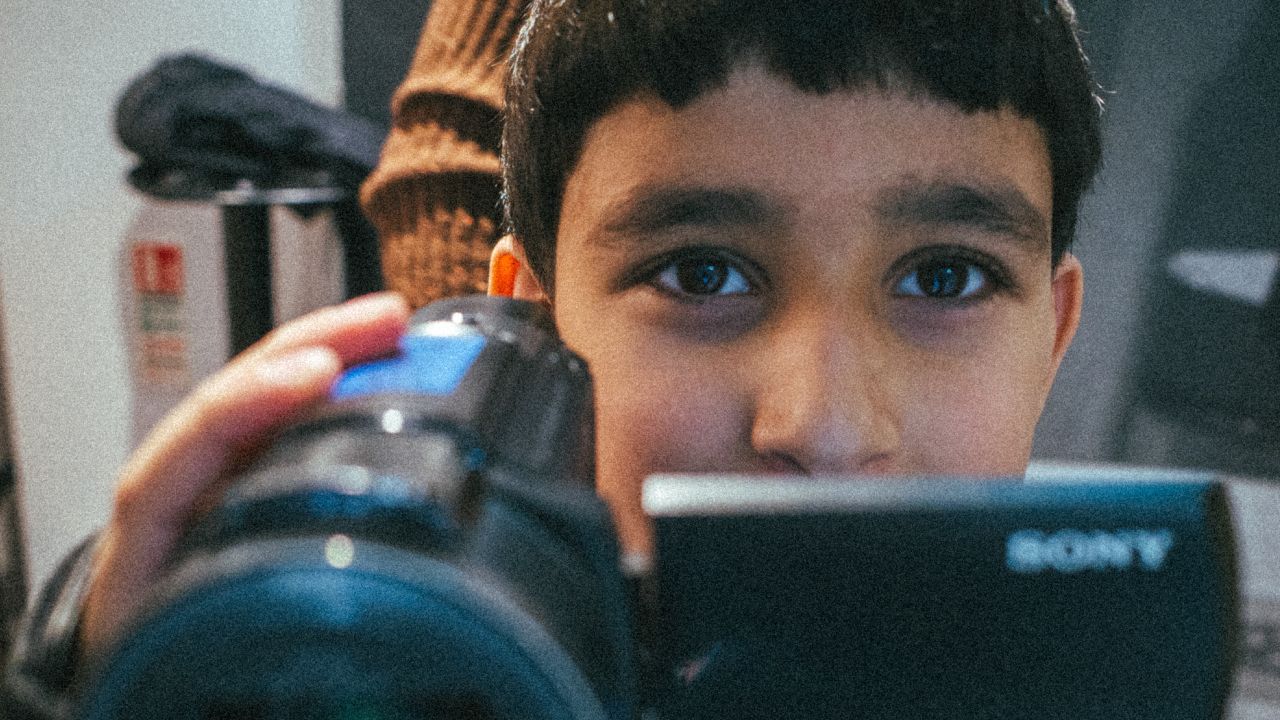
The cover and motion design originated from Jonathan Glazer, a filmmaker deeply attuned to children’s spirit. Academy Films extended his vision by selecting various cameras for 8- and 9-year-olds to film artists playing, singing, and recording without restrictions—letting kids roam the studio freely. This inverted idea treats Abbey Road Studios as a battlefield where no one can bar children from any zone, as all space is their playground. Every shot the children took reflects their play, offering a genuine view of the studio through their eyes.Tags: Jonathan Glazer, child filmmakers, Abbey Road Studios, visual concept
Beyond studio footage, video cameras were sent to children in Gaza, Yemen, and Sudan war zones. Delivering cameras and receiving footage was complex, but partnering with local peace foundations and Academy Films made it possible.Tags: war zone children, video project, peace foundations
The team gave simple filming guidelines: children capturing peers having fun. Glazer believed conflicts would vanish if children had friends to run, jump, climb, laugh, or even fall and lose their cameras. Many kids also filmed natural beauty hidden amid ruins.Tags: child filming, conflict resolution, hope, nature
These images evoke profound emotion, brimming with positive energy and encouragement. Scenes of conflict, normally filled with anger and hatred, transform into hope and light. Humanism permeates almost every shot, as youth is a universal language everyone understands.Tags: emotional impact, child photography, hope, humanity
Children Inspire Studio MusicTags: inspiration, children, music production
These concepts highlight that adults should see children as the future’s center. What children film is their reality, unaffected by political conflict, race, wealth, military power, or geopolitical struggles. Kids film what they want to see—friends playing—not bullet holes, destroyed buildings, or wrecked tanks.Tags: children’s view, reality, innocence, war impact
Similarly, at Abbey Road Studios, children’s curiosity about sounds, instruments, and adult activities drove their filming. They didn’t care about artist fame or adult conflicts, as these were irrelevant to them.Tags: child curiosity, music, adult world
During November 2025 at Abbey Road, the world briefly revolved around children’s innocence. Artists like Damon Albarn, Olivia Rodrigo, Jarvis Cocker, Beth Gibbons, and others adapted to being filmed by kids, humbling themselves and lowering egos to work smoothly without feeling disturbed. The studio was a playground, and every space sparked children’s curiosity.Tags: Abbey Road Studios, artist humility, children’s perspective
To adults, Abbey Road Studios and war-affected areas are vastly different. To children, they are the same: playgrounds and learning spaces—not a legendary music studio or bombed-out city.Tags: perspective, children, environment equivalence
This filming isn’t mere behind-the-scenes footage but a leveling of egos, reducing barriers between superstars and children to equal humanity. Storytelling power rests with children, not victims but chroniclers. Glazer’s footage often lacks polish, yet this rawness perfectly captures children’s innocence—an emotionally powerful weapon fostering empathy.Tags: visual storytelling, Jonathan Glazer, innocence, empathy
Jonathan Glazer’s art is simple and silent yet profoundly resonant. For HELP(2), he crafted a life documentary reminding us that:Tags: Jonathan Glazer, art philosophy, documentary
"While war steals some things from children, it cannot take away their natural playfulness across all races." Adults have much to learn from children if they can set aside egos.Tags: resilience, innocence, war impact, learning
Studio AtmosphereTags: studio environment, collaboration
Many wonder about the studio atmosphere. Rich Clarke, who coordinated artist schedules, said everyone was excited to meet filmmaker and artist Jonathan Glazer, universally admired. The band English Teacher comforted each other when nervous. Lily from Fontaines D.C. paused everything to say hello to Jarvis Cocker, his band’s hero.Tags: studio vibe, artist interactions, Jonathan Glazer, English Teacher
The studio was filled with skilled artists. Johnny Marr often watched other bands rehearse, including Fontaines D.C. practicing 'Black Boys on Moped,' a cover of Sinéad O’Connor. He offered no advice, just a subtle smile.Tags: artist observation, rehearsals, Johnny Marr, Fontaines D.C.
Rich Clarke loved this working atmosphere—free from profit, advertising, or pressure. Everyone worked independently yet happily, building genuine connections. Many artists met for the first time, quickly becoming friends through brief conversations. This reflects the album’s core goal: creating a happy shared space.Tags: collaboration, friendship, working environment
Behind the Album and Context Hidden in Each SongTags: album background, song context
'Flags' was composed by Damon Albarn, awaiting contributions from others. Kae Tempest and Green Chattin wrote their own lyrics responding to each other. Musicians included Johnny Marr on guitar and vocals, Adrian Utley (Portishead) on guitar, Femi Koleoso (Ezra Collective) on rhythm, and Seyé Adelekan (Gorillaz) on bass. Damon said recording took two days. Having children film in the studio inspired better performances, making children integral to the song’s process. Green said collaborating with idols was the greatest gift.Tags: Flags, Damon Albarn, collaboration, child inspiration
The song features two choirs: 43 children and an adult choir including Jarvis Cocker, Carl Barât, and Declan McKenna. It’s driven by a simple but precisely timed piano melody. The core message questions how long humanity will cling to divisive symbols—walls separating people—in a world full of conflict.Tags: song structure, choir, symbolism, unity
The 'wall' symbolizes flags, which no longer represent nations but are waved to deepen 'us' versus 'them' divides. Lyrics such as “Stitch a tear to a prayer...” urge turning flags symbolizing division into sails uniting people to move beyond conflict.Tags: song lyrics, symbolism, unity, division
Depeche Mode’s 'Universal Soldier' employs electronic/darkwave synths with excellent production, blending bass and high-frequency sounds seamlessly, matching the song’s theme well.Tags: Depeche Mode, Universal Soldier, music production, electronic
Originally written by Buffy Sainte-Marie and performed by 1960s folk group The Highwaymen, the song deconstructs war’s mechanisms rather than attacking specific nations or individuals.Tags: song origin, war critique, folk music
'Universal Soldier' implies soldiers can be anyone from any nation. It mentions leaders like Hitler and Caesar, stating their greatness depends on soldiers dying for their glory. Soldiers have morals but are forced by war to act against conscience to protect 'our side.' The song views war as collective responsibility; without citizens’ consent to fight, war cannot exist.Tags: song meaning, war responsibility, soldiers, leadership
Velvet Underground’s 'Sunday Morning' isn’t about war but, given its mood and some lyrics, offers a fresh perspective critiquing modern war, proving the timelessness of this iconic art rock band’s work.Tags: Velvet Underground, Sunday Morning, timeless music
Beth Gibbons of Portishead covers the song as an acoustic ballad with guitar and ethereal keyboard tones enhancing loneliness. Lyrics like “It's just the wasted years so close behind” and “It's all the streets you crossed not so long ago” evoke melancholy, reframing war survivors' haunted memories of lost peace and past beauty.Tags: cover song, Portishead, melancholy, war trauma
The Last Dinner Party’s 'Let’s Do It Again!' blends art rock, power pop, and rock ’n’ roll with ironic storytelling. While addressing toxic romantic relationships, it metaphorically reflects cycles of violence.Tags: The Last Dinner Party, art rock, irony, violence metaphor
The song’s depiction of repetitive love-hate routines symbolizes vicious cycles of violence, and the frightening part is how such patterns become normalized and addictive.Tags: song meaning, cycles, violence, addiction
Lyrics referencing domestic violence—"Cut down the willow tree," "Knocked it down," "Pins on the floorboards"—symbolize a once-safe home invaded by war’s violence. This turns relationships into battlegrounds, with children as primary victims. It reflects humanity trapped in destructive cycles, mirroring our world’s current struggle for peace often ending in fierce power conflicts.Tags: domestic violence metaphor, war impact, cycles
English Teacher’s 'Parasite,' featuring Graham Coxon, is a post-rock track with beautiful guitar rhythms and melodies. It reflects the parasitic dynamic between leaders and people, an inescapable vicious cycle described in the opening line, "I can't escape you, try as I might."Tags: English Teacher, post-rock, social critique
The song critiques ideological brainwashing—fake news, biased reporting, 'us versus them' narratives—viewed as ideological parasites justifying war. In modern warfare, hunters and hunted rely on violence to survive. The line "You don't swing in our moral playground, do you, babe?" sharply criticizes moral decay in war’s ethical arena.Tags: ideological critique, war morality, propaganda
The chilling line "Without you sitting there, I've eaten everyone" epitomizes 'war compulsion'—how war transforms humans into beasts for survival. Without empathy (symbolized by the 'person opposite'), people turn to kill to protect their side. This captures war's cyclical essence, echoed in the repetitive outro.Tags: war psychology, survival, dehumanization
Fontaines D.C. reimagined Sinéad O’Connor’s 'Black Boys on Mopeds,' diverging from their signature indie rock. This slow song builds walls of acoustic pop and noise rock, enhanced by haunting string arrangements toward the end.Tags: Fontaines D.C., cover song, musical style, arrangement
The song questions the state’s (here, Thatcher-era England) image as peaceful and moral, contrasting it with violent oppression of powerless citizens. Thatcher’s shock at Tiananmen Square protests, despite her own domestic violence and refusal to recognize IRA prisoners as political, shows she was a war machine wielding power not to protect but to control for personal gain. Such patterns persist in proxy wars.Tags: political critique, Thatcher, state violence
The lyric "And I love my boy and that's why I'm leaving" expresses a mother’s despair, not wanting her child to grow in a world scarred by state cruelty. This deeply connects with HELP(2)’s theme: the adult world coldly destroying childhood.Tags: maternal perspective, despair, childhood loss
Beabadoobee covers 'Say Yes,' originally by late singer-songwriter Elliott Smith, written after his breakup with Joanna Bolme, bassist of Stephen Malkmus and the Jicks. While a personal encouragement song, Elliott’s tone reveals deep sadness and despair.Tags: Beabadoobee, Elliott Smith, cover song, emotional depth
Beabadoobee’s vocals are sweet yet poignantly lonely, capturing Elliott’s emotional essence that has long captivated fans. Choosing this song for HELP(2) is notable, as its heartbreak theme gains profound resonance in a war context.Tags: vocal performance, emotional interpretation, war context
Lyrics like "But now I feel changed around. And instead of falling down. I'm standing up the morning after" shift from heartbreak to resilience. In a protest song context, it symbolizes resistance against death. War causes injury and destruction, yet 'Say Yes' conveys choosing to stand firm despite peace’s fragility—a hopeful act in a nearly hopeless space.Tags: resilience, protest song, hope
Listening to this song alongside images of children playing amid ruined cities evokes indescribable feelings.Tags: emotional impact, music and imagery
Every song on HELP(2) holds value and layered meaning through simple yet complex storytelling, hidden interpretations, track sequencing, tonal control, sound design, visuals, and production.Tags: album analysis, songwriting, production
This is a top-tier music work including tracks like Cameron Winter’s 'Warning,' a wake-up call against ignoring war’s violence affecting everyone; 'Sunday Light,' an ethereal wave/dream pop featuring Anna Calvi, Nilüfer Yanya, Dove Ellis, and Ellie Rowsell from Wolf Alice, discussing youth frozen in shattered memories.Tags: featured songs, artists, themes
Their time stopped due to loneliness and waiting for something never to come—family or home destroyed. Lyrics like “Handprints on the wall” vividly portray children leaving traces of existence before everything collapses and past beauty is lost forever.Tags: song themes, loss, memory
Other notable songs include 'Strangers' by Black Country, New Road; 'Helicopters' by Ezra Collective; 'The 343 Loop' by Greentea Peng; 'Nothing I Could Hide' by Arlo Parks; 'Lilac Wine' covered by Arooj Aftab and Beck; 'Relive' and 'Redie' by The Big Thief; 'Don’t Fight the Young' by Young Fathers; 'Naboo' by Sampha; 'When the War Finally Done' by Foals; and 'Carried My Girl' by Bat for Lashes—all presenting varied artist perspectives on war and affected children.Tags: diverse tracks, artist perspectives, war themes
Overall, the shared theme reflects humanity shaken by power and possession, how adult violence damages youth spirits, the endless path of death surrounding aimless lives, and the despair when no refuge remains amid unending war cycles.Tags: thematic summary, war impact, human spirit
Yet many songs also offer admirable hope through artists’ tones and subtext, showing that numerous adults strive to guide children out of internal and external battlefields, creating spaces for youth in war zones to grow, imagine, think independently, and choose their paths when possible.Tags: hope, youth empowerment, adult support
After multiple listens and reflections, HELP(2) offers listeners the message: the world is full of violence and injustice, affecting both children and adults. But it’s not our duty to pass our trauma to children’s pure hearts.Tags: message, trauma, innocence
Bombed buildings appear frightening but can be rebuilt when war ends. War isn’t constant; violence’s true nature grows within us. It’s our shared responsibility to break this cycle inside, ensuring it isn’t passed to innocent children unaware of such horrors.Tags: rebuilding, violence cycle, responsibility
Once a child’s innocence is shattered by explosions and inner wounds, it cannot be restored. All we can do is bury the lost fragments in a heartbroken grave.Tags: lost innocence, trauma
HELP(2) was created to protect that innocence or, at worst, to revive the precious spiritual asset of children’s innocence that’s fading.Tags: album purpose, innocence preservation
In a world of complex conflicts beyond a child’s burden, we can’t teach them war’s harsh truths but instead sit beside them, sharing the world’s beauty, pointing out small wonders, and letting them play in vast fields where their dreams can still grow.Tags: hope, childhood, protection
References:Tags: references
https://www.rollingstone.co.ukTags: source
https://radiox.cms.socastsrm.comTags: source
https://diymag.comTags: source
https://www.buildhollywood.co.ukTags: source
https://faroutmagazine.co.ukTags: source
https://www.brooklynvegan.comTags: source