

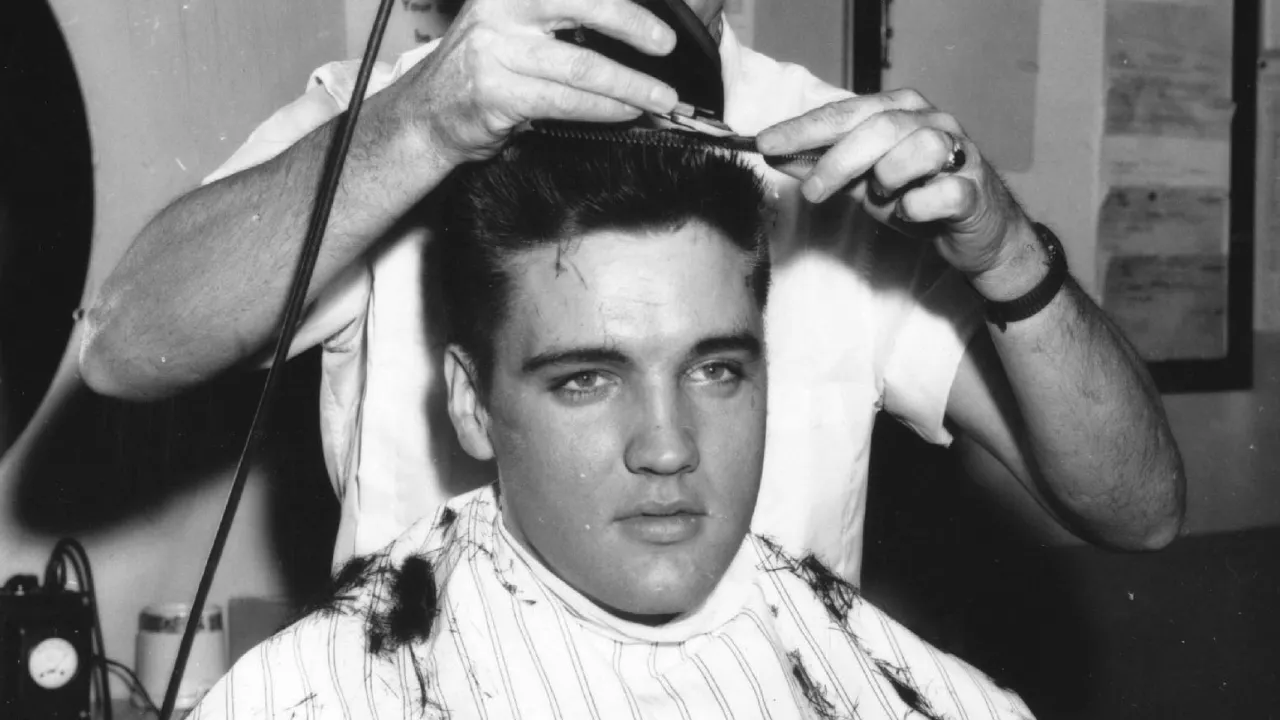
"...Hair today, gone tomorrow." "Hair today, gone tomorrow."
This short, humorous phrase from rock king Elvis Presley echoed amid the shutter clicks and flashing cameras of 55 reporters crowded into the Fort Chaffee military camp barbershop in Arkansas 68 years ago.
The army barber clipped down Elvis’s famously thick hair and signature sideburns—the look that made him the world’s most famous man—resulting in what the media dubbed the "Haircut Heard 'Round the World," a trim that shocked the globe.
This photo, taken on March 25, 1958 GMT+7, captured more than a star’s induction moment; it symbolized the temporary end of a cultural rebellion, transforming the dangerous icon despised by conservative adults into a disciplined, patriotic young man—the true embodiment of American identity at the time.
In 1950s America, Elvis’s sleek Pompadour and long sideburns reaching his cheeks were seen as moral threats and unavoidable symbols of rebellion.
Many high schools banned this hairstyle, newspapers condemned it en masse, and even veteran star Bing Crosby once told him, "Go shave off those sideburns!"
Elvis had been registered for the draft since the end of the Korean War in 1953, initially deferred as a student and later granted a hardship deferment—not for personal hardship, but because Hollywood studios had heavily invested in filming "King Creole."
Naturally, once filming wrapped, Uncle Sam was not willing to wait any longer.
When the draft notice arrived, some politicians, including New Jersey Senator Clifford Case, sought legal loopholes to exempt Elvis from cutting his hair to preserve his star image. However, the military and Elvis himself declared clearly there would be no special privileges.
Moreover, the U.S. Navy tried to recruit Elvis into the Special Services unit, assigning him to sing recruitment songs and giving him private accommodations.
But Colonel Tom Parker, Elvis’s manager, rejected all these comfortable offers.
The manager understood that accepting special treatment would brand Elvis as a privileged star. Allowing the army buzzcut and enlisting as Private Presley erased his delinquent image in adults’ eyes and won over former critics—without any military advertising campaign needed.
Elvis was not sent to grab a microphone but to take the tank driver’s seat in the 3rd Armored Division stationed in West Germany, near the strategic Fulda Gap—the Cold War's most vulnerable frontline corridor, considered the likely Soviet invasion route into West Germany toward the Rhine River.
America’s bold move to deploy a national treasure to such a dangerous frontline made the Soviets suspect a psychological warfare operation aimed at luring communist soldiers.
East Germany’s government tried to counter Elvis’s influence by creating a morally upright dance called "Lipsi," posting signs in dance halls forbidding separate partner dancing to block rock-and-roll moves.
The Lipsi dance failed, as East German youth still craved American freedom. The image of Private Elvis in uniform became a powerful soft power weapon against communism during the Cold War.
Behind the cool military uniform was Elvis’s immeasurable pain. The dawn photo of his departure showed his mother Gladys’s sad, bruised eyes—the last time he saw her healthy before sending her only son far away.
Five months later, Gladys died of a heart attack. Elvis was allowed to return to Memphis for the funeral. He was shattered, calling his mother’s death the greatest tragedy of his life.
In music, Elvis’s two-year absence created a huge vacuum, paving the way for new waves like Motown Records, The Beach Boys, and The Beatles to rise to prominence.
After his 1960 discharge, Elvis reclaimed his throne, but his rebellious, edgy persona had vanished along with the hair cut in that barbershop chair.
The new Elvis became a mainstream Hollywood star, shifting from aggressive rockabilly to softer pop and ballads, reaching a broader audience. His iconic long sideburns disappeared for many years.
Today, visitors to Arkansas can see the Fort Chaffee barbershop preserved as the Fort Chaffee Elvis Barbershop Museum, allowing people to stand where the haircut that shook the world happened.
Elvis in his olive uniform left a legacy showing that, whether conscription is voluntary or not, it takes away something and shapes something new.
It marked a deep turning point in many men’s lives, where once enlisted, their lives and identities might change forever, never to return to what they were.
#ThairathPlus #Thai Rath Plus #Military Draft #ElvisPresley #SoftPower