

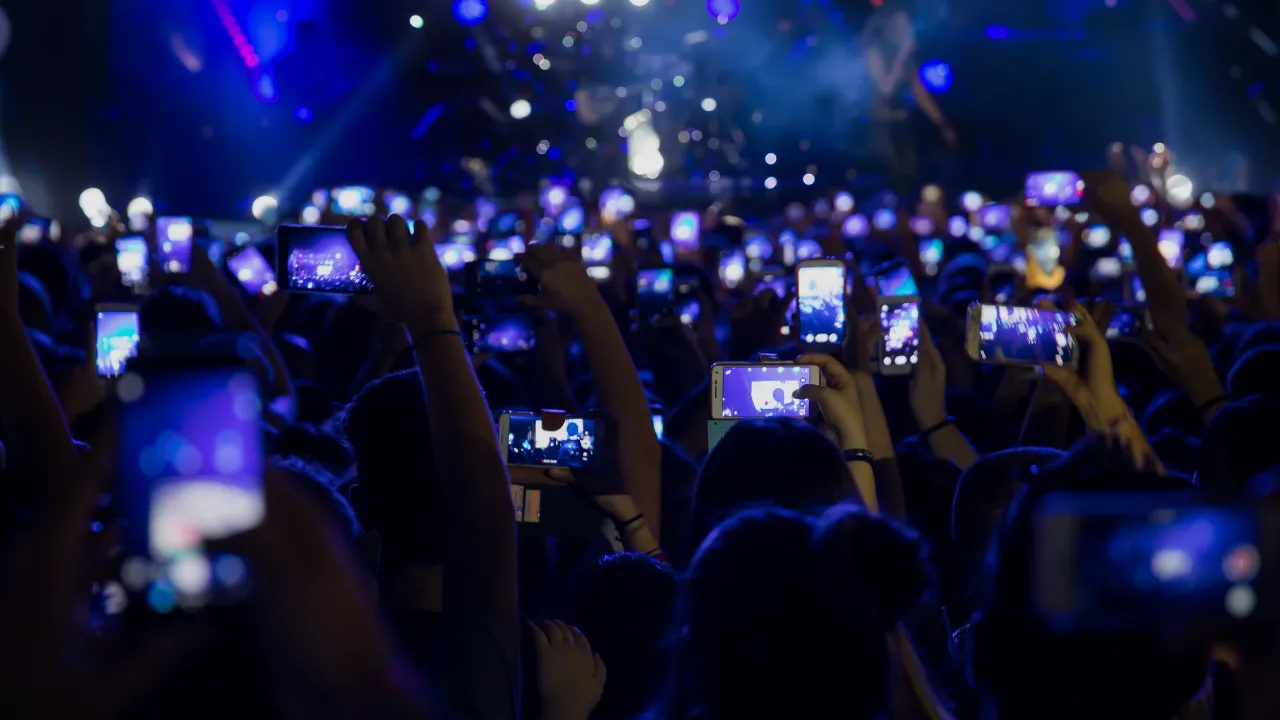
Nowadays, practically everyone owns a mobile phone, and with the continual improvements in smartphone photography and video technology across brands, anyone can act as a cameraman, capturing both still photos and videos. Remarkably, some YouTube clips featuring fan-shot footage of artists show such impressive image quality, perspectives, and editing that it’s often hard to believe these are amateur works.
Today, attending concerts—especially those by world-class artists—and getting a clear view of your favorite performers has become difficult because the view is dominated by countless smartphone screens. It has become normal to dodge these screens just to find a small gap to see the stage. Ironically, shorter attendees, who struggle even to see the stage edge past taller people, solve this by watching the concert through others’ phone screens, which sometimes offer 4K clarity sharper than the venue’s LED screens that can be blocked from view.
This sea of smartphones has become a subculture that delights those filming but causes distress to those who don’t want to record. It’s a paradox for music fans who, despite sharing the same crowded concert space, seem to exist in separate worlds. The idea that filming clips of a beloved artist to keep isn’t wrong is common.
But the big question is: how often do people actually watch the clips they record? Researchers note that many concert video addicts exhibit hoarding-like behaviors—accumulating excessive clips they can’t discard—not because the clips are worthless, but because they hold immense emotional value.
Research titled The Presentation of Self in the Age of Social Media by Dr. Bernie Hogan, Professor of Sociology and Anthropology at Oxford University, reveals that people carefully curate their best selves to compete in digital public spaces. Concerts serve as a “sandbox” environment where attendees use artists as a shared medium, like beach sand, to equally showcase their skill in building the most beautiful sandcastle.
To build the best sandcastle, creators need high-quality tools. Thus, the top-tier smartphones with superior photography capabilities are as essential as expensive plastic sandcastle molds in a toy store. Skill is crucial too, so it’s unsurprising to see concertgoers adeptly adjusting manual camera modes and zooms in sync with the music, like professionals. Yet, these skills are unnecessary if the footage is just for personal viewing.
Dr. Bernie Hogan’s The Presentation of Self in the Age of Social Media builds on Erving Goffman’s influential 20th-century theory The Presentation of Self. Goffman viewed social interaction as essential for modern humans, regardless of introversion or extroversion, since social acceptance provides leverage in building personal stability across social status, career, and finances. He likened socializing to theater, where people choose a “front stage” to present the image they want others to see.
Before smartphones, carrying a small compact camera to photograph favorite artists at concerts was about capturing treasured moments to revisit later. This is nostalgia via tangible photos. Attending a live show meant directly witnessing reality, which ended the moment the concert finished.
Dr. Hogan’s research delves deeper into self-presentation on social media. He argues that when concerts are viewed through phone screens, reality immediately distorts because the pixels on a phone aren’t real. Live performances instantly become exhibitions. The moment someone films, the live experience turns into an “artifact” that’s subsequently displayed online via Instagram Stories, Facebook, X, and other platforms.
This is a new form of self-presentation using smartphones, artists, concert production, and artist popularity as components akin to sand poured into plastic molds to build the most beautiful sandcastle on the beach. In this exhibition stream, the beach fills with diverse sandcastles, which, however, spoil the natural scenery of smooth sand that connects humans with nature. These sandcastles also block the view of the vast, beautiful sea stretching endlessly.
Many art theorists, contemporary philosophers, and researchers argue that in the modern world, anywhere can become an exhibition—including concert venues. Russian art critic and media theorist Boris Groys wrote in Self-Design and Modern Life (2008) that today, people don’t just create art for museums; they themselves become artworks permanently exhibited. Social media transforms personal life into a permanent exhibition requiring constant curation of one’s image for public display.
Back in 1988, cultural scholar Tony Bennett proposed "The Exhibitionary Complex," explaining that exhibitions once meant displaying objects for viewing, but in modern society, the "exhibition mechanism" extends beyond museums into social order, making people feel constantly observed and compelled to perform, fostering self-discipline. This foresaw today’s algorithm-driven world with uncanny accuracy.
Even more prescient was French philosopher Guy Debord, whose 1967 book The Society of the Spectacle criticized capitalism’s impact on human life and social relations. He argued that when power and status are involved, true human identity erodes, and social expression becomes theatrical, resembling a grand fake museum exhibition focused on image over substance. He poignantly noted, “All that was directly lived has become mere representation.”
These thinkers’ theories clearly show that for some, attending concerts and immersing themselves in live music to express deep emotions is now outdated. Social media in Thailand and abroad publish strict concert etiquette rules forbidding loud talking, smoking, and continuous phone use or filming. Yet some rules, like not singing along during rock or metal shows, puzzle many—because before the internet age, singing along was the sincerest way to show love for artists.
Today, concertgoers act as curators, selecting photos and videos in their personal concert museums. Modern concert stages resemble theater sets and Instagram feeds where curators pick the best shots, loudest songs, hottest dance moves, and favorite members to craft an image of “This is me having the best time!”
Ironically, since everyone focuses on the same thing and wants to show the same image, the resulting content looks nearly identical. This panders to large online audiences but causes curators to neglect their primary role: fulfilling the artist’s needs—primarily, experiencing the music live with emotional engagement. Instead, they dilute the depth and quality of the artist’s work to appeal to the lowest common denominator, a contemporary media communication culture term.
Having analyzed audiences, now imagine being an artist on stage. Instead of seeing faces, you face thousands of smartphones obscuring the crowd. Many fans shift and squirm to dodge phones blocking their view, creating a chaotic scene.
Jack White, former member of The White Stripes turned solo artist and founder of Third Man Records, discussed smartphone seas at concerts with Metallica drummer Lars Ulrich on Apple Music’s Beats 1, explaining why he bans phones during his live shows.
He argued that concerts should be fully human-to-human experiences. He described banning phones during shows as an intriguing artistic experiment and joked that it would be surprising if fans demanded full refunds over this rule.
“I always react to the audience, like a stand-up comedian feeding off crowd energy. If I finish a song with a flourish but hear only crickets (silence), I wouldn’t know how to proceed—should I play harder or acoustic? Or maybe they want me to go home? What I hate most is not knowing if they care at all. If that’s the case, I’d rather leave!” Jack White expressed how he would feel if audience energy was absent because they were fixated on screens and texting.
He added, “I love punk concerts because they have no rules. No one films at punk shows; it's pure emotional release. But if the show is disrupted, I wouldn’t know what to play next. I’ve even left the stage before because I was lost. If this continues, it will make true artistry even harder.”
The Yondr Policy uses magnetic lock pouches by Yondr company to create phone-free zones, initially in schools to prevent phone use during class, now applied at concerts. Jack White first used it on his 2018 Boarding House Reach tour, instituting a strict “No photos, video or audio recording devices allowed” rule. Audience phones are locked in pouches opened only in designated areas. To counter the "record for memory" excuse, White hires professional photographers to capture each show and uploads photos free for fans, implying “I’ve got great photos—just enjoy the concert.”
Artist Mitski tweeted, “Hi, I just want to talk about phone use during shows because sometimes I see people filming entire songs or shows. It makes me feel we’re not really there together, separated by devices not made for this.”
Her simple request appeals to concert magic: sharing emotional connection through music, not phones. Songs let artists and fans share dreams, creating memories of fleeting yet equal life moments. She tweeted, “Watching through screens reduces me on stage to a mere commodity in consumerism, serving content creation.”
Later, it emerged that Mitski’s management posted the message. Though reasonable, the tweet sparked backlash from some fans who viewed filming as essential. The backlash led Mitski to quit social media during her 2019 tour, despite previously engaging regularly with fans online.
Having analyzed causes of the smartphone sea culture, let’s hear from fans explaining why they film. One Twitter user said, “What you say makes sense, but some of us have mental health issues like dissociation. I record videos to help remember events—not staring at my phone constantly, just recording.”
Following this, more fans of Mitski explained filming’s necessity due to ADHD, depression, and other mental illnesses requiring phones to capture memories. The intensity of these responses made management delete the tweets, concerned for Mitski’s mental health.
Meanwhile, many fans defended her, arguing artists have the right to request phones be put away. Mitski isn’t alone in this; she only asks for respect, which benefits fans by allowing them to fully experience songs and visuals live—not through screens.
Many artists explicitly reject seeing seas of phones at concerts, including Guns N’ Roses, Pulp’s Jarvis Cocker, Alicia Keys, and the late musical genius Prince. Contemporary American folk-rock band The Lumineers declared filming ruins the atmosphere, urging fans to stay present. Rapper Kendrick Lamar dislikes fans filming and even restricts professional photographers on some tours, allowing only a few who don’t disrupt performances.
Artists who dislike phones at concerts include Bob Dylan, Swedish hard rock band Ghost who banned all phone use during their 2025 tour to preserve atmosphere, and progressive rock masters TOOL who enforce a strict no-filming rule with ejection for violators—allowing filming only during the final song if fans maintain good concert etiquette. Others requesting phone-free shows include Madonna, John Mayer, and Beyoncé.
Adele once said mid-show, “The real me is here—enjoy the show with real life, not through a camera.” Veteran artist Kate Bush prefers interacting with fans through expressions and gestures on stage, since iPhones, iPads, or cameras cannot replicate that. Pink Floyd’s Roger Waters stated, “I will never use a phone during concerts anywhere. Today’s world lacks respect—for artists and fellow audience members alike.”
It’s not just musicians who dislike filming; during a Golden Globes interview, Oscar-winning actress Jennifer Lawrence told a reporter to stop filming her with a phone during the interview.
Celebrities often resist filming because they don’t want unflattering images captured by non-professionals circulating online. Jennifer Lawrence exemplifies this, but usually such incidents involve stars conscious of their image. Similarly, Bob Dylan’s objection partly concerns unauthorized copyright use of concert images online.
Some artists’ filming bans have business reasons: smartphone videos now rival professional footage in quality. High-quality fan-shot concert clips on YouTube can reduce sales of official Blu-rays, DVDs, online releases, or concert films in theaters. Access to quality clips online may discourage younger fans from buying tickets, as many believe watching YouTube is sufficient and free.
Not all artists dislike phones or see fans filming as a serious issue. Recording preserves memories, like souvenirs from invaluable experiences, allowing repeated reminiscence.
From another perspective, recording a few songs at concerts benefits artists. Fans passionate about music want to share it and attract others, making fan recordings excellent marketing in the digital age.
Grateful Dead embraced fan recordings, allowing attendees to freely record live shows. This led to widespread tape trading long before digital video existed. When album sales declined, new fans flocked to concerts after hearing these shared recordings.
Late Grateful Dead guitarist and vocalist Jerry Garcia encouraged live recordings, even designating a “Tapers Section” at shows for fans to set up recording gear. By the mid-1980s, recording and tape trading became subcultures among Deadheads, proving a highly successful marketing strategy endorsed by the band.
Ed Sheeran has a unique view on smartphones. In 2024, he told Jake Shane on the Therapuss podcast that he finds it stressful when people ask for his phone number for business or casual chats, as he lacks a basic phone or a smartphone used primarily for voice communication.
Sheeran said the only way to contact him is by email. He doesn’t own a personal smartphone; he borrows phones from his team only when necessary, including for social media updates. He stopped using a personal smartphone in December 2015 due to overwhelming contact.
“I had a phone number and contacts list of over 10,000 people, all messaging me constantly. I felt overwhelmed by others intruding on my life, but couldn’t ignore messages as replying is polite. Suddenly, I was exchanging 40 back-and-forth messages in a single conversation.”
Clearly, Sheeran views smartphones as technology reducing personal solitude. He sees filming at concerts similarly: “When I look at crowds, I see no eyes—just phone screens checking if the video is clear.” He finds it strange because concerts are best experienced by watching the stage live, not through a phone screen, no matter the resolution. Yet many fall into this smartphone-created illusion.
Still, Sheeran never bans fans from filming. He’s said, “I don’t mind if you record a couple of your favorite songs because I understand wanting to keep memories.” However, he encourages fans to put phones down and experience the live performance fully.
Despite recent pushback against smartphone filming from artists and traditionalist fans who see phones as concert distractions, some artists see smartphones as essential for creating interactive engagement between themselves and fans—a dynamic impossible before smartphones existed.
Katy Perry often invites fans onstage to take selfies with her. In 2009, Radiohead allowed fans to compile amateur footage from a Prague concert into a fan-made concert film, providing high-quality audio files for the project. This collaborative use of technology aligned with their album In Rainbows’ concept, exploring human relationships in the modern world.
That album broke barriers between artists and listeners by letting fans pay any amount for the digital download, asserting music’s value equals what listeners assign. This challenged major labels treating artists as mere products, often diluting artistic identity to fit trends, resulting in homogenized music and image.
Radiohead wasn’t first: in 2006, The Beastie Boys distributed 50 video cameras to dispersed fans at their Madison Square Garden concert, letting them film whatever they wanted.
The band’s media team collected the footage to produce the concert film Awesome; I Fuckin' Shot That!, directed by band founder Adam Yauch (now deceased). This film honored fans by presenting concert visuals entirely from their perspective.
Today, ultra-high-definition smartphone videos have become “Social Currency” online, enabling influencers, YouTubers, and social media users to gain "acceptance" and "visibility"—akin to currency. This explains why many young people relentlessly film concerts, disregarding the discomfort and effort of finding good viewing angles among towering phones.
The reason everyone raises phones despite blocking others’ views or their own is that today, "unrecorded experiences are valueless." Many under social media’s sway aggressively accumulate Social Currency to trade for digital acceptance, forgetting that music’s true value lies in heartfelt, lived experience, not engagement metrics.
While bands like Radiohead and The Beastie Boys used technology to create art aligned with their rebellious album concepts, today it often serves fans’ egos: filming concerts to prove early access to experiences. Some page owners with hundreds of thousands of followers even divert attention from the live show for minutes to upload clips ahead of competitors.
Filming rare indie songs at concerts and posting clips without understanding the music signals offbeat taste within a peer group. Recording top artists from front rows or VVIP zones signals true fandom and personal effort or wealth. When clips get shared or reposted by others or artists, the recorder’s status rises overnight as an influencer. High Social Currency content draws massive comments and shares; clearer audio or unique angles resembling professional quality boost value further.
In K-pop, fan cams—fan-filmed videos of idols on stage—are key industry drivers. The iconic case is EXID’s 2014 fan cam of Hani dancing during "Up & Down," which went viral, resurrected a dropped chart song to #1, and saved the group from disbandment. This highlights fan cams’ tremendous market value in K-pop.
Fan cams build Social Currency for both the filmer and fandom. They let viewers focus on their favorite member throughout a song, impossible in regular TV broadcasts. Fan cams often serve as more genuine artist promotion than expensive official music videos since they capture unfiltered performances.
Due to fan cams’ powerful economic impact, K-pop labels that once spent much effort removing fan cams online over copyright concerns now embrace them as official promotional tools, creating their own official fan cams. Korean broadcasters also use dedicated fan cam cameras to cater to smartphone viewing habits.
In St. Vincent’s song "Digital Witness," she questions if something unseen online truly exists, with the lyric "If I can't show it, if you can't see me, what's the point of doing anything?" This vividly represents how without posting clips or photos on social media, one appears nonexistent.
The song isn’t a direct jab at concert smartphone seas but a satire of modern life’s gradual identity erosion by virtual worlds. The title "Digital Witness" reflects that digital witnesses need constant online evidence, posting proof for social networks; otherwise, events seem never to have happened. This explains why people watch concerts through phone screens instead of live—without filming to upload or keep, it’s as if they never attended.
The song’s closing lines urge, "Keep staring at your screen," and "Digital witnesses, why sleep if no one sees? What’s the point? I won’t sleep anymore." This expresses that to prove existence, one must abandon true identity and create fake personas online. The final plea, "Won't somebody sell me back to me?" poignantly asks who can restore lost real identity once consumed by digital life.
Other songs address online identity loss, like Arcade Fire’s "Reflektor," which discusses seeing each other through symbolic "mirrors"—screens—losing true selves, with lyrics about falling in love at 19 but now just staring at screens, reflecting pixelated human relationships.
Father John Misty’s "Total Entertainment Forever" portrays spiritual decay from technology and entertainment. The knockout punch is: "When historians find us in the future, they’ll find us at home, plugged into hubs, skin and bones, frozen smiles on every face," illustrating humanity’s tragic loss of valuing real experiences in favor of virtual escapism, even to death.
Beck’s "Cellphone’s Dead" asks how we’d handle silence if communication tools failed. Would we still enjoy concerts without phones? Tame Impala’s "New Person, Same Old Mistakes" explores the contradiction of trying to be new to others but clinging to old habits—like vowing to fully enjoy a concert but still filming it.
Imagine the whole world’s daily life reduced to grain on film or pixel dots recorded by someone with a giant smartphone capturing everyone. How meaningful is life seen only through such screens to the one secretly filming?
Answers vary, but certainly, being constantly observed by something other than human eyes distorts your life’s truth to others. This "observer effect" means measurement or observation interferes with the system. Sociologically, observation changes the observed, so your life ceases to belong to you, becoming reality only from the observer’s view.
Modern smartphone evolution is often judged by camera quality; the sharper the image, the more your real self is distorted. Your life, as someone films the world, turns into Truman Burbank’s in the 1998 film "The Truman Show."
When life changes from living to being recorded, its meaning diminishes because it’s interpreted through others’ eyes. What’s valuable to the filmer might be a beautiful frame, but to the person living it, that frame may be utterly empty.
It’s unsurprising many artists oppose fans filming, sensing these truths. They may not deeply feel their artistry or life is devalued by phone screens, but seeing seas of phones instead of fans’ faces is genuinely disheartening. Yet, many artists welcome phones as tools to share live experiences, something impossible before smartphones.
Regardless of opinions, whenever someone raises a phone to film an artist fully, it causes suffering to those behind, escalating exponentially if every row from front to back does the same. This forces even those never intending to film to raise phones and watch through screens like others, since it’s better than watching through someone else’s screen. Complaints are met with, “It can’t be changed; just accept it.”
...Isn’t that sad?
References