

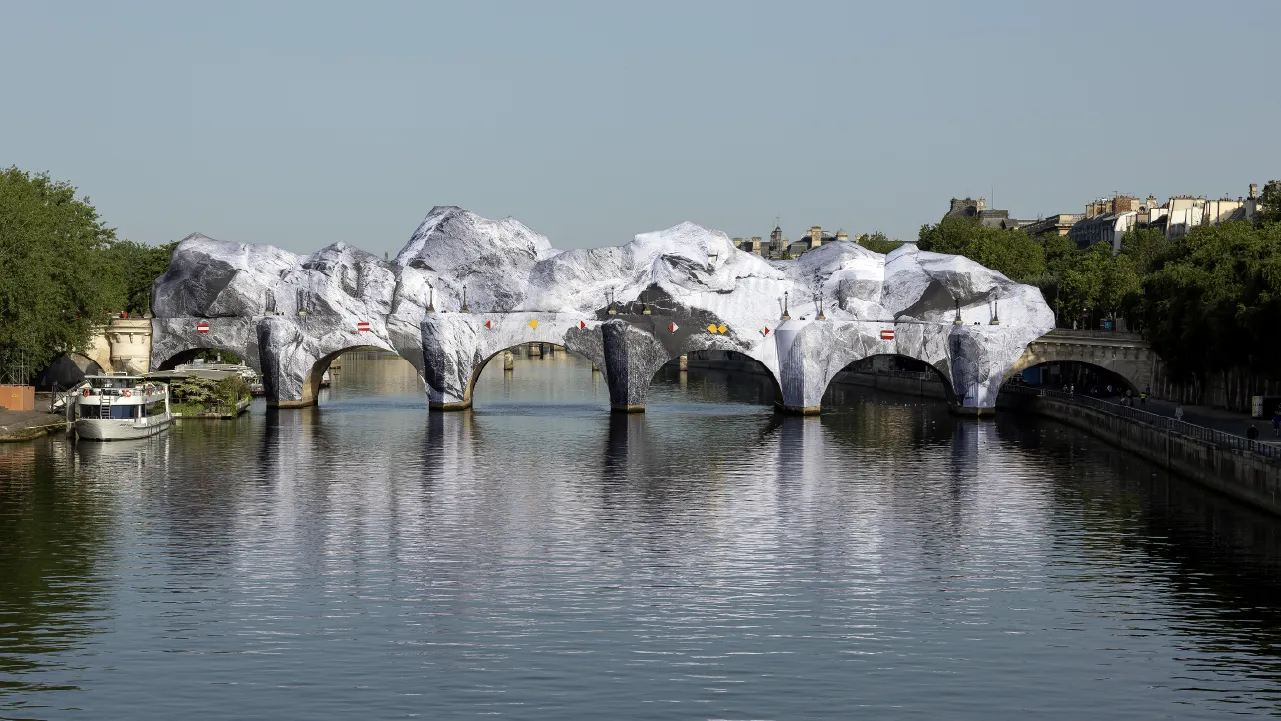
In Paris currently, the Pont Neuf bridge has been transformed into a 120-meter-long giant limestone cliff installation. This large-scale installation is by JR, a French street artist nicknamed the Banksy of France, known for works prompting reflection on identity, conflict, and borders, especially his pieces on the US-Mexico border wall.
This massive work by JR, called La Caverne du Pont Neuf or The Cave of Pont Neuf, is open for public exploration inside the tunnel from 6 to 28 June. Before the official opening, visitors can view it from multiple vantage points including the Eiffel Tower. Unlike inflatable structures used for protests, this installation commemorates Christo and Jeanne-Claude, the artist couple famed for wrapping large sculptures and the Pont Neuf bridge in gold fabric in 1985, marking almost 40 years in 2025.
“I admire what Christo and Jeanne-Claude achieved. I share their idea that art’s mission is to make us think and question what we take for granted,” JR said. “Art transforms and offers a way to change our perceptions of ourselves and the world around us.”
JR designed the artwork with a large steel frame covering 2,400 square meters, shaped like a peak rising about 18 meters above the bridge surface. Inside is a hollow space resembling a cave that visitors can enter. The entire structure is foldable to minimize materials and weight, protecting the bridge from damage.
Why the Pont Neuf bridge?
Pont Neuf is among Paris’s oldest structures. The small island Île de la Cité, spanned by the bridge, was the city’s first settlement around 250–225 BCE, later renamed Lutetia under Roman rule. Surrounded by the Seine River, Île de la Cité served as a fortress from the 4th century and became a royal palace site in 508 during King Clovis I’s reign, the first Frankish monarch. Since then, the island has housed many notable architectures, including Notre-Dame Cathedral.
Île de la Cité connects to various banks by bridges, but in 1550 King Henry II ordered a new bridge—Pont Neuf means “new bridge”—because the crowded Pont Notre-Dame needed repair. Budget constraints delayed the project until 1577 under King Henry III. Although plans and construction began earlier, civil unrest, especially the religious wars between Catholics and Protestants (1562–1598), delayed completion until 1606.
Pont Neuf was the first bridge to break tradition by not having houses on it and was the first stone bridge with sidewalks, making it ideal for leisurely views of the river and city. Its elegant Roman-style arches and 381 mascarons—stone faces decorating the bridge—stand out. Stretching across Île de la Cité with a statue of King Henry IV at its center, Pont Neuf symbolizes medieval innovation and urban grandeur, linking the city to the royal district. Alongside the Seine and the Eiffel Tower, Pont Neuf is a Parisian icon often featured in pop culture and films like The Lovers of Pont Neuf and Midnight in Paris.
In 1985, artist couple Christo and Jeanne-Claude wrapped Pont Neuf with 41,800 square meters of golden fabric, secured by 13 kilometers of rope and weighted with 12.1 tons of chains beneath. The Pont Neuf Wrapped presented a stunning blend of nature and modern urban design, reimagining the familiar bridge form to surprise and delight passersby.
JR’s Allegory of the Cave
“What is our cave today?” JR asked. “Because we believe that social media algorithms represent the truth.”
JR never explicitly states his work’s specific message, but this phrase clearly references Plato’s Allegory of the Cave. Plato posited that the world has a perfect, ultimate truth beyond human grasp, accessible only through philosophy. In The Republic, he describes prisoners chained in a cave who see only shadows cast on the wall from outside objects. They mistake shadows for reality. If one prisoner escapes and discovers the true world, upon returning to explain it, others accuse him of madness. Broadly, the prisoners symbolize ordinary people; the shadows represent the material world; leaving the cave signifies learning and realizing truth beyond everyday perception.
Though Plato’s allegory sounds complex, it is often used as a metaphor for society. Similarly, JR interprets it as the internet obstructing access to reality. To convey this, JR partnered with tech company Snap to design augmented reality (AR) devices revealing images invisible to the naked eye but visible via phones or AR glasses. Visitors also hear music by Thomas Bangalter, former Daft Punk member. The limestone shapes aren’t for mere aesthetics but replicate stone from Paris’s historic quarries used in building Pont Neuf.
La Caverne du Pont Neuf is free to visit 24 hours a day from 6 to 28 June, with temporary road closures on the bridge. After the exhibition, all covering materials will be reused or recycled.
References: