

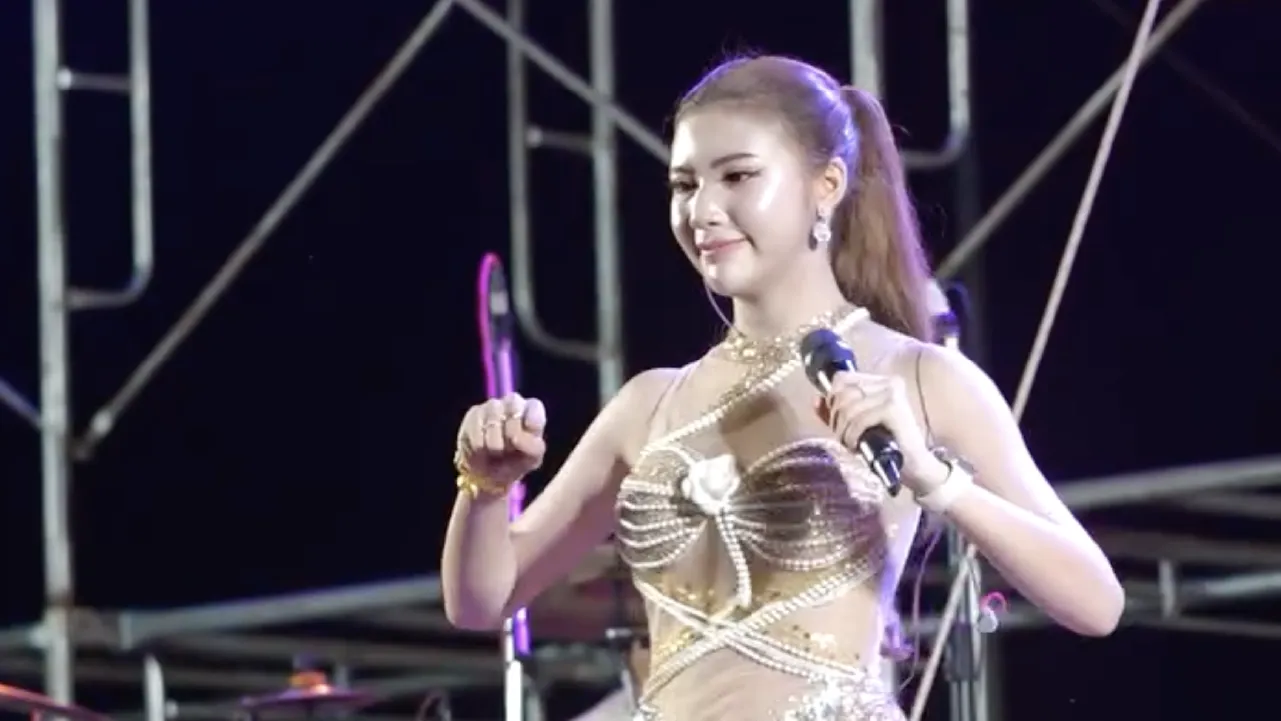
Anyone scrolling feeds lately would find it hard to miss the catchy mor lam sing beat featuring the hit line “Black shirt, shake it a bit, black shirt shake shake.” This clip of Isan artist Khao Fang Kanyavee Sairak has gone viral, with youths enthusiastically creating dance content to follow along.
This phenomenon results from mixing traditional local music with easy-to-digest EDM rhythms that require no deep thought—just hearing the pulsing beat makes bodies move to release stress.
Importantly, simply wearing a “black shirt” lets anyone join the trend instantly, welcoming everyone from regular people to black dogs, black cats, and all sorts of black-themed participants, creating entertainment that truly reaches all levels of Thai society.
Looking at the popular dance move, it is called “bun dao” in Isan culture, originally meaning the “waist” area. As a verb, it refers to shaking the waist and hips rhythmically and enthusiastically to music.
The image of “bun dao” is closely tied to the Isan tradition of performing in front of "parade trucks," a mobile entertainment evolution. Uniquely, these trucks lack the usual backing band typical of luk thung music, instead turning the audience from mere spectators into active performers themselves.
Originally, dancing in front of parade trucks was simple, fun movement, but around 2007 onward, the dance evolved into wilder, more sexually expressive moves through the act of “dao” (shaking).
Participants, often young women and LGBTQ+ groups, dance to attract attention, with those who perform the most daring moves—whether bouncing hips, rolling on the ground, jumping, doing flips, or climbing—earning the unofficial title of “parade truck star.”
To outsiders or some elders, these dances may seem reckless or inappropriate, but from another perspective, “bun dao” dancing or playful sexual symbolism as entertainment is not alien to Isan culture. Historically, the body movements of the khaen player include waist shakes synchronized to the “dao” rhythm, a long-standing tradition.
Sociologically, this aligns with Eric Hobsbawm’s concept of “Invented Tradition,” where the younger generation adapts traditional cultural forms into bun dao dancing to reflect societal changes, allowing people to seek joy through bodily expression.
Moreover, it serves as a temporary “turning upside down” mechanism, defying strict norms imposed by elders. The parade truck stage or even the “Black Shirt Dance” on social media becomes a safe zone where youths openly express themselves and have fun, transforming what was once seen as disreputable into something ordinary and accessible.
Another interesting question is why mor lam and parade truck culture remain vibrant while other regional folk media struggle with younger generations not continuing the traditions?
The likely answer is the high “dynamism” of Isan arts and culture. Mor lam has never stood still, evolving from the “mor lam klon” era with just khaen and vocals, to “mor lam klon sing” incorporating Western instruments like bass, guitar, keyboard, and drums, then to “mor lam moo” or “mor lam pleun” influenced by luk thung, and finally to the “parade truck” era that abandons fixed stages and borrows international and pop music to create new Isan styles.
This ability to adapt and blend traditional culture with modern or pop culture has allowed Isan arts to endure over time.
It is undeniable that “bun dao” dancing attracts youth back into local culture, inviting friends to gather and dance in front of parade trucks at temple festivals or even via short clips with mor lam music, thus sustaining folk culture in a way owned collectively by the new generation.
The viral “Black Shirt Dance” exemplifies Thailand’s local cultural landscape, where tradition and modernity merge to create enjoyment without age or regional boundaries.
References
#ThairathPlus #Thairath #BlackShirtDance #MorLamSing #MorLam