

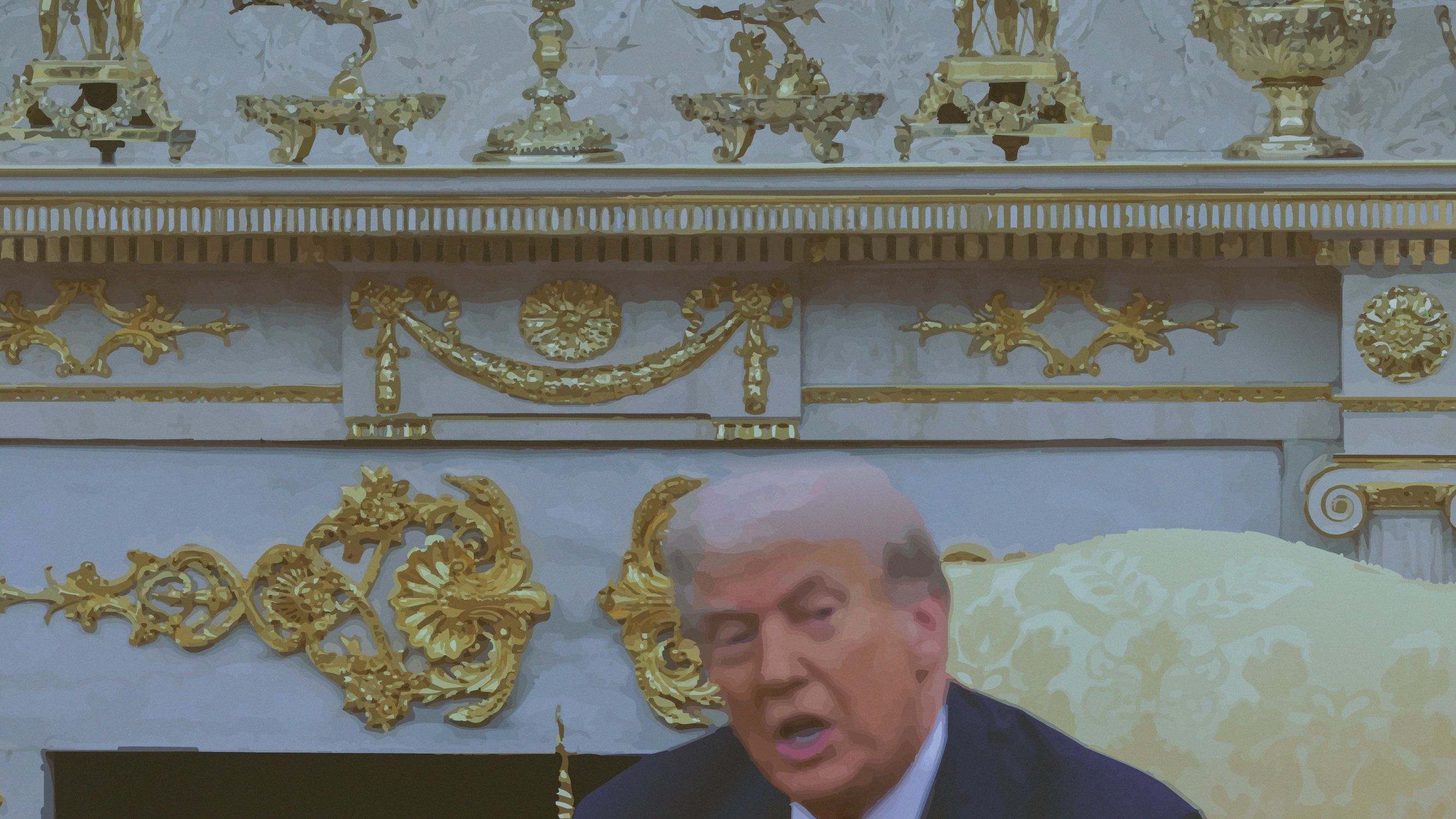
This viral image sparked questions from netizens in Thailand and abroad asking, “Why does the White House decoration now resemble a Thai restaurant overseas?” Some even compared it to a “Thai temple” rather than the workplace of a world superpower leader.
All of this represents a major transformation of key elements within the White House under President Donald Trump’s second term, using architecture and interior design as unprecedented tools to communicate power and express identity.
Traditionally, every U.S. president tweaks small details in the Oval Office to reflect personal taste, such as Ronald Reagan’s collection of bronze saddles and jars of jelly beans, or Barack Obama’s display of a statue of Martin Luther King Jr., a key civil rights activist.
But Trump, with his background as a real estate developer and luxury hotel owner, didn’t just change a few items; he deliberately brought in a ‘Trumpism’ art style to completely remake the space, prominently featuring his favorite color: gold.
Reports say Trump invited John Icart, his trusted 70-year-old carpenter from Florida—whom Trump called “my goldsmith”—to urgently fly on Air Force One to lavish the Oval Office with intricate gilding like his Mar-a-Lago estate. The White House stated that Trump personally covered the gilding expenses.
The gilding operation proceeded vigorously, with The New York Times noting that currently over 33% of the Oval Office surfaces—including door frames, ceiling moldings, picture frames, and even the Great Seal of the United States—are coated in gold.
Trump even ordered the removal of a Swedish ivy plant that had stood under George Washington’s portrait since the Ford administration, replacing it with various gold items—from gold coins and gold-plated pens to coasters engraved with Trump’s name, typical gifts for visiting dignitaries.
Beyond the dazzling gold, Trump added nearly 20 portraits of former presidents on the walls, compared to only six under Joe Biden and two under Obama. Empty spaces were filled with Trump family photos, FIFA Club World Cup trophies, cherub statues brought from Mar-a-Lago, and even the TV remote was gilded.
He also hung a traditional copy of the Declaration of Independence, which conservation experts warned could be damaged by sunlight. Curtains were later installed to prevent this. Trump briefly explained that the room originally looked dull and needed a bit more “life.”
The transformation extended beyond the Oval Office: the Cabinet Room was redecorated in matching gold tones, and the iconic Rose Garden lawn was replaced with a new patio-style seating area resembling Trump’s Florida residence.
The most shocking architectural move was ordering the demolition of the White House’s East Wing to create the lavish “Trump Presidential Ballroom.”
Experts view Trump’s decorative style as heavily inspired by King Louis XIV’s Palace of Versailles, symbolizing the opulence of the French monarchy’s extravagance.
Opposition politicians like Gavin Newsom called it a “fake Versailles in the White House,” and Adam Schiff likened it to the overly lavish residences of former authoritarian rulers such as Romania’s Nicolae Ceaușescu and Iraq’s Saddam Hussein.
The political implications are clear in the “Presidential Walk of Fame” corridor, lined with gold-framed portraits of former presidents accompanied by plaques describing their achievements. However, historians widely criticize these plaques for distorting facts and presenting false information.
For example, Trump’s plaque claims he ended eight wars within his first eight months, while Biden’s plaque calls the 2020 election the most fraudulent in history. There are also false claims that Ronald Reagan was a long-time Trump supporter, despite Trump’s harsh critiques of Reagan’s foreign policy and Reagan’s foundation forbidding use of his image in Trump’s campaigns.
Thus, Trump’s White House décor is not just personal taste but an attempt to “rewrite history” through a nation’s symbolic space.
From a political image perspective, transforming the White House architecture into a personal “theater of power” is a deliberate strategy designed to intimidate and project the image of a grand global leader.
White House communications directors and spokespeople have explained this style as not imperialist aesthetics but an American aesthetic entering a golden age.
Trump used the heavily gilded Oval Office as a backdrop for hosting dignitaries, compelling foreign leaders and major business figures to adjust accordingly, evidenced by the South Korean leader gifting a replica gold crown and Apple CEO Tim Cook presenting a 24-karat gold-plated glass plaque.
Ultimately, the dazzling makeover reflects Trump’s view of architecture as a tool to display identity and amplify power to appear grandiose.
Though historians warn that over time such excesses often become monuments to human vanity and uncertainty,
at this moment it is undeniable that the White House’s image has shifted from a republican government building to a golden power center perfectly tied to Donald Trump’s name.
.ReferencesThe Guardian,Washington Post,Independent,Independent,CNN
#ThairathPlus #Thairath #WhiteHouse #DonaldTrump #Trump #USPolitics #Architecture #InternationalNews #News