

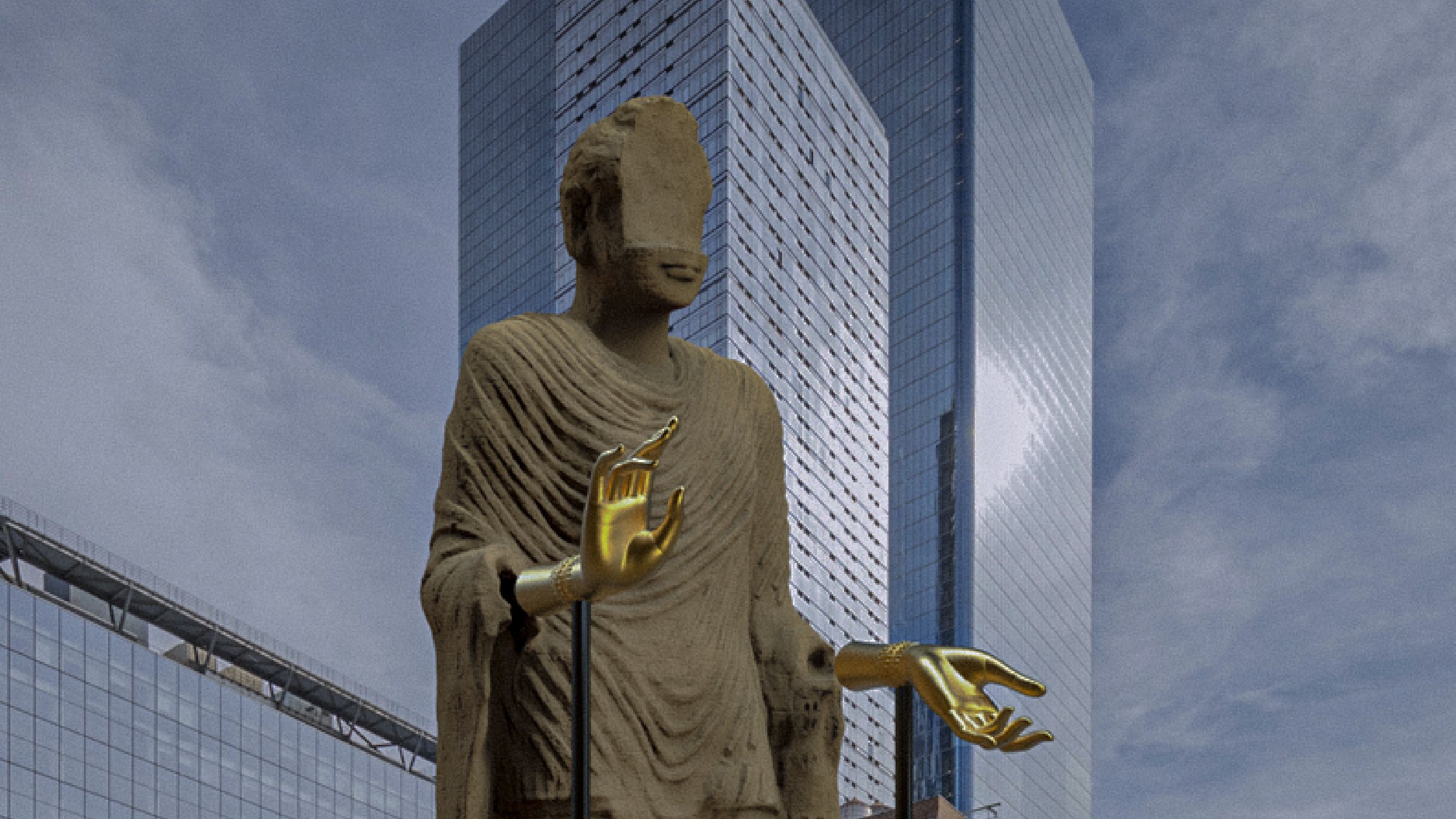
In the heart of New York City right now stands a Buddha sculpture that looks striking amid towering skyscrapers. This sculpture’s face is half destroyed, and its two hands, posed in a blessing gesture, are made of cast iron. Although it resembles an ancient artifact, it is a newly created sculpture modeled after the original Buddha statues in Afghanistan known as the Bamiyan Buddha, which the Taliban destroyed in 2001.
This sculpture, titled The Light That Shines Through the Universe, is by Vietnamese-American artist Tuan Andrew Nguyen. It stands 8.2 meters tall, dominating the street in the The Plinth zone, part of The High Line—a raised green public space stretching over 2.33 kilometers along an old railway in Manhattan’s West Side. Anyone driving along 30th Street under The High Line will encounter this striking artwork.
Nguyen intends this work to reflect the loss of cultural heritage. The title suggests that although the sculpture appears damaged, it still conveys peace and emotional healing. He also invites viewers to explore enduring injustices visible in daily life—changes wrought forever by conflict, from the Vietnam War to tragic events impacting community psyche. With this concept, Nguyen melted down weapon bullet fragments to cast the Buddha's hands, transforming symbols of violence into symbols of healing and hope.
The Bamiyan Buddha that inspired Nguyen’s sculpture invites intriguing interpretations, especially given its location in New York, a major metropolis of the United States.
The original Bamiyan Buddhas stood in Bamiyan village, Afghanistan. There were two statues: the western Buddha measured 55 meters tall, the eastern 38 meters. They were constructed approximately between 544 and 644 CE.
Historians believe Bamiyan was once a Buddhist community under the Kushan Empire, flourishing along the Silk Road around the 2nd century CE before the arrival of Muslims in 770, Turks in 977, Mongols in 1221, and later under the Mughal Empire. Though many religious artifacts were destroyed, the Bamiyan Buddhas remained largely intact except their faces, possibly eroded due to the separate carving or earlier destruction during Muslim conquests.
By 1998, amid Afghanistan’s civil war, local Taliban commander Abdul Wahed intended to destroy the two Buddhas and drilled into the statues’ heads to place explosives. However, Mullah Omar, the Taliban's true leader, intervened, reasoning that the Buddhas lacked value as objects of worship without devotees, and that they were valuable ancient artifacts which could generate tourism income. Local villagers also wanted the statues preserved.
Between 1999 and 2001, Afghanistan faced famine, drought, and economic collapse, worsening as the UN ignored the crisis because the Taliban sheltered Osama bin Laden. The UN feared the Buddhas would be destroyed without intervention, so they raised funds to pay the Taliban to maintain and restore the statues.
On 1 March 2001, the Taliban announced they would destroy the Bamiyan Buddhas and carried out the act soon after. The once faceless Buddhas became flat empty niches, shocking many, especially the UN, which had previously offered assistance.
Taliban diplomat Sayed Rahmatullah Hashemi testified:
“When the Afghan council requested they use the money to feed children instead of repairing the Buddha statues, they refused, saying, ‘This money is only for the Buddhas, not for children.’ At that point, they had already decided the statues must be destroyed.” He added, “If we wanted to destroy those Buddhas, we would have done so three years earlier. In our religion, if something is harmless, we leave it be. If money goes to the Buddhas while children die of malnutrition, that is harmful. So we destroyed them.”
In 2004, before the U.S. invasion, Mullah Omar said he never wanted to destroy the Bamiyan Buddhas. Foreigners came to negotiate repairs for the deteriorating statues from rain damage, but Omar was surprised no one cared about starving Afghans—they only cared about objects without souls like the Buddhas.
The destruction of the Bamiyan Buddhas was a significant loss in Buddhist history. Twenty-five years later, the Buddhas regained public attention in New York. Beyond Nguyen’s message of peace amid violence, the sculpture can also be seen as an ironic critique of the U.S.’s role 25 years ago, highlighting how cultural heritage was destroyed amid fraught international politics between the U.S. and Afghanistan. It also reflects a world distracted by materialism rather than human life.
The Light That Shines Through the Universe is on display from now until autumn 2027.
References: