

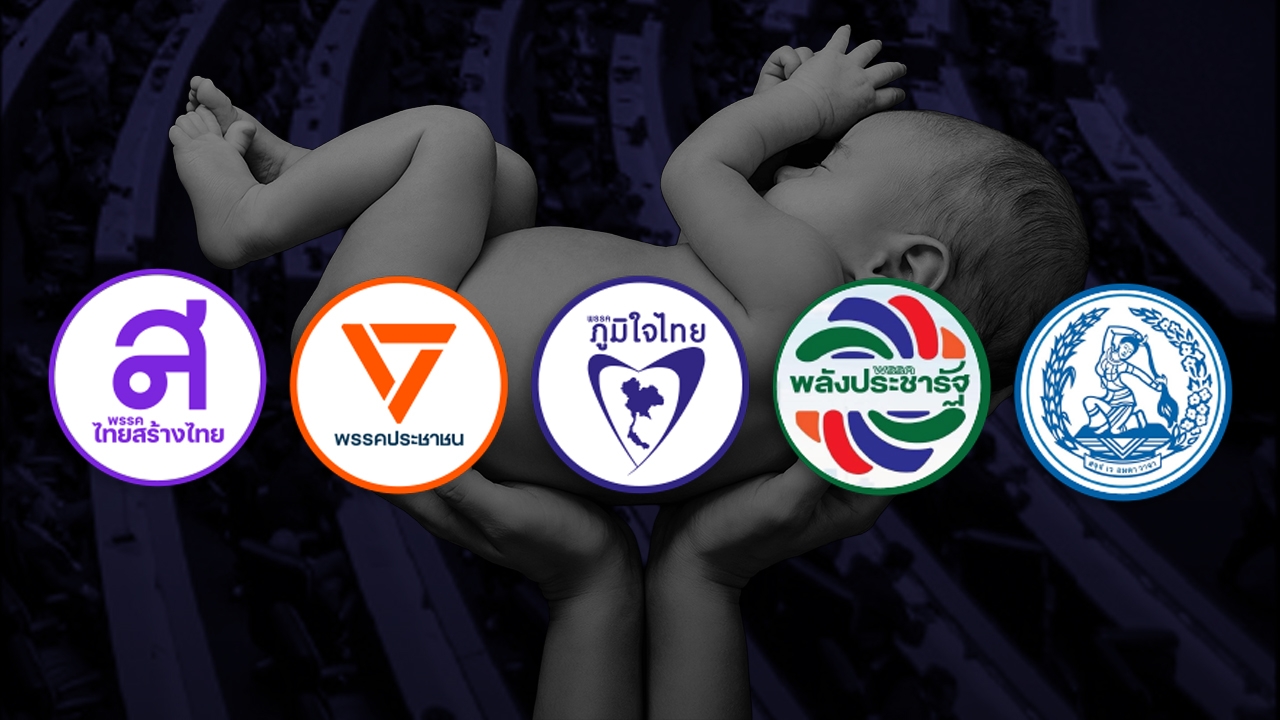
A look at five major political parties promoting "having children" policies to stimulate birth rates and solve Thailand's population decline problem, following continuous decreases in newborn statistics. Meanwhile, many choose to remain single and childless due to high costs, compounded by limited state welfare coverage.
Amid a continuing decline in birth rates, Thailand faces a significant demographic challenge. Birth rates have fallen for several years while the proportion of elderly citizens rises rapidly, marking a clear transition to an aging society. This situation impacts the labor system and economy long-term and reflects the rising costs and quality-of-life challenges for new families facing increased expenses related to childbirth and childrearing in various aspects.

Policies concerning "women having children and young children" have become a key structural issue in political discourse. Many parties propose measures to incentivize families to have children, ranging from financial assistance and maternal and child healthcare to establishing long-term support systems to ease early family burdens and ensure future child security in Thailand.
Thairath Online's special news team has compiled policies from five major political parties promoting "women having children and young children." Each party adopts different approaches, including cash subsidies, public health care, and long-term child savings systems as follows:

- Advocates for supporting pregnant women with monthly subsidies of 2,000 baht from pregnancy until the child is 6 years old, aiming to alleviate rising expenses during pregnancy such as food, prenatal care, and health maintenance.

- Promotes the "State Mother" policy focusing on continuous care from prenatal stages to childhood. Mothers receive 1,500 baht monthly from the fourth month of pregnancy until birth, and after birth, newborns up to age 6 receive 1,000 baht monthly subsidies to reduce high childrearing costs during early years.

- Supports childbirth by providing mothers and children a universal monthly subsidy of 5,000 baht for 12 months without means testing, starting from birth certificate issuance. Additionally, every child receives a monthly savings deposit of 500 baht until age 18, with special bonuses of 10,000 baht every five years if funds remain untouched, promoting financial discipline and long-term security.

- Proposes a child subsidy policy granting 1,200 baht per month continuously for 4 years.

- Advances the "One Village One Volunteer Nurse" concept by employing nursing graduates to closely care for pregnant women, the elderly, and community members, aiming to improve healthcare access, especially in rural areas.
Policies on "women having children and young children" reveal diverse approaches to addressing Thailand's demographic changes. They encompass financial support, healthcare services, and long-term assistance measures, reflecting the country's ongoing challenges of declining birth rates and increasing elderly population. The details, implementation methods, and policy scopes vary according to each party's vision.